Why Would a Generator Not Start? A Troubleshooting Guide
Urgent, step-by-step troubleshooting for a generator that won't start. Learn common causes, quick checks, and maintenance tips for homeowners and property managers to restore power fast.


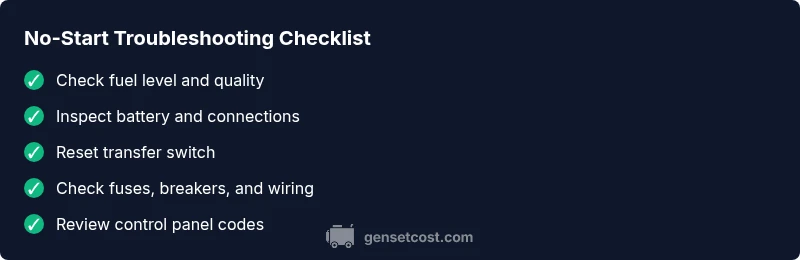
Why would a generator not start? In most cases the culprit is a simple one: fuel, battery, or the transfer switch. Quick fixes include verifying fresh fuel and proper fuel valves, ensuring the battery is charged with clean terminals, and resetting the transfer switch. If the generator still won't start or you see fault codes on the control panel, consult the manual or contact a qualified technician.
Why would a generator not start
When a backup generator won’t start, homeowners and property managers feel the pressure of a looming outage. According to Genset Cost, no-start incidents are often traced to a few repeat culprits: fuel, battery health, or an automation/transfer switch that won’t engage. Understanding these root causes helps you act quickly, rather than guessing. This guide provides the context for the most common scenarios, how to verify them, and safe tests you can perform before calling for professional help. You’ll learn to differentiate a routine maintenance skip from a real electrical fault, so you can protect your building during a power outage and avoid delays. Whether you have a propane, natural gas, or diesel generator, these checks apply across fuel types. By diagnosing the no-start condition early, you reduce downtime and keep systems in reserve for essential loads.
Check the basics before you dive in
Before diving into deep diagnostics, confirm the simplest explanations first. Ensure the generator is in the ON position, the choke is set correctly (for gasoline models), and the transfer switch is not tripped. Check the fuel valve and make sure there is fuel in the tank with no visible contamination. Inspect the battery connections for corrosion, ensure the battery is charged, and verify that the main service panel and generator control panel show no obvious faults. Look for blown fuses or a tripped circuit breaker both at the generator and the house panel. If any safety interlocks have engaged, reset them following the manufacturer’s instructions. These quick checks catch many no-start conditions without specialized tools and save time during outages. In addition, verify the idle or cold-start setting is appropriate for your climate and load expectations.
Fuel and combustion: ensure fuel system is ready
Fuel issues are the leading cause of a no-start. If the fuel has sat in the tank for months, it can degrade and gum up fuel lines, filters, and the carburetor. In this section, you’ll verify fuel quality, test fuel flow, and replace the fuel filter if needed. Also check for water in the fuel, which can settle to the bottom of the tank and create starting hesitation. For diesel engines, confirm the fuel has proper viscosity and that the heater or glow plugs function; for gasoline engines, ensure the choke and primer are operational. After confirming fuel, attempt a controlled start to observe the start sequence and listen for the engine turning over and attempting ignition. If fuel delivery seems sluggish, check the fuel pump or lines for kinks.
Battery and starting system health
Dead batteries are another frequent reason for a no-start. Inspect battery voltage and ensure the battery can deliver a sufficient cranking current. Clean corrosion from terminals, tighten clamps, and ensure the negative/ground connection is solid. If the battery shows signs of weakness, replace it or perform a proper load test. Check the starter motor and its solenoid for wear, and inspect the wiring between the battery, starter, and ignition switch for loose connections. If the ignition switch is faulty or a safety interlock prevents cranking, test with the unit in a controlled, safe environment or consult a technician. Regular battery maintenance can prevent surprising outages.
Electrical and transfer switch checks
Your transfer switch is the gate between utility and generator power. A tripped switch, blown fuse, or loose wiring will prevent starting even when the engine runs. Check the transfer switch position, reset it, and re-test; inspect contact points for wear or corrosion and verify control wiring is intact. Look for error codes on the generator display and refer to the manual to interpret them. Also confirm the generator’s output breaker is not tripped and that there are no short circuits in connections to the load. If you see signs of burning or melted insulation, stop and call a professional immediately.
Air, spark, and ignition components
Air intake restrictions, clogged filters, or ignition problems can prevent start. Inspect the air filter and clean or replace as needed, ensuring the intake path is unobstructed. Check spark plugs or glow plugs for wear, fouling, or improper gap, and replace if necessary. For propane or natural gas models, verify gas valves are open and the fuel supply is steady. Ensure the exhaust system is clear of blockages and there is no back pressure. A misadjusted idle speed or choke that sticks can also stop ignition, so adjust per the manual.
Diagnostics and error codes
Modern generators often communicate fault codes through the control panel or remote monitor. Read any codes shown and cross-check them with the manufacturer manual or Genset Cost's guidance on common codes. Some faults require clearing a fault memory after the issue is resolved, while others require component-level replacements. If codes persist after basic checks, record them with model and serial numbers and seek professional assistance quickly to minimize downtime.
When to call a professional
Safety should come first. If you are unsure about electrical safety, if the unit is tied into a building's power system, or if the no-start involves the transfer switch or main service panel, contact a licensed electrician or generator technician. Professionals can perform load testing, fuel system cleaning, and electrical testing with specialized equipment. If the unit is under warranty, follow the warranty guidelines to avoid voiding coverage and to preserve warranty protections.
Preventive maintenance to avoid future no-starts
Set a regular maintenance schedule and stick to it. Replace fuel filters, clean the air intake, inspect battery connections, and verify the transfer switch works. Keep fresh fuel or stabilize fuel if you know the generator won't be used for long. Schedule annual professional servicing to catch issues before they cause a no-start during an outage. Document maintenance and any replacements to track service history for warranties.
Steps
Estimated time: 30-60 minutes
- 1
Ensure safety and power isolation
Power down all loads and switch off the main breaker before any inspection. Disconnect the battery negative lead to prevent accidental cranking. Wear eye protection and gloves, and use insulated tools as needed.
Tip: Always start with safety first; a live system can cause injury. - 2
Inspect fuel system
Check fuel level and quality; replace stale fuel and inspect for water or contaminants. Open the fuel valve if required and ensure lines are not kinked. If applicable, inspect the fuel shutoff and primer. Attempt a safe start after fuel checks.
Tip: Stale fuel is a common culprit; treat with fresh fuel and stabilizer if stored long-term. - 3
Check battery and connections
Examine battery terminals for corrosion and clean as needed. Ensure clamps are tight and the ground connection is solid. If the battery voltage seems low, recharge or replace it and retest cranking.
Tip: A healthy battery is essential for a confident start; don’t reuse a weak battery. - 4
Test transfer switch and control wiring
Verify the transfer switch is in the correct position and reset if required. Inspect control wires for loose connections or damage. If using ATS, test its response with a light load.
Tip: Follow the manual to perform manual transfer switch tests safely. - 5
Inspect fuses, breakers, and wiring
Look for blown fuses and tripped breakers at both the generator and the main panel. Inspect visible wiring for damage or loose connections and repair as needed.
Tip: Don’t bypass breakers; a tripped breaker is a safety signal. - 6
Check ignition and air system
Inspect the air filter and clean or replace if dirty. Check spark/ignition components for wear and proper gap. Ensure the exhaust is clear of obstructions.
Tip: A clean air path improves starting reliability. - 7
Review control panel codes
Read any fault codes on the control panel. Consult the manual for code meanings and required action. Record codes for professional diagnostics if needed.
Tip: Codes often point to a specific subsystem for faster repair. - 8
Attempt a controlled start with no load
With safety checks complete, attempt to start the generator with no load attached. Observe the engine as it turns over and note any abnormal sounds or failure to ignite.
Tip: If it still won’t start, document symptoms before seeking help. - 9
Decide on professional help
If you cannot identify or fix the fault, contact a licensed technician. A pro can perform advanced diagnostics, load testing, and warranty-approved repairs.
Tip: When in doubt, call a pro to prevent further damage.
Diagnosis: Generator won't start during outage
Possible Causes
- highFuel issue (empty tank, stale fuel, blocked line)
- highBattery problem (dead, corroded terminals)
- mediumTripped or faulty transfer switch
- lowBlown fuse or circuit breaker in the panel
- lowStarter motor or ignition fault
Fixes
- easyRefill or replace fuel; check valve positions and filters
- easyCharge/replace the battery; clean terminals and re-tighten connections
- easyReset the transfer switch and re-test; verify wiring integrity
- mediumInspect fuses/breakers and replace if blown; inspect for damaged wiring
- hardConsult a professional for starter/ignition repairs or complex wiring
People Also Ask
What is the most common reason a generator won't start?
Fuel or battery issues are the most frequent culprits, followed by transfer switch faults. Start with fuel level and quality, battery health, and the switch state. If the problem persists, look for error codes on the panel.
The most common reasons are fuel or battery problems or a stuck transfer switch. Start with fuel and battery checks, then the switch.
Can I start the generator manually if the automatic transfer switch won't engage?
Yes, many systems allow manual transfer switch operation for testing, but follow the manual and ensure you don't create backfeed to the utility. Use caution and disconnect loads during the test.
You can test by manually switching, but follow the manual and stay safe.
What should I check if the generator starts but dies immediately?
This often indicates fuel delivery or air intake issues, or an overheating sensor triggering. Check fuel supply, air filter, and cooling fins; verify there’s no short circuit causing shutdown.
If it starts and stops, look at fuel, air, and possible sensor shuts.
Is it safe to run a generator indoors or in a garage?
Operating a generator inside a garage or enclosed space is dangerous due to carbon monoxide. Always run outdoors in a well-ventilated area and use proper exhaust routing.
No—never run indoors; run outside with good airflow.
How often should I service my generator to prevent no-starts?
Follow the manufacturer’s recommended service schedule and perform seasonal checks. Regular maintenance like fuel stabilization, battery tests, and air-filter replacement reduces no-start risk.
Stick to the maintenance schedule and check fuel and battery regularly.
Watch Video
Key Takeaways
- Check basics first: fuel, battery, transfer switch.
- Inspect fuel quality and air/ignition systems.
- Read and interpret control panel codes for fast diagnostics.
- Follow a safety-first, step-by-step approach.
- Schedule regular maintenance to prevent no-starts.