Will a Generator Start Without Battery? Troubleshooting Guide
Urgent troubleshooting guide to determine if your home backup generator will start without a battery, with common causes, safety tips, and a step-by-step fix.


Will a generator start without a battery? In most modern home backup generators that rely on an electric start, a healthy battery is essential. If the battery is missing or discharged, the starter solenoid won’t engage. This quick guide walks you through the most likely causes and immediate steps to diagnose and fix the issue, so you can restore power quickly and safely.
Will a Generator Start Without Battery: The Realities
The recurring question in home backup power planning is: will generator start without battery? For most electric-start units, the starting process hinges on a functional 12-volt battery. If the battery is absent, damaged, or unable to deliver sufficient current, the starter solenoid cannot energize the starter motor, and the engine will not crank. Recoil-start models, while less common in newer setups, can operate without a battery, but they require physical effort and proper fuel handling. Understanding the distinction between these start systems helps you identify what to inspect first during an outage or routine maintenance.
In practice, a healthy battery is the gatekeeper to reliable starts. If you’re unsure whether your unit uses an electric starter or a recoil mechanism, consult the owner’s manual or the manufacturer’s spec sheet. This article focuses on electric-start configurations, where battery health is typically the most common failure point. Keep in mind that a generator’s starting system is part of a larger electrical and fuel ecosystem, so even a perfect battery may fail if other components are compromised.
The Starting System: What Needs Power to Engage
A typical home backup generator starting system includes the battery, battery cables with clean terminals, a starter solenoid, and the starter motor. When you activate start, the solenoid closes a high-current circuit that sends juice to the starter. If the battery can’t provide enough current, or if cables are corroded or loose, the starter won’t engage and the engine won’t turn over. Safety switches (oil pressure, low fuel, neutral position) and transfer switches can also interrupt the crank even if the starter works. This section breaks down each part so you know where to check first when the unit won’t crank.
The bottom line: most no-start situations trace back to the battery and its connections. If you’re experiencing a no-crank condition, verify the battery is charged, the terminals are clean, and the correct starting sequence is being followed. If the starter motor buzzes or you hear a click but the engine doesn’t turn, focus on the electrical chain and safety interlocks rather than fuel or ignition timing alone.
First Checks You Can Do Safely (Non-Destructive)
Before you dig into complex diagnostics, perform these quick, non-destructive checks. First, ensure you are in a well-ventilated area away from open flames or stored fuel. Then:
- Test battery voltage with a multimeter. A healthy 12-volt battery typically reads around 12.6 volts when resting; anything significantly lower suggests a discharged or failing cell.
- Inspect and clean battery terminals. Look for corrosion and tighten clamps; a loose connection can drop starting voltage significantly.
- Check battery hold-downs. A loose battery can vibrate and disconnect during operation. Ensure the battery is seated firmly.
- Verify the main kill switch and safety interlocks are in the correct positions. Some systems require the switch to be on and the selector in the proper mode.
- Confirm fuel availability and crank/restart sequence if there is a manual choke or primer. Fuel issues can mimic a battery problem if the engine won’t stay running after a crank. If any test shows an abnormal value or if you’re unsure, move to the next diagnostic steps or call for professional help.
Safety note: Do not attempt high-current tests or bypass safety switches unless you have explicit manufacturer guidance. Improper handling can cause shock or fire.
Diagnosing Common Causes When It Won’t Start
No-start conditions have a few common culprits. Start with the simplest, most accessible checks and work toward more complex issues:
- Dead or weak battery: Most frequent cause. Low voltage prevents the starter from engaging.
- Loose or corroded terminals or cables: Voltage drops across a bad connection kill the starter's ability to operate.
- Blown fuse or failed relay in the starting circuit: A protected circuit may cut power to the starter.
- Faulty starter solenoid or damaged starter motor: If the solenoid doesn’t engage, the motor won’t crank even with voltage.
- Safety switch or transfer switch faults: If an oil pressure switch or neutral safety switch prevents cranking, the engine won’t start.
- Fuel system problems: If the unit has no fuel, a good battery won’t matter. Check fuel level, fuel line blockage, and carburetor/fuel-injection reliability.
By separating symptoms (no crank vs. intermittent starting) you can pinpoint likely causes and avoid unnecessary part replacements. Document what you observe (sounds, clicks, voltage readings) to speed up professional diagnostics if needed.
Step-by-Step Troubleshooting Path (Non-Professional)
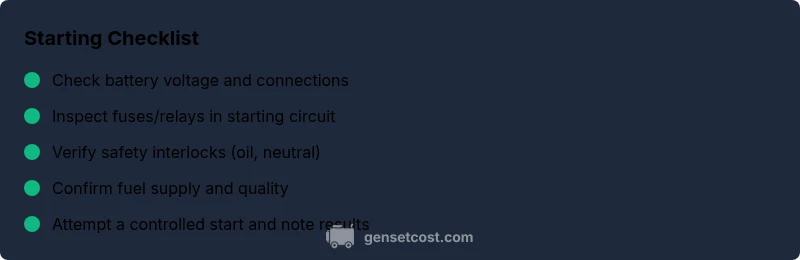
- Safety prep and initial check: Move to a ventilated area, disconnect power, and inspect the battery area for obvious damage.
- Battery health check: Use a multimeter; if voltage is below the healthy threshold, attempt a charge or replace the battery following OEM guidance.
- Clean and reseat connections: Remove terminals, clean corrosion with a wire brush, reinstall, and tighten to spec.
- Inspect starter circuit: Check fuses, relays, and the starter solenoid for signs of wear or burn marks.
- Safety interlocks review: Ensure the oil sensor, neutral switch, and transfer switch are properly positioned and undamaged.
- Final test: Reconnect the battery and attempt a controlled start. If the engine cranks but runs poorly, there may be fuel or ignition timing issues. If it still won’t start, escalate to a qualified technician for electrical diagnostics.
Tip: Keep a maintenance log of readings, parts replaced, and the results of each start attempt to help technicians diagnose faster in the future.
Safety Precautions and When to Call a Pro
Safety is non-negotiable when working on generators. Carbon monoxide can accumulate quickly in enclosed spaces, so never run a generator indoors or in a garage with doors closed. If you smell fuel leaks, hear unusual noises, or see smoke, shut down immediately and seek professional help. Do not bypass safety switches or wind up electrical components without proper training. If the problem remains after basic checks, a licensed electrician or generator technician should diagnose starter circuits, wiring harness integrity, and electrical interlocks. Timely service can prevent further damage and ensure safe operation during the next outage.
Maintenance to Reduce Future Start Problems
Proactive maintenance reduces the odds of a no-start scenario. Develop a routine that includes:
- Regular battery health checks and terminal cleaning every 3–6 months, or before storm seasons.
- Keep the generator in a dry, well-ventilated area and check for corrosion on all exposed metal parts.
- Replace aged batteries every 2–4 years, per OEM guidance, and store a spare with proper safety precautions.
- Inspect fuel quality, filters, and carburetor or fuel-injection lines; stale fuel can disable starting, even with a healthy battery.
- Test starting at least quarterly to ensure readiness, especially before peak outage periods.
Steps
Estimated time: 60-90 minutes
- 1
Safety and area preparation
Power down the unit, unplug any soft starters if present, and move to a ventilated area. Inspect the immediate battery area for damage before touching wiring.
Tip: Wear safety glasses and gloves; never touch battery terminals with metal tools. - 2
Check battery health
Use a multimeter to check voltage; a healthy 12V battery typically reads around 12.6V when rested. If voltage is low, charge or replace the battery.
Tip: Charge a deeply discharged battery fully before testing the system again. - 3
Inspect battery connections
Clean corrosion from terminals, reseat clamps, and ensure cables are fully attached. A loose connection can resemble a dead battery.
Tip: Apply a light coat of dielectric grease to prevent future corrosion. - 4
Test starter and safety interlocks
Check the starter solenoid for clicking sounds and test the neutral/oil/fuel interlocks. Look for damaged wires or burned areas.
Tip: If you hear a click but no crank, focus on the solenoid and wiring. - 5
Check fuses, relays, and fuel system
Inspect the starting circuit fuses/relays for signs of wear; verify fuel is available and not degraded. Check choke and priming steps if applicable.
Tip: Follow OEM wiring diagrams to locate relays and fuses. - 6
Final start test or professional call
Reconnect the battery and attempt a controlled start. If there’s still no crank, document readings and contact a qualified technician.
Tip: Provide the technician with observed symptoms and any voltage readings.
Diagnosis: Starter motor or engine won't crank when attempting to start with an electric start.
Possible Causes
- highBattery is dead or not providing sufficient voltage
- highLoose, corroded, or disconnected battery terminals or cables
- mediumBlown fuse or failed relay in the starting circuit
- mediumFaulty starter solenoid or damaged starter motor
- highSafety switches preventing start (oil, neutral, transfer)
Fixes
- easyInspect battery terminals, clean corrosion, tighten clamps, and verify battery charge with a multimeter
- easyReplace blown fuses/relays in the starting circuit per OEM spec
- mediumTest or replace the starter solenoid or starter motor if needed
- easyCheck safety interlocks and transfer switch positioning; replace faulty interlock
- mediumIf fuel issues are suspected, verify fuel level and prime the system; consult manual for fuel-related steps
People Also Ask
Can a generator start without a battery?
Most electric-start generators require a healthy battery to engage the starter. Recoil-start models can sometimes operate without a battery, but many modern systems rely on battery power.
Electric-start units usually need a battery; recoil-start ones may work without one.
What should I check first if it won't start?
Begin with the battery: voltage, connections, and secure mounting. Then verify safety switches and fuses before looking at fuel or ignition components.
Check the battery and safety switches first.
Is it safe to jump-start a generator?
Only if your manual allows it and you use the correct jump-start procedure and wiring. Incorrect jumps can damage the starting circuit or battery.
Follow the manual; incorrect jumps can harm the generator.
What maintenance helps prevent starting problems?
Regular battery maintenance, terminal cleaning, fuel stabilization, and keeping the generator in a dry area reduces start problems.
Keep the battery healthy and fuel clean to prevent issues.
When should I call a professional?
If your checks indicate a faulty starter, interlock, or electrical wiring, or if you smell fuel leaks, contact a licensed technician.
If you suspect wiring or starter faults, get a pro.
Can a faulty fuel system stop a generator from starting even with a good battery?
Yes. A blocked fuel line, bad fuel, or clogged filters can prevent starting. Check fuel quality and supply first if the battery is healthy.
Fuel problems can stop starting even if the battery is fine.
Watch Video
Key Takeaways
- Verify battery health and clean connections.
- Follow the safe start sequence to isolate issues.
- Document observations for faster diagnostics.
- Regular maintenance reduces random start failures.
- Call a professional for complex electrical faults.