How to Clean a Generator Carburetor Without Removing It
Learn to clean your generator's carburetor in place, without removing the carburetor. This step-by-step guide covers safe practices, required tools, and practical tips to improve starting, idle, and fuel efficiency for home backup generators.


Learn how to clean a generator carburetor without removing it. This step-by-step method uses carb cleaner, light brushing, compressed air, and a brief idle run to flush varnish from accessible jets. You’ll save time, avoid disassembly, and improve starting and running. Always prioritize safety: turn off fuel, disconnect spark, and work in a well-ventilated area.
Why Cleaning a Generator Carburetor Without Removing It Matters
Maintaining a generator carburetor in place saves time and reduces service costs for homeowners and property managers who rely on backup power during outages. Cleaning the carburetor without removing it minimizes teardown, reduces the risk of misalignment during reassembly, and keeps critical components like diaphragms intact. According to Genset Cost, in-place cleaning can help keep your generator ready for operation without sending it to a shop. This approach emphasizes safe cleaning solvents, a clean workspace, and careful handling of rubber components. Access points are usually at the air intake, and for many models you can flush varnish and gum without disturbing fuel lines or fasteners. The payoff is smoother starting, steadier idle, and better throttle response during load changes. Not all models respond to in-place cleaning, so always check the owner’s manual for model-specific notes and limitations. When done correctly, you extend intervals between major overhauls and preserve reliability during power outages.
This guide focuses on safe, in-place cleaning methods that work for most portable or home-backup generators. It also outlines when to stop and seek professional service. By following the steps and using proper cleaners, you minimize risk to seals and gaskets while maximizing compressor- or engine-driven performance. As you practice, you’ll gain confidence in diagnosing simple carburetor issues without forced disassembly, saving time and money over the life of your backup power system.
This block continues to cover the importance of in-place maintenance and how it ties into broader generator upkeep.
Tools & Materials
- Carburetor cleaner spray (safe for rubber and plastic components)(Choose a product labeled safe for carburetors and compatible with your fuel type and seals.)
- Safety glasses(Protect eyes from spray and fumes.)
- Nitrile gloves(Keep hands clean and protected from solvents.)
- Rags or paper towels(Catch drips and wipe surfaces.)
- Compressed air can or air compressor(Clear jets and passages without disassembly.)
- Flathead screwdriver or small socket/driver(To lift or loosen air cleaner housing as needed.)
- Small tray or catch pan(Contain any spilled fuel during the procedure.)
Steps
Estimated time: 30-45 minutes
- 1
Power down and prep safety
Shut off the generator and, if available, close the fuel valve. Disconnect the spark plug boot to prevent accidental starting. Allow the engine to cool before you begin.
Tip: Keep a clear workspace and have a rag ready for spills. - 2
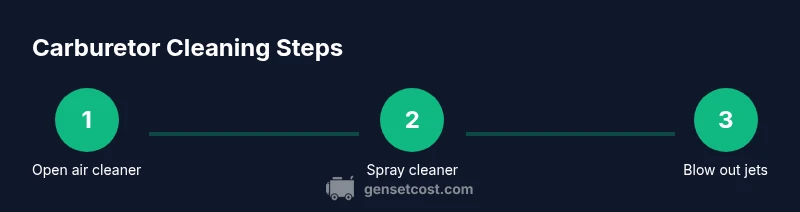
Open the air cleaner housing
Loosen screws or clips and lift the air cleaner top to expose the carburetor throat. Do not remove the carburetor itself. This grants access for cleaner and air passages.
Tip: Take a quick photo of the original assembly to reference during reassembly. - 3
Apply carb cleaner into the air intake
With the choke open, spray a light mist of carb cleaner into the air intake and onto accessible jets. Avoid saturating rubber diaphragms. Allow the cleaner to sit for 30–60 seconds.
Tip: Use short bursts to prevent oversaturation of sensitive parts. - 4
Blow through the passages with compressed air
Using a nozzle, blow through the throat and any accessible jets from the intake side. This helps dislodge varnish and gum without taking apart the carb.
Tip: Keep your face away from the spray and wear eye protection. - 5
Reassemble and test idle
Reinstall the air cleaner housing and reconnect fuel flow. Start the generator and let it idle; observe for smoothness and stable idle. If roughness persists, repeat the cleaning cycle.
Tip: Do not over-tighten screws; ensure a proper seal to avoid air leaks. - 6
Run under load and verify performance
Run the generator at a light load for 5–10 minutes to flush remaining cleaner. Check for smooth acceleration and stable RPM. If performance remains off, consider deeper cleaning or professional service.
Tip: Document symptoms for the next maintenance cycle.
People Also Ask
Is it safe to clean a generator carburetor without removing it?
Yes, for many generator models you can clean the carb in place by using carb cleaner and compressed air, provided you follow safety steps and do not disassemble seals.
Yes, you can clean it in place by using carb cleaner and air, as long as you follow safety steps.
What cleaners are safe for carburetors?
Use products labeled safe for carburetors, rubber diaphragms, and plastics. Avoid harsh solvents that can damage gaskets.
Choose carburetor cleaners that are safe for rubber and plastic parts.
Will this method work on all generator models?
Most portable and home standby generators have accessible carburetors; check your owner's manual for model-specific access and cautions.
Most models respond to in-place cleaning, but verify with the manual.
How often should I clean the carburetor?
Clean when you notice starting issues, rough idle, or reduced power. For some units, an annual check is wise, especially in areas with high humidity.
Clean when you notice starting issues or poor idle; annual checks help.
Can I use starting fluid if cleaning doesn’t help?
Starting fluid is not a substitute for proper carburetor cleaning and can cause engine damage or flooding; use recommended cleaners instead.
Starting fluid isn’t a substitute for proper cleaning and can cause damage.
What should I do if the engine still runs poorly after cleaning?
Check fuel filters, air filter, and fuel lines for blockage or leaks. If issues persist, seek professional service.
If problems persist, check other fuel-system components or call a pro.
Watch Video
Key Takeaways
- Power down and prep safety before any cleaning
- Access the carb without removal by removing the air cleaner cover
- Use carb cleaner and compressed air to flush varnish
- Reassemble and test run to confirm improvements
- If symptoms persist, consult a pro or inspect fuel system parts