Generator and Manifestor Relationship: A Practical Comparison
A detailed, analytical side-by-side look at how generator and manifestor archetypes interact in home energy planning, including sizing, automation, and collaboration tips for homeowners.


The generator and manifestor relationship offers a practical framework for homeowners to optimize backup power planning. By understanding how these two energy patterns interact, you can tailor sizing, automation, and decision-making to daily routines. This comparison highlights core traits, communication styles, and collaboration dynamics to help align home power strategies with lived experiences.
Context: Why this relationship matters for homeowners
In modern homes, backup power is more than equipment — it is a system that reflects how people live together. The generator and manifestor relationship provides a lens to view how energy decisions emerge from distinct behavioral patterns. According to Genset Cost, recognizing these archetypes can reduce miscommunications during outages and improve planning for peak load periods. This section explains why couples, families, or property teams benefit from mapping archetype roles to practical outcomes, such as when to start a generator or how to time critical loads. Ground rules are simple: generators supply power when needed, manifestors initiate action, and smart planning translates intentions into measurable steps. By framing home power decisions around these roles, homeowners can avoid reactive testing and abrupt changes that disrupt daily comfort and reliability.
Generator archetype: core traits and energy flow
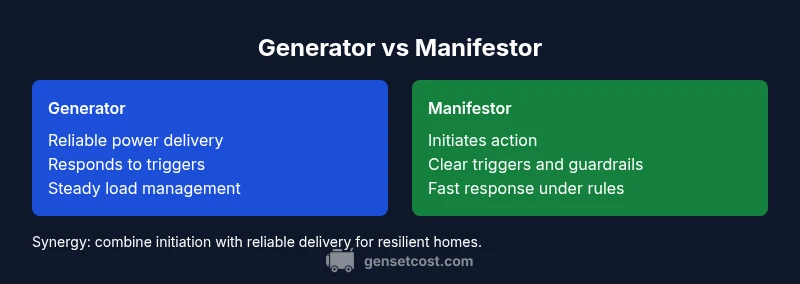
The Generator archetype is characterized by sustainable energy that responds to external cues. In a home backup context, this means designing a system that waits for a clear trigger—such as a grid outage or a safety alert—before engaging. Generators often thrive on routine, predictability, and reliability. For homeowners, this translates into load prioritization, scheduled maintenance, and clear response plans for common events (weather events, outages, or routine testing). Effective sizing for a Generator mindset emphasizes steady power delivery to essential circuits, with a fallback for nonessential loads during longer outages. Clear, consistent routines help prevent fatigue and ensure the system remains ready when needed. In practice, this archetype benefits from user-friendly interfaces, predictable testing cycles, and transparent energy dashboards that reinforce confident decision-making.
Manifestor archetype: initiating energy and its boundaries
Manifestors are natural initiators who can prompt action without waiting for a stimulus. In a home energy setting, this means readiness to set up a scenario, pre-charge essential circuits, or trigger automation sequences that start the backup when a real need arises. Boundaries are important with Manifestors to prevent over-activation or unintended load spikes. The key is to pair initiating energy with clear guardrails, such as pre-approved load thresholds, time-based restrictions, and robust monitoring. For homeowners, this translates into automation rules that balance rapid response with energy efficiency. When used properly, Manifestor energy can compress response times during outages, ensuring critical loads are prioritized promptly without compromising safety or system integrity.
Synergy in a household: when Generator and Manifestor work together
A well-balanced home energy plan blends Generator steadiness with Manifestor initiative. The Generator maintains reliability by managing essential loads and maintaining system health, while the Manifestor drives timely actions for outages or unusual events. Clear communication channels are essential: one party initiates a plan, the other ensures it lands safely on the right circuits. This synergy reduces delays, minimizes peak demand, and improves resilience during severe weather. The interplay also supports better maintenance Habits, as the Generator ensures routine checks while the Manifestor coordinates updates to automation rules and load shedding strategies. The result is a more resilient home that can adapt to changing conditions without reactive, ad-hoc fixes.
Practical steps: translating archetypes into a backup power plan
Start with a documented energy map that outlines essential circuits (critical loads) and nonessential loads. For Generator-aligned planning, create a stable baseline by sizing for essential circuits with an eye toward efficiency and battery backup for rare outages. For Manifestor-aligned planning, establish trigger-based automation—such as switching to generator power when a weather advisory is issued or when grid reliability dips below a threshold. Use a centralized control system to coordinate initiation and response. Regularly test safety interlocks, transfer switches, and fuel logistics. Finally, schedule quarterly reviews to adjust load priorities and adjust automation rules based on household routines and seasonal changes. This practical approach aligns energy decisions with real-life patterns.
Sizing, automation, and control strategies
Sizing for a generator-manifestor framework requires balancing steady power delivery with responsive capability. Start by profiling peak loads and defining essential circuits that must stay powered during outages. Implement automation that gracefully ramps loads up or down to prevent surges and protect appliances. Consider a smart transfer switch with remote monitoring to ensure initiations and responses occur seamlessly. For households with multiple occupants, set up personalized profiles so different rooms or zones respond to outages in a predictable way. Automation should be transparent, with clear feedback on why a load was shed or reconnected. This fosters trust and reduces confusion during stressful outage scenarios.
Communication, boundaries, and decision-making protocols
Effective communication is central to the generator-manifestor dynamic. Establish a shared decision-making protocol that assigns roles for initiating actions versus validating outcomes. Use simple, non-technical language when discussing triggers, thresholds, and safety rules. Define boundaries to prevent overuse, such as limits on runtime or mandatory cooldown periods after a generator starts. Schedule regular check-ins to review performance, outages, and any necessary system tweaks. Document decisions so future household members or property managers can follow the established framework. Clear, consistent communication reduces conflicts and increases the likelihood that the backup plan meets real-life needs.
Case studies: hypothetical scenarios to illustrate dynamics
Scenario A: A family experiences a grid outage during a heatwave. The Manifestor initiates a pre-approved sequence to power critical circuits, while the Generator maintains baseline support and coordinates battery backup for essential devices. Outcome: comfort is preserved with minimal manual intervention. Scenario B: A storm causes intermittent outages. The Generator handles routine cycling, and the Manifestor adjusts automation thresholds to conserve fuel and keep nonessential loads offline until reliability returns. Outcome: energy efficiency improves without compromising safety or comfort. These examples illustrate how the archetypes complement each other under pressure, guiding practical decisions rather than leaving outcomes to chance.
Comparison
| Feature | Generator | Manifestor |
|---|---|---|
| Decision style | Responds to triggers; relies on routines | Initiates action; sets conditions for engagement |
| Energy pattern | Steady, reliable output when engaged | Proactive, initiates bursts or sequences |
| Best use case | Stable outages with predictable loads | Outages requiring quick initiation or pre-emptive actions |
| Automation fit | Value predictable automation and load management | Benefit from guardrails and clearly defined triggers |
| Communication style | Clear feedback loop; responsive to changes | Direct instructions; need boundaries to avoid overload |
| Risk considerations | Over-reliance on routine; potential delays in unexpected events | Boundary breaches can cause rapid, unmanaged load shifts |
The Good
- Clarifies decision-making flow for backup power
- Encourages disciplined load management and maintenance
- Promotes proactive automation while preserving reliability
- Supports clear stakeholder roles in multi-occupant homes
The Bad
- Abstract concept if not grounded in real-life routines
- Requires coordination to align two distinct energy patterns
- May demand initial setup time for automation rules
- Can feel theoretical without practical templates
A balanced Generator-Manifestor framework offers resilience when both archetypes are aligned
Use a shared energy map, define initiating triggers, and establish guardrails. This approach improves reliability and reduces conflicts during outages.
People Also Ask
What is the generator archetype in home energy planning?
In this framework, the Generator archetype reflects steady, reliable energy delivery that responds to triggers and routines. They thrive with predictable load management and consistent maintenance schedules. The focus is on safety, reliability, and long-term efficiency.
The Generator archetype stands for steady power that comes when conditions are right, with predictable maintenance and loads.
What defines the manifestor archetype in this context?
The Manifestor archetype initiates action and sets conditions for engaging backup power. They work best with clear boundaries, pre-approved triggers, and guardrails to prevent unplanned load shifts. Their role is to start automation quickly when needed.
The Manifestor initiates action and helps start backup power when conditions call for it, within clear rules.
How can homeowners apply this to backup power planning?
Map essential versus nonessential loads, define triggers for generator start, and set guardrails to prevent overloads. Use automation with clear feedback so every household member understands why decisions occur.
Create a simple plan that defines what starts when and why, with clear rules.
Are there risks in combining archetypes in a household energy plan?
Yes, without alignment there can be miscommunication and abrupt load changes. Proper governance, ongoing dialogue, and tested automation reduce these risks and improve reliability.
Misalignment can cause surprises. Keep rules clear and test regularly.
Should I install an automatic transfer switch with this framework?
An automatic transfer switch is generally recommended to ensure seamless handover between grid and generator. It provides safety interlocks and reduces manual handling during outages.
Yes, an ATS helps switch power safely and automatically.
What are best practices for communication between archetypes?
Use concise, non-technical language for triggers and thresholds. Schedule regular check-ins and keep a shared log of decisions to avoid confusion during outages.
Keep messages simple, meet regularly, and log decisions.
Key Takeaways
- Align roles: Generator for reliability, Manifestor for initiation
- Pair triggers with safeguards to prevent overload
- Prioritize essential loads with clear automation
- Maintain open, simple communication about decisions
- Regularly review and adjust energy plan