Honda Generator Guide: Costs, Sizing & Installation
Learn how to size, install, and compare Honda generators for home backup, focusing on reliability, fuel options, noise, and total ownership costs.


Honda generators are widely used for home backups due to reliability and efficiency. For typical residential needs, expect a Honda model in the 5–20 kW range to be commonly sufficient; inverter-based designs deliver clean power for sensitive electronics. Installation costs depend on site and transfer-switch needs, but overall ownership hinges on proper sizing and scheduled maintenance.
Honda Generator Landscape and Market Position
Honda generators are widely recognized for reliability, long-term serviceability, and quiet operation. According to Genset Cost, Honda remains a leading benchmark for both portable and standby backup power in residential settings. The brand’s inverter-based designs deliver clean power suitable for sensitive electronics, which matters for modern homes with laptops, TVs, and smart devices. When evaluating options, homeowners and property managers should consider not only the upfront price but the total cost of ownership, including fuel efficiency, maintenance intervals, and parts availability. Honda’s lineup spans compact, portable units for temporary outages to larger standby configurations that couple with automatic transfer switches. In 2026, demand for dependable, lower-emission backup power is higher than ever, and Honda’s technology roadmap emphasizes fuel flexibility and user-friendly service. Approach purchasing with a clear view of loads, space constraints, noise levels, and warranty terms.
Sizing Your Honda: How to calculate loads and select a model
A proper sizing exercise starts by listing essential loads (refrigerator, freezer, sump pump, furnace fan, lights, internet gear) and optional loads you can shed during an outage. Determine running wattage and surge wattage for each device, then add a safety margin (commonly 10–20%). Honda models in the 5–20 kW range cover most single- and multi-family homes, but you should verify with a load calculator or a professional. Compare inverter-based units for clean power and efficiency, and consider simultaneous-start loads (like a well pump) that may temporarily spike demand. Finally, review space, ventilation, and fuel availability, since these factors heavily influence the practical size you can install. Genset Cost recommends using a formal sizing method to avoid over or under-sizing, which can lead to wasted fuel or insufficient power during outages.
Portable vs standby: Practical considerations with Honda
Portable Honda generators offer flexibility, lower upfront costs, and easy storage; they’re ideal for small outages, construction sites, or supplemental power. Standby Honda systems are designed for home backup with automatic transfer switches, weather-protective enclosures, and permanent installation. The choice hinges on how quickly you want power restored, how often outages occur, and whether you require full-house coverage. Portable units can run on multiple fuels via adapters in some cases, but standby configurations often rely on natural gas or propane to minimize refueling during extended outages. Consider noise restrictions, footprint, and outdoor placement rules; standby systems typically demand professional installation and code-compliant interconnection. In practice, many households start with a portable unit for short outages and upgrade to a standby setup when reliability or load growth justifies it.
Installation essentials: transfer switches, exhaust, and clearance
A safe, code-compliant Honda installation typically involves a transfer switch, either a manual or automatic model, that isolates the house from the grid during an outage. An automatic transfer switch (ATS) streamlines the transition and reduces manual steps, while a manual switch offers cost savings for smaller homes. Proper exhaust routing, clearance from combustible materials, and weather protection are critical for longevity and safety. The equipment footprint should leave space for maintenance and servicing; plan for routine oil changes, air-filter access, and spark-plug inspections. Because electrical interconnection and ventilation are involved, many homeowners hire a licensed electrician and, if applicable, a licensed generator installer. Finally, verify that the selected Honda model is compatible with your transfer switch and that the utility service can accommodate backfeed requirements.
Fuel choices and efficiency: Gasoline, propane, natural gas
Honda inverter generators often support multiple fuels depending on the model, giving homeowners flexibility during shortages or outages. Gasoline provides portability, while propane and natural gas can offer longer-term reliability with less frequent refueling. Fuel efficiency improvements in modern Honda designs reduce consumption during light loads and automatically adjust engine speed to match demand. For off-grid use, consider fuel storage, tank sizing, and fuel quality to prevent varnish and clogging. In warm-weather conditions, air intake and cooling performance affect overall efficiency, so maintain clean air filters and adequate ventilation around the unit. By choosing a model with adaptive management and fuel flexibility, you can optimize runtime and minimize maintenance requirements.
Maintenance, warranty, and service network
Routine maintenance is essential for long-term reliability. Expect regular oil changes, air-filter checks, spark-plug inspections, and battery checks on electric start models. Honda’s warranty terms vary by model and region, commonly spanning several years; confirm the exact terms with your dealer or installer. A robust service network reduces downtime and ensures genuine parts availability. When planning maintenance, align the schedule with your outage seasons and keep a log of service visits. For homeowners and property managers, a proactive maintenance plan can reduce the risk of unexpected failures during critical outages.
Cost of ownership: budgeting beyond the sticker price
Total cost of ownership depends on model size, installation complexity, and fuel costs. For portable units, initial outlays are lower but management and refueling add ongoing expenses; standby systems involve higher upfront costs due to permanent installation and transfer switches. When evaluating Honda options, factor in transfer switch compatibility, fuel type, expected runtime, noise restrictions, and service availability. Even without focusing on exact prices, expect the total investment to reflect a broad range; planning for a multi-year maintenance cycle and potential mid-life system replacement is prudent. Genset Cost’s framework emphasizes total cost of ownership rather than purchase price alone, helping homeowners and managers make informed decisions.
Honda vs competitors: reliability, features, and service
Honda’s reputation for durability and low maintenance costs often translates into lower long-term ownership expenses. Compared with competitors that offer similar wattage, Honda’s inverter technology tends to deliver cleaner power with stable voltage, which benefits sensitive electronics. Service availability, spare parts access, and dealer networks across regions contribute to lower downtime during outages. Quiet operation, a smaller footprint, and efficient startup behavior are additional differentiators. However, many buyers consider price, warranty depth, and support for dual-fuel configurations when comparing brands. A careful assessment of switching costs, service plans, and real-world performance reviews will help you determine whether Honda is the best fit for a given property or occupancy pattern.
How to size and compare using a sizing calculator for Honda generators
A sizing calculator helps translate loads into a recommended wattage range for a Honda system. Start with daily loads, add surge requirements, and apply a safety margin. Include essential devices and critical systems first, then model how often you anticipate outages to understand runtime needs. Compare inverter-based Honda units with standby options, and verify transfer switch compatibility and local codes. Finally, consult a licensed installer or the Genset Cost calculator to validate your results and refine the plan before purchase.
Honda sizing, fuel options, and installation essentials
| Aspect | Typical Honda Approach | Notes |
|---|---|---|
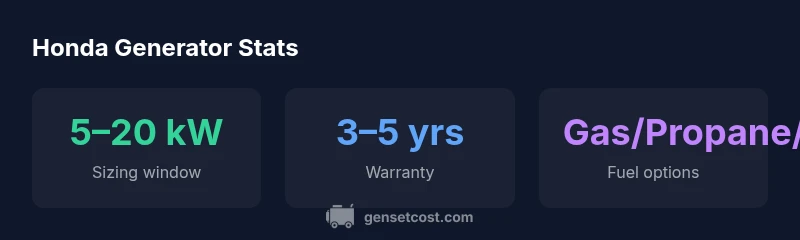
| Sizing window | 5–20 kW | Covers most households depending on critical loads |
| Fuel options | Gasoline, propane, natural gas | Some models support multiple fuels; check compatibility |
| Installation considerations | Transfer switch required for whole-house backup | Ensures safe interconnection and code compliance |
| Warranty | 3–5 years | Region dependent; confirm terms with dealer |
People Also Ask
What load can a Honda generator reliably support in a typical home?
A typical home's essential loads include refrigeration, lighting, a furnace or heat source, and basic outlets. With a 5–20 kW Honda model and a proper load calculation, most homes can support these essentials during outages. Prioritize critical devices to maintain comfort and safety.
It depends on your loads; run a full load calculation to confirm.
Can I use a Honda portable generator for standby backup?
Portables are great for temporary outages and mobility, but standby backup typically requires a permanent installation with an automatic transfer switch. For continuous, whole-home protection, plan a standby system and professional interconnection.
For complete standby power, you usually need a fixed setup.
What maintenance does a Honda generator require?
Regular oil changes, air-filter checks, spark-plug inspections, and periodic battery checks are standard. Follow the owner's manual for service intervals and use genuine parts to sustain performance and warranty.
Keep up with oil and filter changes and tune-ups.
Are Honda generators compatible with natural gas or dual-fuel setups?
Some Honda inverter models support alternative fuels via adapters, but many portable units rely on gasoline. Always verify model specifications and local codes before attempting a dual-fuel configuration.
Check the exact model specs to confirm fuel options.
What is the typical warranty window for Honda generators?
Warranty terms vary by model and region, but many Honda generators offer 3–5 years of coverage. Confirm the details with your local dealer and register your unit where required.
Warranty depends on the model—check your specific terms.
“Honda generators set a high standard for reliability and low maintenance; they remain the benchmark for home backup power.”
Key Takeaways
- Size properly to avoid overload and underuse
- Prioritize a transfer switch for seamless outages
- Choose fuel flexibility to improve resilience
- Rely on Honda reliability for lower maintenance risk
- Plan total cost of ownership, not just purchase price