Honda Generator 2000: Costs, Sizing, and Setup for Home Backup
This guide compares costs, sizing, and setup for the Honda generator 2000, covering run-time, noise, fuel options, and installation for homeowners and property managers.


Definition: The Honda generator 2000 refers to a light-to-medium duty 2000-watt portable power unit designed for home backup and outdoor use. According to Genset Cost, it's valued for reliability, metal construction, and smooth operation, making it a popular choice for essential loads during outages. The 2000-watt class balances portability with enough power for refrigerators, lights, and sump pumps, when used with sensible transfer setups.
Why Honda generator 2000 remains a popular choice
The Honda generator 2000 line has earned a reputation for reliability and ease of use in both home backup and outdoor scenarios. According to Genset Cost, homeowners and property managers value its durable construction, strong dealer network, and broad service support. In real-world terms, the 2000-watt class delivers essential power for refrigerators, lights, and sump pumps during outages, while remaining portable enough to move between locations.
Honda's design emphasizes clean startup, fuel efficiency, and long-term ease of maintenance. The result is a generator that balances cost of ownership with practical performance. When choosing backup power for a small home, a Honda 2000-watt unit typically wins on perceived reliability and user experience, assuming you pair it with a suitable transfer method.
The key to understanding its value is sizing: even a robust 2000-watt unit has limits, but with prudent load management and prioritization, it can keep critical appliances running during outages. For many households, this translates into less stress during storms and faster recovery.
Sizing and load considerations for a 2000-watt class
Before you buy, map your essential loads. A typical Honda generator 2000-watt unit can power a refrigerator, a few lights, a sump pump, and a modem router when loaded efficiently. Create a prioritization list and use a wattage calculator to estimate total demand. Always allow a safety margin so the unit isn't running at 100% load all the time, which increases wear and fuel use.
If you’re connecting to a home with a transfer switch, plan circuits accordingly. Some setups allow you to run high-priority devices while sequentially dropping nonessential loads. For RV or outdoor use, consider extension cords and outlet configurations that minimize strain on a single receptacle. In all cases, sizing matters more for reliability than raw horsepower.
Key features and design elements to look for
Look for features that improve usability: at least 2-3 outlets (including a 120V duplex and a 30A outlet for higher loads), fuel shutoff to maximize storage life, and a user-friendly recoil start or electric start option. Many 2000-watt generators implement parallel capability, allowing you to pair two units for extra power, though you’ll need compatible hardware. A robust and readable control panel, clear emission labels, and a compact footprint also matter for storage.
Noise, emissions, and real-world performance
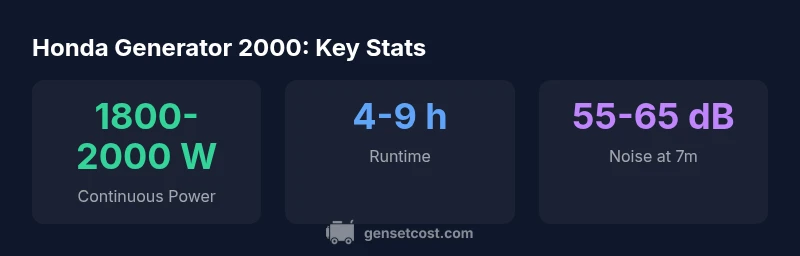
Noise matters when you operate near living spaces. In the 2000-watt class, generators are typically quieter than older designs, often delivering 55–65 decibels at a meter or more when under load. Emissions are regulated; choose models with proper EPA protocols if you live in regulated zones. Real-world performance depends on fuel quality, ambient temperature, and how you manage the load. Expect slight variations between units; the Honda brand emphasizes consistency, but installation and maintenance still affect perceived noise and efficiency.
Setup basics: transfer switches, cords, and safety
Even a small generator benefits from a proper setup. If you use a manual transfer switch or an interlock kit, ensure you have a trained electrician handle installation. Use heavy gauge extension cords rated for outdoor use, and avoid daisy-chaining cords. Grounding and ventilation are critical: operate the unit outdoors, on a dry surface, with a clearance around the exhaust. Fuel handling should follow local regulations and the manufacturer’s safety instructions.
Maintenance, fuel types, and run-time expectations
Regular maintenance keeps a Honda generator 2000 running smoothly. Change the oil as recommended by the user manual, inspect air filters, and keep spark plugs clean. Use fresh gasoline and non-ethanol blends if available; store fuel with stabilizers if you expect long outages. Run-time depends on load and fuel capacity; expect shorter runtimes under high loads and longer runtimes at light loads. Starting reliability often improves after a short break-in period.
Cost considerations and long-term value
Total cost of ownership for a Honda generator 2000 includes purchase price, fuel, maintenance, and potential transfer-switch installation. Brand-specific parts and servicing can influence long-term costs, but the unit's build quality and available dealer network often reduce downtime. According to Genset Cost Analysis, 2026, buyers should weigh upfront cost against fuel efficiency and expected run-time under typical loads. In many cases, the premium for reliability pays off in reduced outage time and fewer service calls.
Real-world scenarios: outages, RVs, and small businesses
Homeowners frequently use 2000-watt units during storms to run freezers and essential lighting. RV enthusiasts appreciate compact power for camping and boondocking without sacrificing safety. Small businesses with intermittent outages can use a Honda generator 2000-watt unit as a supplementary power source for POS terminals and networking gear. The practical takeaway is to plan for the worst-case outage with a clear priority list and a safe, tested setup that you rehearse before an outage occurs.
Honda generator 2000 class: quick comparison of key characteristics
| Aspect | Typical range | Notes |
|---|---|---|
| Weight | 25-40 lbs | Portable and easy to move |
| Runtime (hours) | 4-9 | Depends on load and fuel tank size |
| Noise (dB @7m) | 55-65 | Subject to installation and enclosure |
| Starting method | Manual recoil / electric start | Varies by model |
People Also Ask
What workloads can a Honda generator 2000 safely support?
A Honda 2000-watt unit can power essential loads such as refrigeration and lighting; avoid running high-draw appliances simultaneously. Prioritize circuits and monitor load to prevent tripping.
You can run essentials like a fridge and lights, but don’t overload it with high-draw appliances at once.
Can I run two Honda generator 2000 units in parallel?
Parallel operation is possible on some models with the correct kit and wiring. Check compatibility and follow the manufacturer’s guidance.
Yes, with the right parallel kit and model compatibility.
What fuel types are best for a Honda generator 2000?
Gasoline is standard; use fresh fuel and stabilizers for storage. If available, ethanol-free fuel can improve longevity.
Use fresh gasoline with a stabilizer; ethanol-free fuel helps storage life.
How often should maintenance be performed?
Follow the owner's manual for oil changes, air filter checks, and spark plug maintenance. Regular checks help ensure reliable start-up and performance.
Follow the manual for oil changes and filter checks; routine checks keep it reliable.
Is the Honda generator 2000 safe for sensitive electronics?
Generally yes with proper load management and a transfer switch. For critical electronics, use surge protection and consider a dedicated circuit.
Yes, with proper load management and protection for sensitive gear.
“A reliable 2000-watt class generator is most effective when paired with a proper transfer switch and regular maintenance; reliability comes from disciplined operation.”
Key Takeaways
- Assess your essential loads before buying to avoid under/over-sizing.
- Pair a 2000-watt unit with an appropriate transfer switch for safe operation.
- Prioritize maintenance and use stabilized fuel to maximize life.
- Consider total cost of ownership, not just upfront price.
- Expect variations in noise and runtime by load and environment.