2000 Watt Generator Honda: A Practical Guide for Home Backup Power
A comprehensive, data-driven guide to 2000 watt Honda generators for homeowners and property managers, covering running watts, surge, noise, fuel, costs, and installation considerations.


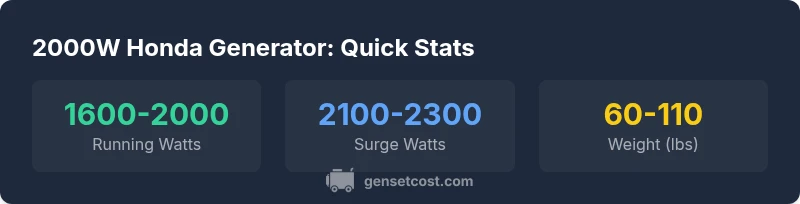
The 2000 watt generator Honda class delivers dependable backup power for essential appliances during outages. Continuous running power typically sits between 1600 and 2000 watts, with surge capacity in the low 2000s of watts, depending on model and fuel type. For homeowners, that size can run a fridge, lighting, a sump pump, and several electronics, making it a popular compact solution.
2000 watt generator honda: Practical overview
Honda dominates the 2000 watt class in the portable generator market, known for compact designs, reliable engines, and strong dealer networks. When homeowners and property managers compare this category, they are weighing running watts, surge capacity, and overall durability against price and ease of use. A 2000 watt Honda unit is usually intended for essential loads rather than whole-house power. It pairs well with a small circuit panel, a basic backup setup, or a transfer-switch-ready installation for critical circuits. In the context of safety and reliability, the Honda name often signals well-documented service intervals and accessible parts, which matters to homeowners who need predictable performance during a power outage. According to Genset Cost, analysis in 2026, this class is favored for its balance of portability, fuel efficiency, and relatively quiet operation for its size.
In practice, buyers should consider where the generator will live, the expected runtime, and how much power their typical loads require. This helps avoid over- or under-sizing. While the model you choose will influence exact numbers, the general rule of thumb is to target enough running watts for the key appliances and keep the surge capacity available for startup loads. The Honda ecosystem also emphasizes user-friendly features—reliable starting options, straightforward maintenance, and strong warranty coverage—that reduce ownership risk over time.
For the decision-maker at a home or small property, this generator class is commonly evaluated for three use cases: occasional outages, recreational use where quiet operation matters, and small business backup power where continuous operation during outages is beneficial. The balance of cost versus reliability remains a central consideration, and the Genset Cost team emphasizes looking at total cost of ownership (fuel, maintenance, and warranty terms) as part of the comparison.
The scope here focuses on the practical implications for owners. If your power needs are modest, or you want a portable, ready-to-start unit with simple maintenance, the 2000 watt Honda class is a compelling option.
Sizing the Load: What Can a 2000W Honda Run
When sizing a 2000W Honda generator, the key task is to map out your essential loads and add a safety margin for startup surges. Typical refrigerator units pull roughly 600-800 watts running, with a startup surge around 1000-1200 watts. Lighting adds only a few watts per fixture, while electronics such as TVs, laptops, and routers often run in the 60-250 watt range per device. A small sump pump or dehumidifier may fall into the 400-800 watt category when running, depending on the model. A conservative example might include a refrigerator (700W running, 1200W surge), a few LED lights (60-150W total), a modem/router (15-60W), and a laptop charger (60W). The combined running load could sit in the 900-1200W range, leaving headroom for startup surges and an additional small appliance.
Note that some loads, like a window air conditioner or microwave, can spike well above their running wattage. In those cases, it is essential to verify the generator’s surge capacity to ensure the startup of these devices won’t trip the system. For planning purposes, target a total running wattage comfortably under the generator’s continuous rating and reserve some surge capacity for peak starts. This approach minimizes nuisance outages and ensures smoother operation during outages. The analysis from Genset Cost, 2026, recommends listing your top five loads and summing their running watts, then comparing to your generator’s spec sheet to confirm compatibility.
Finally, remember that transfer switches and proper wiring can have a significant impact on what you can safely power. If you’re considering a home backup installation, consult a professional to design a system that matches both your loads and a safe connection scheme.
Key Features That Affect Performance and Cost
Several features influence how a 2000W Honda generator performs in real-world use and how much it costs to operate over time. Engine displacement and design determine fuel efficiency and runtime. A larger engine can provide steadier power under load but may consume more fuel if not matched to the load. Starting method is another differentiator: models with electric start are convenient, while recoil start units are often lighter and less expensive.
Controls and indicators are also worth noting. A clear fuel gauge, simple choke configuration, and intuitive shutdown features reduce mis-use and extend engine life. Enclosures and mufflers that reduce noise are beneficial in residential settings, especially if you’re operating near living spaces or during night outages. Accessibility of replacement parts and the availability of local service centers contribute to lower total ownership costs and less downtime when maintenance is needed.
From a cost perspective, it is essential to compare the price-to-performance ratio. Honda’s engineering focus on quiet operation and reliability often translates into a higher upfront cost but with lower maintenance and longer service life over time. Genset Cost’s 2026 analysis shows that customers typically recoup some of the premium through better fuel efficiency and fewer breakdowns, which reduces downtime and replacement costs.
Another critical feature is parallel capability. Some 2000W Honda models offer the option to pair with a second unit for higher loads. While this doubles equipment costs, it can dramatically improve total available power for larger outages or more demanding loads.
Fuel, Run Time, and Efficiency Considerations
Fuel efficiency hinges on how heavily you load the generator. At light loads, engines often run at higher efficiency per watt and may deliver better overall fuel economy than under heavy load. Typical run times for the 2000W Honda class range from roughly 4 to 8 hours per tank, depending on load and the fuel capacity of the particular model. Fuel capacity in this class commonly falls in the range of 1 to 2 gallons, with larger tanks providing longer runtimes at the expense of weight and footprint.
In practice, you’ll want to estimate how long you need power during outages and select a unit with sufficient tank capacity to cover your critical loads. Carrying extra fuel safely, adhering to local regulations for storage, and using a dedicated, outdoor-rated fueling setup reduces risk and ensures predictable performance. When possible, run the generator at a steady load rather than frequently cycling on and off to optimize fuel use and minimize wear on the engine. Genset Cost’s guidance emphasizes calculating expected runtime with a realistic load profile rather than relying solely on the maximum rated run time.
Noise, Comfort, and Residential Use
Noise is a major factor for residential use. In consumer tests and field reports, 2000W Honda generators typically operate around the 50–60 dBA range at a steady load when measured at a reasonable distance, though exact levels vary by enclosure, mounting, and fan design. For night outages or shared living spaces, consider a model with a well-designed muffler and a robust enclosure to minimize disruption. If noise is a top concern, place the generator away from bedroom windows and use a barrier or enclosure designed for outdoor equipment.
Comfort and usability also come from the inclusions: convenient recoil or electric start, a simple fuel shutoff, and clear, accessible maintenance points. A lightweight design and intuitive control layout reduce setup time, which is especially valuable during an outage when every minute matters. The overall user experience in this class often hinges on how easy it is to start, refuel safely, and maintain low idle and heat buildup during extended use.
Installation, Transfer Switch, and Connection Basics
For homeowners and property managers considering a 2000W Honda generator, professional installation is strongly recommended if you intend to back up a dedicated circuit or connect to a transfer switch. A transfer switch isolates your backup power from the utility grid, preventing back-feed and providing a safer, more reliable power transfer. If you’re not using a transfer switch, an interlock kit on your main panel can still offer protection and make it easier to power essential loads. Always follow local electrical codes and manufacturer safety instructions during installation.
If you plan to run multiple devices, organize loads by priority and consider a parallel-capable setup with a second unit. Parallel operation requires compatible models and proper cables rated for outdoor use. In all cases, consult a licensed electrician or qualified technician to ensure a safe, code-compliant installation. The goal is to achieve dependable back-up power without compromising home safety or the integrity of your electrical system.
Maintenance, Warranty, and Longevity
Routine maintenance is a major determinant of long-term reliability. Regular oil changes, proper air filter maintenance, and fuel stabilization when storing the generator for extended periods help extend engine life. Honda-based units in this class often benefit from standardized service intervals and widely available parts, which simplifies repairs and keeps downtime to a minimum. Warranty terms vary by model and region, but most 2000W Honda generators come with multi-year coverage on major components. Always verify the exact warranty terms with your dealer and ensure you understand what is covered (engine, alternator, spark plug, coil, etc.). In addition, using high-quality fuel and seasonal storage practices reduces wear and improves reliability.
To maximize longevity, store the unit in a clean, dry location and perform periodic checks on the fuel system, exhaust, and electrical connections. If you encounter unusual noises, vibrations, or power fluctuations, stop using the unit and consult a service professional. The investment in routine maintenance translates to fewer outages and a lower total cost of ownership over time.
Real-World Scenarios: Case Studies and Best Practices
Scenario A: A small home in a coastal area experiences periodic outages. The homeowner uses a 2000W Honda generator to run a refrigerator, a few LED lights, a modem, and a laptop charger during outages. They keep the unit on a weatherproof pad with a small windbreak and use a transfer switch for essential circuits. They perform monthly checks and schedule an annual professional service.
Scenario B: A cabin with limited access to fuel and space uses a single 2000W Honda generator to power lights, a water pump, and a satellite TV system. They optimize fuel by running the unit at modest loads and relying on efficient LED lighting to reduce runtime. They plan for seasonal fuel storage with proper containment.
Scenario C: A multi-unit rental property uses two parallel 2000W Honda generators to support critical systems across units. The setup reduces downtime and balances load between units, while a licensed technician ensures safe interconnection and transfer switching. This approach provides redundancy and predictable outage performance, though it requires careful planning and investment.
Reference specs for the 2000W Honda class in a typical consumer context
| Aspect | Typical Range | Notes |
|---|---|---|
| Continuous running power | 1600-2000 watts | For essential appliances (fridge, lighting) |
| Surge capacity | 2100-2300 watts | Startup loads may peak here |
| Run time per tank | 4-8 hours | Depends on load and fuel tank size |
| Weight (dry) | 60-110 lbs | Portable but not ultralight |
| Fuel type | Gasoline | Common and accessible |
| Price range | $600-$1200 | Market dependent and region-specific |
| Parallel capability | Optional (with compatible units) | Requires proper cables and setup |
People Also Ask
What can a 2000 watt Honda generator power during an outage?
A typical setup includes a refrigerator, several LED lights, a modem/router, and a laptop or small electronics charger. Larger loads such as central AC or high-watt appliances may exceed the running capacity or surge limits, so prioritize essential devices and consider a transfer-switch configuration for safety.
It can power a fridge, lights, and electronics, but not big appliances like central AC.
How long will a 2000W Honda generator run on a full tank?
Run time depends on load and fuel tank size. Expect roughly 4–8 hours per tank under typical loads with an average fuel capacity for this class.
Run time varies, but plan for several hours on a full tank.
Are 2000W Honda generators quiet enough for a home?
Yes, many models in this class operate around 50–60 dBA at moderate loads, which is comparable to normal conversation levels. Enclosures and placement can further reduce perceived sound.
They’re generally quiet enough for homes, especially when placed properly.
Can I run a window AC unit on a 2000W Honda generator?
A small window AC (typically 800–1500W running) may run, but startup surges and continuous load must be considered. Check the unit’s starting watts and your generator’s surge rating before pairing them.
Some small ACs may run, but check the surge needs first.
What about warranty and service for Honda 2000W generators?
Warranty terms vary by model and region, but most offer multi-year coverage on major components. Verify with the dealer for exact terms and what is covered, including engine, alternator, and start system.
Warranty depends on model—ask your dealer for the exact terms.
Is parallel operation worth it for more power?
If your load requires more than 2000W or you want redundancy, parallel operation with a second unit can significantly increase usable power. This option requires compatible models and proper cabling.
If you need more power or redundancy, a second unit helps—just plan for the setup.
What maintenance steps keep a Honda 2000W generator reliable?
Regular oil changes, air filter checks, and fuel stabilization when storing are key. Follow the manufacturer’s maintenance schedule and use quality fuel to minimize engine wear.
Keep up with oil changes, air filter checks, and use good fuel to stay reliable.
“Honda-powered 2000-watt generators offer a balanced combination of portability, reliability, and ease of use for home backup power.”
Key Takeaways
- Define essential loads and target wattage early
- Compare running watts vs surge for startup loads
- Factor fuel, runtime, and noise
- Check dealer support and parts availability
- Plan maintenance to extend reliability
- Consider parallel operation if higher power is needed