Honda Generator 5000: A Practical Guide for Home Backup
A data-driven guide to Honda generator 5000 options for home backups. Explore sizing, costs, runtimes, and safety with insights from Genset Cost.


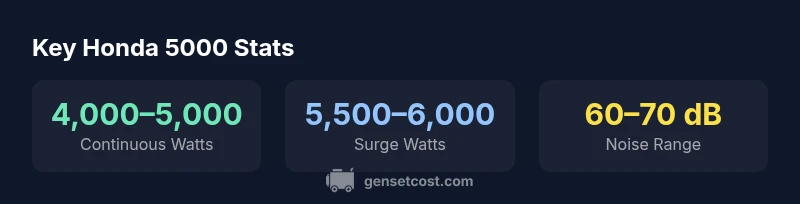
A Honda generator marketed as 5000 typically delivers 4,000–5,000 watts of continuous power with a surge capacity around 5,500–6,000 watts, depending on model and operating conditions. Real-world performance differs with load, altitude, and fuel quality. For home use, this class is enough to run lighting, essential electronics, a fridge, well pump, and some small circuitry; however, it may not support a large central air conditioner or high-demand appliances simultaneously. When sizing, prioritize continuous running watts over peak surge and account for startup draw of inductive loads. Always follow the manufacturer’s maintenance schedule and store fuel safely. Expect longer runtimes with lean loads and consider a transfer switch for smooth outages.
What a Honda generator 5000 actually delivers
A Honda generator marketed as '5000' translates to roughly 4,000–5,000 watts of continuous power with a surge capacity around 5,500–6,000 watts, depending on the model and operating conditions. Real-world performance differs with load, altitude, and fuel quality. For home use, this class is enough to run lighting, essential electronics, a fridge, well pump, and some small circuitry; however, it may not support a large central air conditioner or high-demand appliances simultaneously. When sizing, prioritize continuous running watts over peak surge and account for startup draw of inductive loads. Always follow the manufacturer’s maintenance schedule and store fuel safely.
Use-case scenarios and load considerations
In typical residential outages, a 5k Honda excels at supporting essential circuits: lighting, refrigeration, Wi‑Fi, and a small sump pump. A common rule of thumb is to list your critical loads and sum their running wattage, then add some headroom for startup surges. For example, a refrigerator may pull 600–800 watts when running but spike higher on startup, while a sump pump can require 800–1,200 watts briefly. A laptop or modem consumes modest power, while a furnace blower or AC unit can exceed 1,500 watts for short bursts. If you rely on several heavy loads at once, you may need a larger unit or staged operation (alternate power cycles).
Fuel, runtime, and maintenance basics
Most Honda 5k-class generators run on gasoline. Runtime depends on fuel tank size, load, and idle controls; expect longer runtimes at light loads and shorter runtimes when powering multiple high-demand devices. Regular maintenance—oil changes, spark plug checks, air filter cleanings, and carburetor care—extends life and reliability. Use fresh fuel and stabilizers to minimize starting trouble. Remember that ethanol-blended fuels may affect performance over time; running on clean, stabilized fuel is best for longevity, while shutting the unit down properly prevents moisture buildup in the carburetor.
Sizing fundamentals: matching 5000-watt capacity to home needs
Sizing a generator involves translating home electrical needs into wattage terms. The running wattage reflects continuous load; starting wattage accounts for motor- starting spikes. A Honda 5000-watt unit typically covers essential appliances but may require shedding nonessential circuits during peak startup. For homeowners with sensitive electronics, consider a generator with good AVR (automatic voltage regulation) and clean power output to minimize risk to electronics. A professional load calculation helps identify required watts, system efficiency, and whether a transfer switch is advisable.
Efficiency and operating costs: what to expect
Operational costs depend on fuel prices, load factor, and maintenance. A 4k–5k watt Honda generator will consume fuel more efficiently at moderate loads than when heavily loaded or idling. To estimate annual running costs during outages, multiply expected hours of use by fuel consumption per hour and fuel price. Routine maintenance reduces the risk of costly repairs; replace spark plugs and oil as recommended and keep the air filter clean. Even with good efficiency, owning a 5k generator entails ongoing costs beyond purchase, including fuel storage, oil, filters, and occasional service.
How Honda 5000-class compares with other 5k-class gensets
In the 5k-watt space, performance varies by engine design, muffler noise, and controller quality. Honda’s reputation for durable engines and smooth power output is a key differentiator, though some competitors may offer lower initial purchase prices or longer warranties. When evaluating, look for continuous power ratings, surge capacity, noise levels, fuel economy, and service network. Remember that a lower upfront price can result in higher long-term costs if fuel efficiency or reliability is inferior.
Installation, safety, and transfer switches
For safe operation, install your generator in a well-ventilated outdoor location, away from doors and windows. A transfer switch is highly recommended to avoid backfeeding and to protect utility workers. Electricians can install a simple transfer switch or a more advanced automatic transfer switch (ATS) depending on your needs. Plan for proper grounding and weatherproof fueling and storage. Use heavy-duty cords rated for outdoor use and monitor connections for wear.
Warranty, service networks, and reliability considerations
Honda generators typically come with manufacturer warranties and a broad service network designed for residential users. Reliability hinges on regular maintenance, clean fuel, and correct startup/shutdown procedures; neglecting these can shorten life. If you rely on a generator during long outages, ensure you have access to authorized service centers and replacement parts. Consider an extended warranty if available in your region and verify what it covers for components subject to wear and tear.
Quick-start buying checklist and next steps
To move from planning to purchase, build a simple checklist: confirm essential loads, estimate total running watts, evaluate transfer-switch options, compare noise and fuel economy specs, and review warranty terms. Check local code requirements and whether installation requires permits. Finally, obtain a few quotes that include delivery, installation, and service terms, so you can balance up-front cost with long-term value.
Comparison of wattage, runtime, and noise across common 5k-class gensets
| Model | Continuous Power (W) | Surge Power (W) | Fuel Type | Runtime at 50% Load | Noise (dB) |
|---|---|---|---|---|---|
| Honda 5000-class | 4,000–5,000 | 5,500–6,000 | Gasoline | 8–12 hours | 60–70 |
| Other 5k-class genset | 4,000–5,000 | 5,000–6,000 | Gasoline | 7–11 hours | 65–75 |
| Small 3k-class backup | 3,000–3,500 | 3,500–4,000 | Gasoline | 6–9 hours | 65–75 |
People Also Ask
Can a Honda generator 5000 power essential home appliances during an outage?
Yes. A 5000-watt Honda unit can support essential loads like lighting, refrigeration, Wi-Fi, and basic outlets during outages. You may need to shed nonessential circuits when multiple high-draw devices startup. Always follow safety guidelines and consider a transfer switch for safe operation.
A 5k Honda can run essential loads during an outage; you may need to limit what runs at once.
What appliances can a 5000-watt Honda run at once?
A typical 5k setup can handle refrigerators, lights, a modem, and a small sump pump. Start-up surges require planning; plan for two or three smaller loads rather than heavy machines in parallel.
It can handle several basics plus a small pump, but think about startup surges.
Is a transfer switch necessary for safe operation?
A transfer switch is highly recommended to prevent backfeeding and to protect workers during outages. It simplifies switching between utility power and generator power and reduces risk.
Yes, a transfer switch is recommended for safety and simplicity.
How long does fuel last, and how should I store it?
Fuel longevity depends on storage conditions and fuel stabilizers. Use stabilized gasoline and store in approved containers. Run the generator periodically to prevent stale fuel issues.
Store stabilizer-treated fuel and run periodically to prevent gumming up.
How does maintenance affect reliability?
Regular maintenance—oil changes, filter replacements, spark plug checks, and carburetor care—significantly improves reliability and life. Follow the manufacturer’s schedule and use quality parts.
Sticking to maintenance schedules keeps reliability high.
Are there quiet, efficient options in the Honda 5000 range?
Honda offers models with quieter operation and cleaner power within the 5k range, though noise and efficiency depend on model design and load. Compare decibel ratings and AVR quality when shopping.
Yes, there are quieter models; check decibels and power quality.
“Sizing a 5k-class generator should focus on continuous power draw and reliable operation during extended outages, not just peak watts.”
Key Takeaways
- Define essential loads before sizing a 5k generator.
- Prioritize continuous wattage over surge for reliability.
- Plan for a transfer switch to enable safe outages.
- Factor total ownership costs, including fuel and maintenance.
- Verify warranty and service network before purchase.