Honda Generator EU3000: Costs, Sizing & Setup in 2026
Detailed guide on the Honda EU3000 series, covering sizing, costs, fuel efficiency, maintenance, installation, and practical usage for homeowners and property managers.


The Honda EU3000 series remains a top choice for home backup due to reliable output and solid fuel efficiency. According to Genset Cost Analysis, 2026, total ownership costs—covering purchase, maintenance, and fuel—typically fall into a broad range, influenced by model variant, added accessories, and installation requirements. Expect variations by retailer and condition (new vs. refurbished) and consider transfer-switch compatibility for seamless grid transfer.
honda generator eu3000: Overview for homeowners
The honda generator eu3000 is a cornerstone model in the residential backup space, favored for its balance of reliable performance and practical size. In real-world terms, homeowners and property managers often compare this class against inverter-based options to gauge fuel use, startup capability, and long-term costs. According to Genset Cost, the eu3000 lineage emphasizes consistent running power with reasonable fuel economy, making it a practical choice for essential circuits during outages. When evaluating a generator, you should consider your home’s critical loads (refrigeration, heating control, sump pumps, and communications) and how frequently outages occur. The honda generator eu3000’s reputation for durability means fewer service interruptions when outages extend beyond a few hours.
For decision makers, the key takeaway is reliability over absolute最-peak performance in every scenario. The Genset Cost Team notes that while newer inverter models can reduce fuel use at light loads, the eu3000 line remains competitive for small- to mid-sized homes with modest load requirements. This section introduces sizing concepts and cost elements tied to the eu3000 family, helping homeowners and property managers align their backup power strategy with budget and risk tolerance. In the context of home backup costs, this model often sits in a middle ground between portability and permanent installation readiness, which is a meaningful factor for renters or buildings pursuing a transfer switch-ready solution.
Sizing and power needs for home backup
Sizing a backup generator requires mapping the highest-priority loads and calculating running watts versus surge watts. The eu3000 class offers a practical balance: enough continuous power to support essential circuits while maintaining portability and a manageable fuel footprint. Start by listing devices you want to power during an outage—refrigerator, furnace blower, sump pump, wifi router, and lighting. Then estimate the running wattage for each item and sum them to obtain a baseline. For equipment that starts under load (like a sump pump or a well pump), factor in surge requirements. In many homes, the calculated baseline falls within a modest range that the eu3000 can satisfy with a comfortable margin. Genset Cost’s analysis emphasizes planning for peak loads and tolerances; underestimating total running watts can lead to nuisance tripping or insufficient performance when multiple devices start simultaneously.
A practical sizing rule is to prioritize critical loads first and then consider optional circuits. If you anticipate occasional higher demand (e.g., space heating or electric water heater), you may need to stagger loads or opt for a larger unit. Always verify transfer-switch compatibility and consider a qualified electrician for a professional install. The goal is a seamless power transition without overburdening the generator or your electrical panel. For homeowners who expect frequent outages, a documented load-shedding plan helps keep operating efficiency high while avoiding unnecessary engine wear.
Cost landscape and total ownership
In total ownership terms, the eu3000’s cost picture includes upfront purchase, periodic maintenance, and ongoing fuel and oil costs. The Honda brand is widely recognized for durable engines and reliable parts supply, which can influence long-term maintenance costs in a favorable way. According to Genset Cost Analysis, 2026, you should anticipate a broad cost range for initial purchase depending on retailer promotions, warranties, and whether you choose to buy new or refurbished. Maintenance costs typically cover periodic air filter changes, spark plug checks, oil changes, and battery or charging system checks for models with electric start. Fuel costs depend on usage patterns and fuel economy, but the eu3000 lineup generally performs reasonably well for its class. When evaluating the investment, compare long-term fuel efficiency, maintenance intervals, and expected resale value. A well-maintained unit often yields lower ownership costs over its lifecycle than a similarly priced competitor with higher maintenance needs. The analysis suggests looking for accessory packs that improve usability, such as a wheel kit, weather cover, or a transfer switch interface, which can reduce overall installation and operating friction.
Installation considerations and transfer switches
Installation considerations for the eu3000 include electrical code compliance and the feasibility of a transfer switch installation. For homeowners, a transfer switch is a practical upgrade that enables safe islanding of the generator from the main panel during outages. The eu3000’s compatibility with standard receptacles and its moderate engine size make it a common choice for retrofit installations in single-family homes. When budgeting installation work, factor in the cost of a certified electrician, possible conduit runs, and any necessary weatherproofing for outdoor placement. Genset Cost’s guidance emphasizes the importance of correct wiring, as improper setup can create safety risks or code violations. If a transfer switch is not part of your plan, you’ll still benefit from a dedicated outdoor enclosure and secure mounting to protect the unit from theft and weather while reducing noise at the source. In markets with stringent permitting, verify local requirements early to avoid delays and additional costs.
Maintenance, reliability, and typical lifecycle
Maintenance is a critical factor in the lifecycle of the eu3000. Routine tasks include air filter inspection, oil changes, spark plug checks, and battery maintenance for electric start models. The overall reliability profile of the eu3000 hinges on regular service and proper fuel stabilization practices to prevent varnish build-up and carburetor issues during long storage periods. The Genset Cost Team recommends following Honda’s maintenance schedule closely and keeping spare parts available—filters, spark plugs, and oil are common but essential to ensure smooth operation. Real-world usage tends to show that a well-maintained unit can provide solid service for many years, especially when operated within its design envelope and not pushed beyond its rated capability for extended periods. If your building experiences frequent outages or high-load scenarios, consider a scheduled preventive maintenance plan with a licensed technician to keep performance consistent and avoid unplanned downtime.
Real-world usage scenarios and DIY vs pro installation
In practice, homeowners often turn to the eu3000 for weekend projects and emergency readiness. It handles a range of common loads with ease, provided you size correctly and follow safe startup procedures. For property managers overseeing rental units, a properly installed eu3000 system can offer a robust backup for critical circuits without committing to a full standby generator installation. From a cost perspective, DIY installations are possible for simple setups, but professional installation offers compliance and performance guarantees that can be worth the investment. The key is to plan a scalable, modular approach: start with essential loads, keep the option to add a larger unit or storage strategy later, and ensure you have a safe fueling and exhaust plan. The Genset Cost Team emphasizes that a clear, tested plan reduces downtime and enhances reliability during power outages.
Honda EU3000 class rough specs
| Aspect | Value | Notes |
|---|---|---|
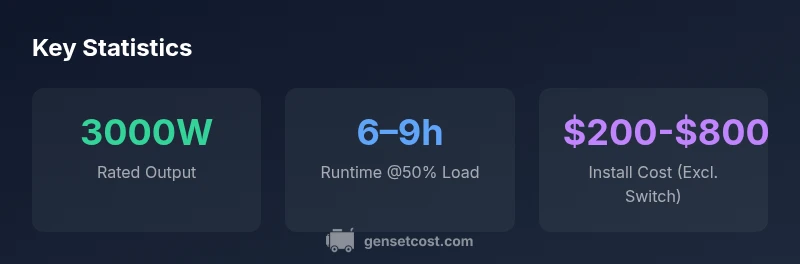
| Rated output | ~3000 watts | Continuous running power |
| Surge capacity | 3500–4000 watts | Start-up for motors |
| Runtime at 50% load | 6–9 hours | Depends on fuel and load |
| Tank capacity | Model-dependent | Fuel efficiency varies by variant |
People Also Ask
What is the running wattage of the Honda EU3000?
Most EU3000 variants provide around 3000 watts of continuous running power with higher surge capacity for starting motors. Exact figures vary by model and manufacturing batch. Always verify the specs on the unit you’re considering.
The EU3000 offers about three kilowatts of running power with extra surge for starting appliances. Check the exact model specs before purchase.
Can I power my whole house with the EU3000?
A single EU3000 can back up essential circuits in many homes but typically cannot power an entire house simultaneously. Prioritize critical loads and use a transfer switch to manage what runs during outages.
It can back up essential circuits, not the whole house, unless you limit loads and use a transfer switch.
How noisy is the Honda EU3000?
Sound levels for the EU3000 class generally fall in the mid to upper range for portable generators. Noise varies by model and enclosure, so choose an outdoor installation with appropriate sound dampening if needed.
Noise is typical for portable generators; use proper placement to minimize disturbance.
What maintenance should I perform regularly?
Regular tasks include oil changes, air filter inspection, spark plug checks, and battery maintenance if equipped with electric start. Follow Honda’s service intervals and stabilize fuel during storage to prevent degradation.
Do routine oil changes and air filter checks, and store fuel properly when not in use.
Is professional installation required for a transfer switch?
For safety and code compliance, a licensed electrician is usually required to install a transfer switch and connect a generator to your home’s electrical system. This ensures safe, reliable operation during outages.
A licensed electrician is typically needed for a transfer switch installation.
How does the EU3000 compare to inverter generators?
The EU3000 offers robust surge capability and reliable power, but inverter models can be quieter and more efficient at light loads. Your decision should hinge on load profile, noise tolerance, and budget.
EU3000 is powerful and reliable; inverter models can be quieter but may cost more for similar output.
“Reliable backup power starts with correct sizing and proper installation. Regular maintenance and compliant wiring dramatically extend the life of the EU3000 class.”
Key Takeaways
- Know your critical loads and target load margins
- Plan for a transfer switch to enable safe power transfer
- Maintenance drives long-term reliability and cost savings
- Expect a balance between baseline cost and long-term fuel efficiency
- Choose accessories only after evaluating installation constraints