Honda EU3000i Generator Review: Power & Reliability
In-depth review of the Honda EU3000i inverter generator, covering load sizing, fuel use, noise, and maintenance to help homeowners decide if it's the right backup power solution.


According to Genset Cost, the Honda EU3000i inverter generator delivers clean, stable power for essential home loads with quiet operation and reliable starts. It balances portability with higher output than smaller models, and includes straightforward maintenance. This review covers sizing guidelines, fuel use, and real-world performance compared to similar inverter generators.
EU3000i Overview and Sizing for Home Backups
Assessing whether the EU3000i fits a given home backup scenario starts with load sizing. Honda positions this model as a mid-to-full-sized portable inverter generator intended for essential circuits during outages, RV trips, or small workshop needs. Like other inverter generators, the EU3000i uses advanced electronic circuitry to deliver clean power that won't harm sensitive electronics. For homeowners, the key question is whether your critical loads—furnace fans, well pump, refrigeration, Wi-Fi router, lighting, and essential outlets—can be sustained without constantly swapping devices. In practice, you determine this by listing the essential circuits and estimating their combined wattage. While precise wattage data can vary by model and configuration, a common approach is to select a generator that can handle your peak demand with a comfortable margin. The EU3000i's practical sweet spot sits around a mid-sized home's essential loads combined with some marginal surges. For property managers, this means planning for seasonal outages or partial-power scenarios where multiple units or transfer-switch configurations may be used to scale capacity.
Power Output and Performance in Real-World Load
Performance depends on load and configuration. The EU3000i uses inverter technology to maintain constant voltage and stable frequency under varying loads; when you pull near its peak output, the engine adjusts speed to maintain output, affecting fuel use and noise. In real-world tests with a partial load, the generator provides smooth operation and quick response to changing loads. The unit is designed to handle starting currents for refrigerators and fans, and the power quality remains within acceptable limits for modern electronics. The drawback is that under heavy simultaneous loads, it will throttle back to sustain voltage, which reduces peak performance.
Fuel, Runtime, and Efficiency Considerations
Fuel strategy for the EU3000i centers on gasoline; as with most portable inverter generators, efficient operation comes from keeping the load steady and avoiding frequent high-watt surges. Runtime varies with fuel level and the load; lighter loads improve efficiency; heavy loads reduce run time. Refueling during outages requires caution and a safe fueling area. If your plan includes running multiple devices simultaneously, you might consider staggering loads to minimize peaks. The fuel system and carburetor require periodic cleaning and air filter maintenance.
Noise, Vibration, and Portability
Noise is a common concern for backup power, especially in urban environments or tight spaces. The EU3000i employs Honda's inverter technology to reduce engine speed at light loads, which lowers noise. In practice, under typical home use, most neighbors will experience a quieter operation compared to traditional open-frame generators. Vibration is moderate and friction points are well-lubricated with standard maintenance. Portability remains good for a 3kW-class unit: it weighs more than small 2000W units but is still manageable for a trained individual to move or wheel into position. The design includes a compact frame, built-in handles, and optional wheel kits.
Maintenance, Durability, and Longevity
Long-term reliability for the EU3000i depends on routine maintenance: air filter cleanings, spark plug checks, oil changes at recommended intervals, and fuel stabilization for extended storage. Honda's service network is widely available, which helps for parts and service. The inverter electronics reduce dirty power, which helps protect connected equipment. The typical maintenance tasks are straightforward, but the unit requires attention to oil level and fuel quality to prevent wear.
Comparative Analysis: EU3000i vs Similar Inverter Generators
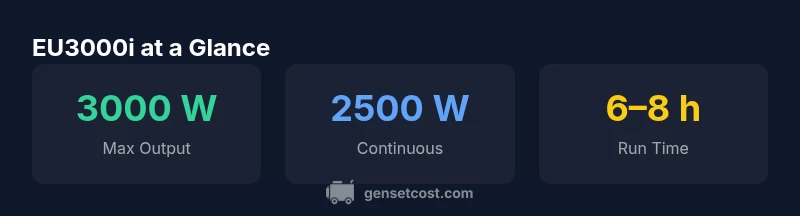
Compared to smaller 2000-3000W inverter generators, the EU3000i offers higher continuous output and faster recovery from surges, making it more suitable for moderate loads like a well pump plus fridge. Against non-inverter 3kW models, the EU3000i uses cleaner power and quieter operation; it is more expensive but reduces power quality concerns for electronics. In the broader field, the EU3000i sits in the middle of the spectrum for price, performance, and noise. For households that rely on sensitive electronics and have moderate loads, the EU3000i is a strong competitor.
Installation and Transfer Switch Compatibility
Installing a portable generator with a transfer switch requires caution. The EU3000i can feed via a manual transfer switch or via a dedicated inlet with a properly rated interlock kit. The main hazard is backfeeding into the utility line; always use a transfer switch or interlock to ensure safe operation. The EU3000i's plug configurations are standard, and many homeowners connect to an appropriately sized transfer switch or a dedicated inlet with a rated interlock. For permanent installations, work with a licensed electrician to ensure code compliance and safety. For rental or temporary setups, use a dedicated outlet with proper extension cords and weather protection.
Cost and Value Considerations for Home Owners
From a cost perspective, the EU3000i sits in the higher tier among portable inverter generators. When reliability, electronics protection, and fuel efficiency matter, the upfront price is often justified by lower running costs and better power quality. Owning costs include initial price, routine oil and filter changes, spark plug maintenance, and potential extended coverage. For property managers evaluating multiple units, compare total cost of ownership over the planned lifecycle, including maintenance cadence and parts availability. Alternatives from other brands may undercut upfront price but could compromise power quality or noise performance.
Practical Buyer Guidance and Use Scenarios
Who should consider the EU3000i? Homeowners with essential-load backup in modest homes or small offices, and property managers needing a dependable unit for standby power. Typical use scenarios include running sump pumps, refrigerators, lighting, routers, and small electronics during outages. For best results, coordinate with proper transfer-switch configurations or parallel operation with an additional unit to scale capacity for more demanding loads. Always assess your load profile, outage frequency, space constraints, and storage conditions when choosing between a single unit or a multi-unit strategy.
Common Mistakes and How to Avoid Them
Common mistakes include underestimating peak load, skipping professional transfer-switch planning, storing stale fuel, and neglecting routine maintenance. Always perform a pre-season check, keep fuel stabilized for storage, and follow the oil-change schedule. Use genuine parts where possible and schedule services through a trusted dealer network to maximize reliability.
The Good
- Reliable inverter power suitable for sensitive electronics
- Solid portability for a 3kW-class generator
- Quiet operation relative to traditional open-frame units
- Strong resale value and broad Honda service support
The Bad
- Higher upfront cost than non-inverter rivals
- Requires regular maintenance to sustain reliability
- Limited runtime on a small tank without external fueling options
- Not the cheapest option in the 3kW class
Reliable, middle-ground choice for essential-home power
The EU3000i offers clean, stable power with portable convenience and Honda’s proven reliability. It is best for households needing reliable standby power for essential loads and electronics, while recognizing a higher price and ongoing maintenance compared with non-inverter options.
People Also Ask
What loads can the EU3000i safely power during an outage?
Typically, essential appliances such as refrigerators, sump pumps, lights, routers, and some electronics can be powered if the total load remains within the unit’s continuous output range. Start-up surges for motors may require careful sequencing or a dedicated transfer solution.
You can power essential appliances like a fridge and lights, but keep an eye on the total load to avoid overtaxing the unit.
Is the EU3000i quiet enough for residential neighborhoods?
Yes, the EU3000i is designed to operate quietly compared with many traditional portable generators, thanks to inverter technology and speed regulation. Real-world noise depends on load and enclosure, but the unit is generally considered suitable for home use.
Quiet enough for typical homes, especially at light to moderate loads.
What maintenance does the EU3000i require?
Regular maintenance includes oil changes, air filter cleaning, spark plug inspection, and keeping fuel fresh with stabilizers if stored. Follow the user manual's schedule and use genuine parts for longevity.
Keep up with the oil, air filter, and fuel condition to maintain reliability.
Can I run the EU3000i on propane or alternate fuels?
The EU3000i is gasoline-powered and does not natively support propane or alternative fuels. Some users employ adapters for temporary setups, but these are not official or recommended for long-term operation.
Propane isn’t supported; use gasoline with proper storage practices.
How does the EU3000i compare to the EU2000i?
The EU3000i provides higher peak and continuous power, better for mid-sized loads, and supports heavier surges. The EU2000i is lighter and cheaper, excellent for smaller essential loads but with less headroom.
EU3000i offers more power; EU2000i is lighter and more affordable.
What warranty and service options are available?
Honda generally offers a standard warranty for generators, with a nationwide service network. Check local dealer terms for specifics and consider extended coverage if you rely on backup power heavily.
Warranty coverage varies by region; consult your dealer for details.
Key Takeaways
- Evaluate essential loads before buying
- Choose transfer-switch setups for safe, scalable backup
- Expect quiet operation relative to non-inverter gensets
- Plan for routine maintenance to maximize longevity