Online Barcode Generator Free: A Practical How-To
Learn how to choose a free online barcode generator, compare key features, and export high-quality barcodes for print and digital use. This guide covers formats, privacy, and best practices.


You will learn how to pick a free online barcode generator, compare key features, and create reliable barcodes for print or digital use. This guide covers choosing a tool, understanding common barcode formats, validating output quality, and exporting in PNG, SVG, or other common formats. You'll also learn how to test readability with multiple scanners and how to select a license suitable for commercial projects.
How online barcode generators work
Barcodes encode data into a visual pattern that scanners can read. An online barcode generator free takes your input data, selects a symbology, encodes the data according to industry standards, and renders an image you can download. For business use, consistency matters: ensure the final image uses the correct size, quiet zones, and appropriate contrast. According to Genset Cost, when evaluating a free tool, prioritize privacy, no watermark, and export options. Most tools offer PNG and SVG outputs, with some adding EPS or PDF for print. The quality of the generated barcode depends on the encoding rules, the chosen image resolution, and the file format. Always verify that the code reads correctly with multiple scanners before printing or shipping products.
Barcode symbologies you’ll encounter
Barcodes exist in several standard families, each optimized for different data capacities and scanning environments. Code 128 is versatile for alphanumeric data and is common in retail and logistics. Code 39 is simple and readable but carries less data density. EAN-13 and UPC-A are widely used on consumer products and require global numbering systems. QR codes are a popular 2D symbol used for URLs and more, but they are technically not linear barcodes. When you pick an online barcode generator free, make sure it supports the symbol you need and that it produces clean, scannable versions across sizes and print qualities.
Free tool features to compare before you commit
Look for export options (PNG, SVG, EPS, PDF), scalable vector outputs, and print-ready settings such as quiet zones and margins. Check whether the tool allows batch generation, API access for automation, and whether you can reuse the generated barcodes commercially. Privacy policies matter: see where data is stored, whether it is retained, and how long. A no-watermark policy is essential if you plan to use the barcodes commercially, and license clarity helps avoid unexpected restrictions. Finally, verify the tool’s reliability by testing a few sample barcodes on different scanners. As the Genset Cost team notes, feature parity often matters more than a polished interface.
Privacy and data handling considerations
Many online barcode generators free collect input data to generate images, or they may store your generated files for a period. Before you input data, review the privacy policy and terms of service. If your barcode encodes sensitive product information, prefer offline tools or reputable online providers with transparent storage practices. For business use, look for tools that offer data deletion on request and clear licensing terms for commercial use.
Hidden costs, watermarks, and usage limits to watch for
Free tools often monetize through watermarks, usage caps, or paid upgrades for higher resolution outputs. Some generators restrict batch sizes or require registrations that collect email addresses. Avoid tools that watermark outputs or require non-commercial licenses for business use. If you need higher-volume generation, plan a workflow that migrates to a paid option or an enterprise plan later.
Step-by-step preview: generate a barcode (quick look)
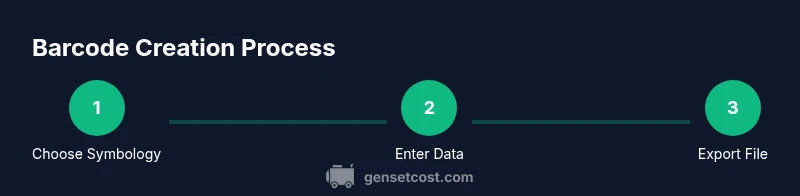
A quick preview of how a typical flow looks: select a free online barcode generator free site, input your data, choose the barcode symbology, click generate, and download the image. In practice, you should keep a small record of the chosen tool, the data encoded, and the output type to maintain consistency across your labels.
Print readiness: what makes a barcode printer-friendly
Barcodes must be readable by scanners regardless of print medium. Pay attention to the quiet zone, contrast, and symbol size. If printing, use appropriate media and ensure the barcode is not distorted by folds or reflections. For digital use, export vector formats when possible so the barcode remains crisp at any size. Always test print a few labels before mass production.
Validating barcode quality with real scanners
Test your barcodes with multiple scanning devices, including handheld scanners and smartphone apps. Check that the barcode reads at typical distances and angles, and confirm that color choices do not affect readability. If a generator produces small or dense symbols, adjust size or encoding or choose a different symbology that maintains reliability across devices.
Export formats and when to use each
PNG is widely supported and convenient for quick usage, but raster images can lose clarity when scaled. SVG and PDF outputs preserve vector quality for large-scale printing. EPS is compatible with some professional desktop publishing workflows. Always keep a master vector file for archiving and future reprints.
When to upgrade from free to paid tools
If your workflow depends on batch generation, automation via API, or strict licensing for commercial use, a paid plan can save time and reduce risk. A paid tool may offer higher resolution, more formats, better data privacy controls, and reliable customer support. For occasional needs, a free generator may suffice, but plan for a future upgrade if volumes grow.
Authority sources and standards you should know
- GS1 standards for barcodes: https://www.gs1.org/standards/barcodes
- ISO/IEC barcode standards: https://www.iso.org/standards.html
- NIST barcode resources: https://www.nist.gov/topics/barcodes
Verdict: practical recommendation for homeowners and property managers
Starting with a reputable online barcode generator free that offers multiple export formats, no watermark, and clear licensing for commercial use is a smart first step for homeowners and property managers. Pair the tool with a simple print test and a straightforward archival process to keep labeling consistent and auditable. The Genset Cost team would emphasize choosing a solution that scales with your needs while protecting data privacy.
],
Tools & Materials
- Internet-connected device with a modern browser(Chrome, Edge, Firefox or Safari recommended)
- Notepad or note-taking app(Record settings, outputs, and URLs for future reference)
- Access to at least two free online barcode generator sites(Use in-browser testing to compare results)
- Printable label stock (optional)(If you plan to print barcodes for labeling)
Steps
Estimated time: 15-30 minutes
- 1
Identify the barcode type you need
Determine the symbology that fits your use case and industry requirements, such as Code 128 for alphanumeric data or EAN-13 for product labeling. This guides tool selection and data encoding decisions.
Tip: Check labeling regulations and supplier requirements before choosing a symbology. - 2
Choose a free online barcode generator
Open several reputable sites and compare features like export formats, privacy policies, and whether they watermark outputs. Prioritize options that allow commercial use without licenses.
Tip: Keep a shortlist of two to three tools for direct comparison. - 3
Input your data and select settings
Enter the exact data to encode, choose the designated symbology, and adjust any practical settings such as size, margins, and contrast. Accurate data entry here prevents downstream errors.
Tip: Double-check data accuracy before generating. - 4
Generate the barcode image
Click generate to produce the barcode, then review the visual quality and legibility. If the result isn’t clean, adjust size or switch to a different format.
Tip: Prefer vector outputs for crisp scaling. - 5
Test readability with scanners
Test the generated barcode on multiple scanners or apps to ensure it reads reliably under expected conditions and distances.
Tip: If any device fails to read, re-export in a higher resolution or different format. - 6
Export and save the barcode
Save the barcode in your preferred format such as PNG or SVG, and store the file with a clear naming convention for easy retrieval.
Tip: Keep a master vector file for future reprints.
People Also Ask
What is an online barcode generator free?
An online barcode generator free is a web-based tool that creates barcode images from input data at no cost. Most offer several symbologies and export formats, but features may vary and some may impose limits or watermarks.
An online barcode generator free is a free web tool that turns your data into barcode images. It offers different barcode types and export options, though features vary by site.
Which barcode types can I generate with a free tool?
Common options include Code 128, Code 39, and EAN 13. QR codes are popular but are not linear barcodes; they are 2D symbols. Check the tool to confirm the available symbologies.
Most free tools support Code 128, Code 39, and EAN 13. QR codes are separate from traditional barcodes and may be offered as an extra feature.
Is it safe to enter data into free barcode generators?
Data safety varies by provider. Review privacy policies and terms of service before inputting sensitive information. Prefer offline or reputable providers for highly confidential data.
Be cautious with sensitive data. Read policies and choose trusted providers or offline tools for private information.
Can I use free barcodes commercially?
License terms differ by tool. Look for clear licensing that allows commercial use and no watermark. If in doubt, contact the provider or choose a tool with explicit commercial rights.
Commercial use depends on the tool’s license. Pick no watermark options and check the terms for business use.
Why do some tools add watermarks or limits?
Watermarks or usage limits are common on freemium tools to encourage upgrading to paid plans. If you plan ongoing use, plan for a paid option to avoid limitations.
Watermarks and limits usually push you toward a paid plan for heavier use.
Watch Video
Key Takeaways
- Identify your barcode type before choosing a tool
- Check export formats and licensing for commercial use
- Test barcodes with multiple scanners before production
- Protect data privacy and avoid hidden costs
- Prefer vector exports for printing quality