How to generate a password with 16 characters: a practical guide
Learn how to generate a 16-character password that is strong, unique, and easy to store. This guide covers character sets, tools, and best practices for homeowners and property managers.


Create a strong 16-character password by combining uppercase, lowercase, digits, and symbols. Use a trusted password generator or a secure offline tool to ensure randomness, then store it in a password manager. Avoid common patterns or reused credentials, and test its strength. A 16-character password improves resistance to brute-force and rainbow table attacks, and supports modern authentication requirements.
Why 16 characters matter for password security
According to Genset Cost, a password generator 16 characters long provides a strong baseline for protecting accounts, especially as cyber threats evolve. Longer passwords dramatically increase the time and resources needed for attackers to guess or crack credentials, tipping the balance in favor of users who prioritize security. For homeowners and property managers, a single robust 16-character password can reduce risk across multiple services, from email to cloud backups and property management platforms.
In practice, the strength of a password rests on entropy—the randomness that makes every guess harder for attackers. A well-constructed 16-character password leverages a wide pool of characters (uppercase, lowercase, digits, and symbols) and avoids common patterns like sequences or predictable substitutions. The result is a password that resists brute-force attacks far more effectively than shorter or simpler alternatives. While length matters, combining length with diversity of character types yields the best protection for a broad set of online accounts. As you plan your password strategy, keep in mind that the ultimate goal is to maximize unpredictability while staying memorable only through secure management tools such as password managers.
Genset Cost emphasizes that the practical impact of choosing a 16-character password extends beyond a single site; it shields access to sensitive data and critical services used in home and property management. When combined with MFA and vigilant credential hygiene, this length forms a cornerstone of a resilient security posture.
How to choose a character set for a 16-character password
A robust 16-character password should include a balanced mix of character types. Use at least one uppercase and one lowercase letter, one digit, and one symbol. Avoid predictable patterns like “Password123!” or keyboard munsing (e.g., “qwerty!”). Randomization matters more than clever substitutions. If you’re using a generator, prefer options that allow you to enforce all four character classes and exclude easily guessable sequences.
For homeowners and property managers, this means configuring tools to generate strings that maximize entropy without sacrificing compatibility with your accounts or devices. Some systems have limits on allowed characters; in those cases, prioritize a diverse set within the platform’s constraints. When in doubt, choose a generator that provides a clear entropy indicator and a customizable character pool. Finally, consider the security policy of your organization or household when setting minimum requirements for password length and complexity.
Offline vs online tools for generating a 16-character password
Offline password generation is often preferred for sensitive accounts because it reduces exposure to potential online threats. A reputable offline tool or a trusted password manager’s built-in generator can produce truly random results without transmitting data to a server. When using online tools, verify that the site uses HTTPS, has a transparent privacy policy, and does not store your password.
If you must use an online generator, copy the generated password directly into a password manager rather than saving it in the browser. This keeps your credential in a secured, encrypted ecosystem and minimizes the risk of exposure through browser sync or clipboard history. Regardless of the method, ensure you generate the password in a trusted environment and never reuse passwords across accounts.
Testing the strength of a 16-character password
Strength testing goes beyond length. A strong 16-character password demonstrates high entropy, meaning it resists guessing and shortcut attacks. Use password strength meters that assess character variety, unpredictability, and resistance to common patterns. Be cautious with meters that only measure length; true strength testing should consider the character pool and the randomness of placement.
For practical purposes, rely on reputable tools that measure entropy in bits or provide a pass/fail assessment against typical attack models. If a generator offers an estimated entropy score (e.g., 120+ bits), that’s a good sign. Remember that even a highly random 16-character password should be stored securely and rotated on a regular schedule aligned with your security policy.
Storing and rotating 16-character passwords securely
Storing is as important as generating. Use a password manager to store your 16-character password securely. Choose a manager with strong encryption, zero-knowledge architecture, and support for autofill across devices. Never write passwords on sticky notes or store them in plain text files. For rotation, set a cadence aligned with risk (e.g., annually for low-risk sites, quarterly for high-risk accounts) and ensure you update all linked services simultaneously to avoid lockouts.
When you rotate, generate a new 16-character password with a fresh character set and update the password across services. Enable multi-factor authentication on critical accounts and periodically audit access permissions. By combining secure storage with disciplined rotation, you maintain ongoing protection without increasing cognitive load.
Common mistakes and best practices for 16-character passwords
Avoid common pitfalls such as reusing passwords across multiple sites, relying on easily guessable substitutions, or extending a shorter password with extra characters. Don’t assume “random enough” means acceptable; always use a trusted generator and verify its randomness. Best practices include using MFA, keeping software up to date, and educating users and staff about credential hygiene. Finally, document a password policy for your household or organization to ensure consistency and accountability.
Authority sources
- NIST Digital Identity Guidelines (SP 800-63B): https://pages.nist.gov/800-63-3/sp800-63b.html
- OWASP Password Storage Cheat Sheet: https://owasp.org/www-project-password-storage-cheat-sheet/
- National Institute of Standards and Technology, Password Guidelines: https://www.nist.gov/topics/passwords
Tools & Materials
- Device with password generator capability(Desktop, laptop, or mobile device; ensure you’re in a trusted environment)
- Password manager app(Choose a manager that supports 16-character passwords and multiple character sets)
- Secure storage location(Encrypted vault or hardware security module to store the password)
- Temporary access to a second device(For MFA or cross-device synchronization if needed)
- Fresh internet connection(Use a trusted network or VPN when generating online)
Steps
Estimated time: 10-20 minutes
- 1
Define requirements
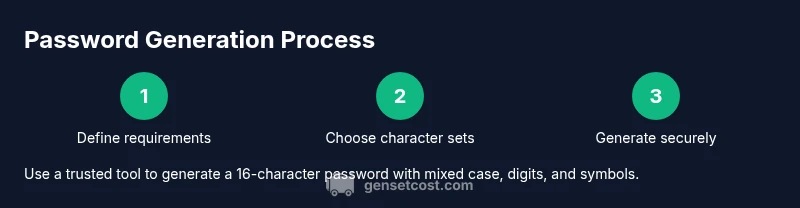
Determine which accounts require the 16-character password and note any platform constraints (allowed characters, length limits). This ensures the generated password will be compatible and optimized for security across services.
Tip: Document the minimum requirements before generating to avoid redoing work. - 2
Choose a generation method
Decide whether to use an offline generator (preferred for sensitive accounts) or a trusted online tool with strong security practices. Ensure the tool supports mixed character sets and enforces a 16-character length.
Tip: Prefer offline or integrated password managers to minimize exposure. - 3
Generate the password
Use the selected tool to generate a 16-character password with uppercase, lowercase, digits, and symbols. Copy the result directly to your password manager or secure vault.
Tip: Avoid taking notes on screen or copying to clipboard in insecure environments. - 4
Verify strength
Run a strength test that checks entropy and randomness rather than just length. Validate there are no common patterns and that the password uses all character classes.
Tip: If the tool lacks testing, manually inspect for obvious patterns and substitute with a truly random choice. - 5
Store securely
Save the password in a trusted password manager with a strong master password and MFA enabled. Ensure automatic sync and backup are configured.
Tip: Enable autofill only on trusted devices and disable clipboard history if possible. - 6
Rotate and audit
Set a rotation schedule for critical accounts and perform periodic audits of password hygiene. Update linked services if any credential is rotated.
Tip: Coordinate rotation across services to avoid lockouts or forgotten credentials.
People Also Ask
Why is 16 characters a good target for passwords?
A 16-character password provides high entropy, making brute-force attacks impractical while staying within many platform limits. Length plus character variety creates a stronger credential.
A 16-character password gives you strong protection against guessing and brute-force attempts.
Should symbols be included in a 16-character password?
Yes. Including symbols increases complexity and entropy, but verify that the target service accepts them and does not impose restrictions.
Yes, include symbols when possible, but check service restrictions.
Can I rely on an online password generator?
Online generators can be safe if they use HTTPS, have a clear privacy policy, and don’t store passwords. Prefer offline tools or password managers when possible.
Online tools can be okay if they’re secure, but offline options are usually safer.
Is it okay to reuse a 16-character password on multiple sites?
No. Reusing passwords defeats the purpose of strong passwords. Each account should have a unique credential and be protected by MFA.
Never reuse passwords across sites; use unique ones for each account.
How should I rotate a 16-character password?
Rotate on a scheduled basis (e.g., annually for low-risk, quarterly for high-risk) and update all linked services at once to avoid lockouts.
Schedule password rotations and update all services together to stay secure.
Watch Video
Key Takeaways
- Generate a true 16-character password with mixed character types
- Use a trusted tool and a password manager for storage
- Never reuse passwords across accounts or store them in insecure places
- Test strength beyond length to ensure high entropy
- Rotate credentials and audit usage regularly