QR Code Generator in Google Chrome: A Practical Guide
Learn to generate QR codes directly in Google Chrome using trusted extensions. This guide covers selection, installation, data input, export options, and best practices for homeowners and property managers.


By the end of this quick guide, you will be able to generate QR codes directly in Google Chrome using a trusted extension, encode common data (URL, text, contact, Wi‑Fi), and export the image for use in print or screens. Before you start, ensure Chrome is up to date, you have internet access, and you know what data you want to encode.
What is a QR code generator for Google Chrome?
QR codes are compact, machine-readable graphics that encode data such as URLs, plain text, contact cards, Wi‑Fi credentials, or calendar events. A QR code generator for Google Chrome is typically a small extension you install from the Chrome Web Store, which lets you turn any data you copy into a scannable image with a few clicks. Using a browser-based tool keeps the workflow close to your daily tasks—no need to switch apps or upload data to a cloud service. For homeowners and property managers, this can speed up sharing of evacuation instructions, access codes, or maintenance portals with tenants or technicians. The Genset Cost team emphasizes choosing a trusted extension with clear privacy practices and a straightforward export option to ensure you retain control over your data.
Why use Chrome extensions for QR codes?
Chrome extensions designed for QR codes provide instant generation right from the browser, eliminating the need to visit a separate site. They tend to support multiple data types (URL, text, Wi‑Fi, vCard) and offer quick customization like color, size, and error correction. For many users, this reduces steps when sharing links for service manuals, booking portals, or installation guides. From a reliability perspective, Chrome extensions stay in your control; data never leaves your device unless you choose to share or export. The convenience factor is heightened when you’re evaluating several options side by side, which is why the Genset Cost approach leans on comparing permissions, export formats, and user reviews before committing to one extension.
How to choose a reliable QR code generator extension
When selecting a Chrome QR code extension, prioritize data privacy, permissions, and export options. Look for extensions that request only what’s necessary (e.g., clipboard access or storage) and provide a clear privacy policy. Compare supported data types (URLs, text, contact cards, Wi‑Fi), whether SVG export is available for scalable prints, and whether you can set color contrasts that meet accessibility guidelines. Read user reviews, check recent update dates, and confirm that the extension stores minimal data locally rather than uploading it to a cloud. The key is finding a tool that aligns with your workflow while safeguarding tenant or client information. Genset Cost’s guidance is to prefer extensions with offline functionality and transparent data handling.
How to install and set up a QR code generator in Chrome
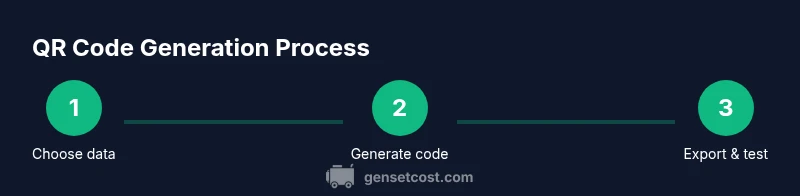
First, open the Chrome Web Store and search for a reputable QR code generator extension. Click Add to Chrome, then confirm the permissions requested by the extension. After installation, pin the extension to the browser toolbar for quick access. Open the extension, grant any necessary permissions (such as clipboard access), and set your preferred export format (PNG or SVG). Finally, test the setup by generating a sample QR code from a simple data string like a URL. If your extension offers color or size options, adjust them to maximize readability. The key is to keep the workflow tight: data input, code generation, export, and quick test.
Practical use cases: URLs, text, vCard, Wi-Fi, and more
QR codes generated in Chrome are ideal for a variety of practical tasks. For example, you can convert a service portal URL into a QR code on property signage or tenant welcome packets, encode a support email address for quick contact, or share a vCard with contractors. You can also embed Wi‑Fi credentials for guest access in a limited, controlled environment where guests can scan for network access without revealing passwords. In short, any data you routinely share digitally can be converted to a QR code for easy scanning. When dealing with sensitive data, prefer generating codes that do not link back to cloud storage unless you control the hosting.
Export options, data privacy, and best practices
Most Chrome QR code extensions offer multiple export formats, typically PNG and SVG. SVG is preferred for print and scaling without loss of quality, while PNG is widely supported for quick sharing. Always review the extension’s privacy policy to understand whether data is stored locally or uploaded. If you handle tenant or client data, disable any autosync features and delete generated codes from local caches after use. Consider adding a simple naming convention for exported files to track codes (e.g., “Tenant_Apt24_QR.svg”). For accessibility, ensure sufficient contrast and provide alt text when codes are displayed in digital materials.
Troubleshooting common issues
If a generated QR code does not scan, verify the input data is correctly formatted and there is a sufficient quiet zone around the code. Check that the extension’s color contrast isn’t too low and that the export format retains fidelity. If the code looks pixelated at small sizes, re-export in SVG and scale in a vector-capable editor. Some extensions may require a browser refresh after installation or permission changes—perform this if you don’t see updates appear in the extension panel.
Security considerations and accessibility
Only install QR code extensions from reputable developers with good reviews. Avoid extensions that request excessive permissions or access to sensitive data beyond what you actually use. Use high-contrast colors and an adequate quiet zone to improve readability, especially for printed materials. Keep accessibility in mind by providing descriptive surrounding text or captions for codes shown in digital media. If you make a QR code public, consider rotating or regenerating codes periodically to minimize misuse.
Beyond basics: dynamic QR codes and analytics
Dynamic QR codes point to a URL that can be updated after creation, allowing you to redirect scans without regenerating the image. Some Chrome extensions offer dynamic codes via integrated services; compare whether updates are free or require a paid plan. If you rely on analytics, confirm what metrics the service provides (scan counts, device types) and how that data is stored. For property managers, this can help track engagement with digital tenant portals, event registrations, or service requests while maintaining control over the underlying data.
How to test and verify QR codes across devices
Always test generated codes with multiple devices (smartphones, tablets, and desktop scanners) to ensure reliability. Use different camera apps or built-in scanners to confirm readability under varying lighting conditions. If a code doesn’t scan, adjust contrast or re-create it in SVG format for better clarity. Maintain a simple data structure (a single URL or short text) for initial tests, then broaden to more complex data as you validate the workflow.
Tools & Materials
- Chrome browser (latest version)(Keep updated for security and features)
- Active internet connection(To access Chrome Web Store and extensions)
- Data to encode (URL, text, contact, etc.)(Prepare the data you want to turn into a QR code)
- QR code extension from Chrome Web Store(Choose a reputable extension with good reviews)
- Export preference (PNG/SVG)(Optional if you want a specific format)
- Device to test (smartphone, tablet)(Scan the generated code to verify readability)
Steps
Estimated time: Total time: 5-12 minutes
- 1
Identify data to encode and select an extension
Decide whether you need to encode a URL, plain text, contact data, Wi‑Fi, or another data type. Browse the Chrome Web Store and pick an extension with solid reviews, clear privacy terms, and export options that match your needs.
Tip: Check data types supported by the extension before installing. - 2
Install the extension from Chrome Web Store
Click Add to Chrome and confirm the installation. If prompted, grant only essential permissions and pin the extension to the toolbar for quick access.
Tip: Keep permissions minimal to protect data privacy. - 3
Open the extension and input data
Click the extension icon to open its interface. Paste or type the data you want to encode, such as a URL or Wi‑Fi credentials.
Tip: Use a staging example first to verify format. - 4
Generate the QR code and adjust options
Generate the code and adjust settings like color, size, and error correction level if available. Ensure there is a clear quiet zone around the code for reliable scanning.
Tip: Higher error correction improves scan reliability but may affect size. - 5
Export or save the QR code
Choose PNG or SVG export depending on your plan and intended use. Save to a known folder with a descriptive filename.
Tip: Use SVG for printing at large sizes. - 6
Test the QR code with a device
Scan the generated code with a smartphone or tablet to verify readability under different lighting conditions.
Tip: If it fails, re-create using SVG and check contrast. - 7
Document and reuse the QR code
Store a copy of the code and its data mapping in a simple log for future reference. Reuse codes for recurring tasks, updating only the underlying data if supported by your extension.
Tip: Maintain an organized archive to prevent data drift.
People Also Ask
Do I need to pay for QR code extensions in Chrome?
Many QR code extensions are free to use, with optional paid features. For basic code generation, a free version is typically sufficient. If you need advanced options, compare available plans before committing.
Most QR code extensions have free options; check the features before buying.
Can I encode Wi-Fi credentials in a QR code with Chrome extensions?
Yes, you can encode Wi-Fi network details in a QR code using the appropriate data type. Most extensions support this format and generate a scannable code.
Yes, you can embed Wi‑Fi credentials in a QR code.
Will the extension store my data?
Trustworthy extensions typically perform generation locally in your browser and do not upload data unless you opt in. Always review the extension’s privacy policy.
Check privacy settings and policies.
What makes a QR code 'dynamic' and do Chrome extensions support it?
Dynamic QR codes point to a URL that can be updated after creation. Some Chrome extensions support this via online services, but many basic extensions generate static codes.
Dynamic codes are possible with some services; read extension notes.
Can I customize the QR code color and size in Chrome?
Most extensions let you adjust color and size within reasonable limits. Ensure sufficient contrast for readability.
Yes, you can customize colors and size.
What should I do if scanning fails?
Verify input data, ensure valid encoding, and check for quiet zone and contrast. Recreate the code if needed.
If it doesn't scan, re-create with correct data and contrast.
Watch Video
Key Takeaways
- Choose a reputable Chrome QR extension with good reviews
- Prepare the data you want to encode before generating
- Export in a scalable format (SVG) for print
- Test the code on multiple devices to ensure readability
- Respect privacy and avoid storing sensitive data in extensions