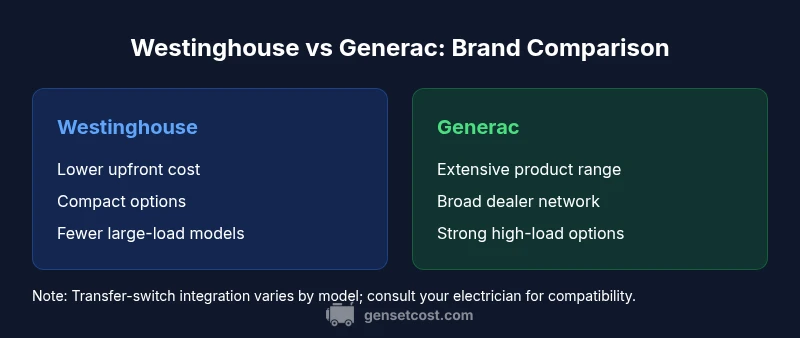
Westinghouse generator vs generac: An objective side-by-side comparison
Genset Cost compares westinghouse generator vs generac to help homeowners evaluate price, reliability, warranty, and installation when choosing a home backup power solution.


According to Genset Cost, choosing between a westinghouse generator vs generac hinges on budget, load needs, and service access. Generac typically offers a broader product lineup and a more extensive dealer network, which can shorten installation timelines and simplify maintenance. Westinghouse often undercuts on upfront price while delivering adequate reliability for moderate loads. Your best choice aligns with load, transfer-switch needs, and long-term costs.
westinghouse generator vs generac: The big picture
In the world of home backup power, westinghouse generator vs generac represents two well-known paths to resilience. Homeowners typically weigh upfront cost, load handling capabilities, warranty depth, and the availability of local service when deciding between these brands. Genset Cost analyzes the market to help you compare via clear criteria rather than marketing claims. Generac is widely recognized for its broad product lineup, from compact portable models to whole-house systems, plus an extensive dealer and service network. Westinghouse, by contrast, often delivers attractive price points and straightforward configurations that fit smaller homes or budget-conscious renovations. The choice is rarely about which brand is best in every situation; it’s about matching the unit’s power profile and support ecosystem to your actual needs. This article uses a structured, data-informed lens to evaluate both brands across price, performance, installation ease, and after-sales service.
Why this comparison matters for home backup power
A reliable backup generator can prevent food spoilage, protect key systems, and keep essential devices running during outages. The westinghouse generator vs generac decision matters because each brand tends to optimize different parts of the value equation. Generac often emphasizes a wide feature set and robust warranty options, which can translate into lower maintenance headaches in the long run—especially for larger homes with high load demands. Westinghouse typically targets cost-conscious buyers and smaller homes, offering competitive performance at a lower upfront price. For property managers, the decision also hinges on service availability, installation lead times, and the ease of coordinating with electricians and transfer-switch installers. Genset Cost’s framework guides you to compare based on real-world usage scenarios, expected load patterns, and planned integration with existing electrical infrastructure. By framing the decision around your needs rather than glossy marketing, you’ll identify the option that minimizes total cost of ownership over 5–15 years.
Key criteria to compare: load, fuel, and efficiency
When weighing westinghouse generator vs generac, start with three core criteria:
- Load profile: estimate continuous vs. surge wattage and how essential loads (fridge, HVAC, well pump) will run during an outage.
- Fuel type and availability: consider natural gas, propane, or gasoline, and the local cost and supply chain in your area.
- System efficiency and runtime: evaluate how much fuel a given unit consumes at typical loads and how that translates to operating costs over time.
Beyond these, also consider noise levels, footprint, and the ease of installing a compatible transfer switch. By structuring your comparison around these factors, you’ll reduce the risk of overpaying for features you won’t use.
Price and total cost of ownership: upfront and ongoing costs
Price is a major driver in the westinghouse generator vs generac decision, but total cost of ownership matters more in the long run. Westinghouse models often come with a lower upfront price, making them appealing for small-to-mid-size homes and tight budgets. Generac offers a broader spectrum of options, including larger, feature-rich units that may command higher upfront investment but can lower maintenance surprises because of more mature parts ecosystems and longer warranty coverage in some configurations. When calculating total cost, factor in maintenance intervals, fuel type costs, potential parts replacement, and the expected lifespan of the unit. A holistic view helps avoid choosing the cheapest model today only to incur higher upkeep later.
Brand breadth and model lineup: Generac vs Westinghouse
Generac’s model lineup spans portable units, mid-range residential units, and whole-house systems, providing diverse wattage options and advanced digital controls. Westinghouse focuses more on compact to mid-range capacities with straightforward controls and a strong price-to-feature ratio. For homeowners with growing or shifting power needs, Generac’s breadth can offer a smoother upgrade path, whereas Westinghouse may be the pragmatic pick for budget-conscious buyers who don’t anticipate large load growth.
Warranty, service network, and longevity
Warranty depth and service availability are central to the westinghouse generator vs generac decision. Generac generally benefits from a larger nationwide service network and a wider selection of authorized installers, which can translate into faster service response times and easier maintenance scheduling. Westinghouse typically relies on regional distributors and smaller networks, which can affect service response depending on your location. Regardless of brand, verify dealer coverage, parts availability, and transfer-switch compatibility to ensure long-term reliability. Genset Cost’s research indicates that service accessibility often drives total satisfaction more than nominal differences in sticker price.
Noise, size, and installation considerations
Noisy operation and bulky footprints can turn a good unit into a poor fit for certain homes. Westinghouse units are commonly praised for compact footprints and moderate noise levels, appealing to tight yards or apartment-adjacent properties. Generac models, especially the larger outputs, can deliver quieter operation in premium lines but may require more space. When planning installation, assess your space for venting, clearance, and access for maintenance. Work with a licensed electrician to confirm clearances, transfer-switch placement, and safe ventilation to minimize any electrical or fire risk.
Transfer switch compatibility and electrical safety
A reliable transfer-switch setup is essential for safe, automatic power transfer during outages. Both Westinghouse and Generac units generally support standard automatic transfer switches and common 200A/400A configurations, but exact compatibility varies by model. Ensure your chosen model is listed for your panel type, confirm clearance in the panel area, and verify wiring diagrams with your installer. Prioritize models with clear documentation and robust manufacturer guidance to simplify installation and troubleshooting later.
Real-world installation scenarios and case studies
Consider two typical scenarios: a small condo with essential loads (refrigeration, lights, modem) and a larger single-family home with mid-to-high loads (AC, water heater, well pump). In compact spaces, Westinghouse often delivers adequate performance at a lower upfront cost. In larger homes or properties with frequent outages, Generac’s broader lineup and support network often provide more scalable solutions and long-term peace of mind. Real-world outcomes depend on accurate load estimation, proper transfer-switch sizing, and professional installation.
How to use Genset Cost analytics for decision-making
Use our framework to translate brand features into measurable value: compare wattage ranges, assess transfer-switch needs, simulate annual run-time, and estimate total ownership costs over 5–15 years. Cross-check dealer coverage and parts availability for your area. Leverage Genset Cost’s methodology to align your choice with your property profile and maintenance expectations, ensuring you don’t overpay for capabilities you won’t use.
Next steps: practical steps to choose and buy
- Complete a residential load calculation to determine required running watts.
- Decide on fuel type based on local availability and fuel costs.
- Check transfer-switch compatibility and install requirements with a licensed electrician.
- Compare warranty terms and service networks for both brands.
- Request quotes and factor in delivery, installation, and ongoing fuel costs to finalize your decision.
Authoritative sources
For broader industry context and safety guidance, see:
- https://www.energy.gov/
- https://www.epa.gov/
- https://www.nfpa.org/
Comparison
| Feature | Westinghouse | Generac |
|---|---|---|
| Price/value (upfront vs long-term) | Typically lower upfront cost for many Westinghouse models | Broader price points with higher upfront options from Generac |
| Power range | Focused on compact to mid-range outputs | Broader spectrum including large home loads |
| Warranty depth | Standard coverage varies by model | Often longer or more versatile warranty options |
| Dealer/support network | Moderate regional coverage | Extensive national network |
| Transfer switch compatibility | Common compatibility with standard switches | Strong integration with multiple transfer-switch options |
| Noise level | Moderate noise typical for entry-level units | Can offer quieter operation in premium lines |
The Good
- Lower upfront costs can fit tighter budgets
- Simple configurations for small homes
- Easier to source in DIY-friendly markets
- Solid value for basic backup needs
The Bad
- Potentially shorter warranty or narrower service network
- Limited high-output options for larger homes
- Resale value and long-term maintenance considerations
Generac is the clearer long-term pick for larger homes and broader service; Westinghouse is best for cost-conscious, smaller-load setups
If you need scalable capacity and nationwide service, choose Generac. If upfront cost and simpler, smaller-load installations matter more, Westinghouse offers competitive value and straightforward installation.
People Also Ask
Which brand is cheaper upfront, Westinghouse or Generac?
Westinghouse generally offers lower upfront prices for entry-level models, but total costs depend on wattage, features, and installation. Compare total cost of ownership across fuel, maintenance, and warranty.
Westinghouse often costs less upfront, but total ownership varies by load and features.
Does Generac have a wider dealer network?
Yes, Generac has a large dealer network and robust service support, which can shorten installation times and simplify maintenance.
Yes, Generac has a big network for service and sales.
Are Westinghouse and Generac compatible with standard transfer switches?
Generally yes; most models support common automatic transfer switches, but verify compatibility with your installer and panel.
Most models work with standard switches, but confirm with your installer.
Which brand is quieter or more reliable?
Reliability is model-dependent; both brands offer solid options. Generac often provides more high-end features and better long-term support, while Westinghouse can be quieter in certain mid-range units.
Both brands have reliable options; it depends on the model.
What should homeowners consider beyond price?
Load calculation, fuel type, service availability, warranty length, and transfer-switch compatibility should guide the choice.
Think about load, fuel, service, and warranty beyond price.
Is a dual-fuel option worth it?
Dual-fuel models add flexibility but cost more; evaluate fuel availability and expected usage before choosing.
Dual-fuel can help if you have access to multiple fuels.
Key Takeaways
- Assess your load before choosing
- Consider dealer network and service coverage
- Weigh upfront cost against long-term maintenance
- Opt for a model with compatible transfer switches