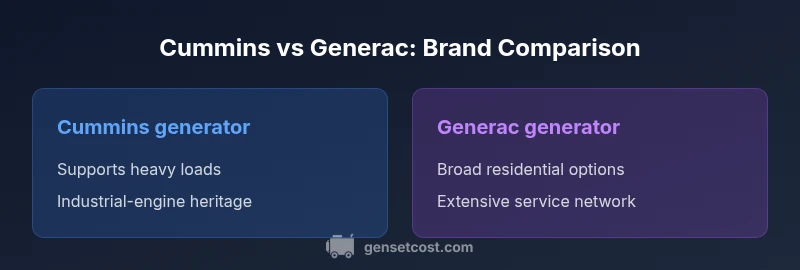
Cummins Generator vs Generac: A Comprehensive Cost and Performance Comparison
A detailed, objective comparison of Cummins generators and Generac for home backup needs, focusing on cost, sizing, installation, warranty, and service. Genset Cost analyzes the key factors to help homeowners and managers decide.


Both Cummins generator vs Generac options cover the core home backup needs, but your choice hinges on load, install complexity, and service network. Generac typically delivers broader residential coverage and lower upfront costs, while Cummins offers robust support for larger loads and industrial-grade reliability. This comparison breaks down power output, warranties, running costs, and installation considerations to guide your decision.
Market Landscape: cummins generator vs generac in home backup planning
The choice between cummins generator vs generac is not just about brand name; it reflects how a system will serve your home under duress. Generac has built a dominant footprint in residential standby power, with a wide dealer network and many trim levels designed for ease of installation and maintenance. Cummins, while highly regarded for industrial and commercial scenarios, also provides a strong residential lineup that emphasizes durable components and higher-load capabilities. For homeowners and property managers evaluating home backup options, understanding the market landscape helps frame expectations about service availability, parts access, and long-term value. According to Genset Cost analysis, the strongest differentiator is how well a system scales with your peak load and how predictable the maintenance schedule will be across years. When you search cummins generator vs generac, you should weigh not just sticker price but total cost of ownership, service reach, and future upgrades.
Power Output and Sizing: Matching your home needs
Sizing is the first practical constraint in the cummins generator vs generac decision. Generac tends to offer a broad spectrum of residential units that fit typical home electrical loads with straightforward installation pathways. Cummins covers many load profiles as well, including larger homes or properties with high simultaneous demand. The key is to map your critical circuits and expected load during an outage, then align to a model that can sustain that load without frequent cycling. Both brands provide online sizing calculators, but verification with a licensed electrician is essential to ensure the selected generator aligns with your panel and transfer switch capacity. In the context of cummins generator vs generac, the decision often comes down to peak wattage and how well the unit sustains it over extended outages.
Reliability, Warranty, and Service Support
Reliability and ongoing service are central to the cummins generator vs generac comparison. Generac has a wide residential service network and standardized warranty options, which many homeowners find reassuring for routine maintenance and quick part replacement. Cummins emphasizes a robust component design and a deep parts ecosystem, especially for larger units, which can translate into strong long-term durability in demanding scenarios. Warranty terms vary by model but typically include multi-year coverage with transferability considerations. Genset Cost highlights that service availability and the ease of obtaining authorized technicians should influence your choice, especially if you live in rural areas or regions with limited contractor access.
Cost Considerations: Upfront, Operating, and Maintenance
Cost is a major factor in the cummins generator vs generac evaluation. Generac models often come with a lower upfront price for entry-level residential units, and broader financing options can help with budgeting. Cummins units generally carry a higher initial cost but may offer advantages in long-term performance and higher load capacity, which can reduce the need for future replacements. Running costs depend on fuel type and utilization; diesel, natural gas, and propane have different price dynamics across regions. Total cost of ownership should consider installation charges, transfer switch requirements, and periodic servicing. Genset Cost's comparative approach suggests creating a simple TCO model using your local fuel prices and a realistic outage frequency to decide which brand aligns with your budget and risk tolerance.
Installation, Transfer Switches, and Permitting
Installation complexity significantly shapes the cummins generator vs generac decision. Generac systems are frequently marketed as easier to install for typical home layouts, with plug-and-play transfer switches and widely available installers. Cummins installations may involve more specialized preparation for larger units or commercial-grade configurations, which can elevate labor costs and permitting complexity. Both brands require a compliant transfer switch and professional connection to your electrical panel. Planning should include a contingency for utility company coordination and potential inspection fees. In this area, the landscape often tilts toward Generac for simple, faster installs, unless your load profile clearly benefits from Cummins specialization.
Fuel Types, Efficiency, and Emissions
Fuel strategy is a practical differentiator in cummins generator vs generac. Generac offers flexible options across natural gas and propane for many residential units, supporting common fuel utilities in neighborhoods. Cummins also provides natural gas and propane capable models, with some diesel variants for specific commercial or rural contexts. Fuel efficiency relates to load factor and engine design, so a model tuned for your typical outage profile will perform better than a generic recommendation. Choosing between these brands should consider fuel availability, long-term fuel costs, and any emissions requirements that apply to your property or HOA guidelines.
Noise, Footprint, and Aesthetics
Noise levels and physical footprint matter in tight urban lots or multi-tenant properties. Generac’s residential lines are generally designed for quieter operation and more compact installations suitable for standard home exteriors. Cummins units, especially the larger sizes, can be bigger and louder, but they are often installed away from living spaces and paired with robust enclosures for noise management. If exterior aesthetics and neighbor-friendly behavior are priorities, you should compare decibel ratings for specific models and discuss enclosure options with your installer. In cummins generator vs generac debates, the practical outcome is to match noise expectations with installation location and homeowner policy constraints.
Real-World Scenarios: When Generac shines vs Cummins
In typical single-family homes with standard loads, Generac frequently provides a straightforward path from sizing to installation and maintenance, making it a practical default choice. For properties with high concurrent loads such as large cooling systems, multiple pumps, or remote structures, Cummins may deliver the headroom and reliability needed to sustain essential loads through prolonged outages. Property managers overseeing multifamily buildings often prioritize service networks and predictable parts availability, where Generac’s footprint can be advantageous. Understanding your scenario helps in choosing cummins generator vs generac by aligning the brand strengths to actual outage patterns and critical-load priorities.
How Genset Cost Analyzes Brand Comparisons
Genset Cost emphasizes total value over initial purchase price. Our framework weighs installation complexity, ongoing maintenance, and fuel economics alongside the base price of the unit. When comparing cummins generator vs generac, we stress the importance of local dealer availability, transfer switch compatibility, and long-term availability of parts. A disciplined approach reduces the risk of costly surprises after installation and helps homeowners decide which brand best serves their operational requirements and budget over the life of the system.
Comparison
| Feature | Cummins generator | Generac generator |
|---|---|---|
| Power output range | Broad range from small to large residential and some commercial units | Broad residential range with emphasis on straightforward home backup sizing |
| Fuel options | Diesel and natural gas; propane for select models | Natural gas and propane; diesel variants for some models |
| Installation complexity | Can be more complex for large homes; strong when scaled | Typically simpler, broad installer base, faster installation in many cases |
| Warranty and service | Model-dependent, robust industrial heritage with transferable terms | Extensive residential warranty options with large service network |
| Best for | Large homes or loads requiring headroom and durable components | Most homes seeking ease of install, good value, and quick service |
The Good
- Well-established dealer and service networks for both brands
- Strong warranty coverage on many residential models
- Broad selection supports different home sizes and budgets
- Resale value and parts availability help long-term ownership
The Bad
- Higher upfront cost for Cummins on larger units
- Installation complexity can increase total project cost with Cummins
- Brand-specific parts access may require authorized service partners
Generac generally delivers better value for typical homes; Cummins excels with higher loads and industrial-scale reliability
Choose Generac for straightforward installation and strong residential support. Opt for Cummins if your load is heavy or future expansion is likely and you can accommodate a longer project timeline.
People Also Ask
What is the main difference between Cummins and Generac for home standby systems?
The main difference lies in load handling and network reach. Cummins often targets heavier loads and industrial-grade reliability, while Generac focuses on broad residential coverage and ease of installation. Both brands offer solid protections, but your choice should align with the expected outage duration and service availability.
Cummins is built for heavier loads, Generac for easier residential setups. Pick based on your load and service availability.
Which brand offers better warranty coverage for homeowners?
Both brands provide multi-year warranties that vary by model. In general, residential models from Generac emphasize transferable warranties and widespread dealer support, while Cummins emphasizes durable components. Always check the exact model warranty terms before purchase.
Both offer solid warranties; check the specific model terms for transferability and coverage.
Are Cummins generators more expensive than Generac on average?
Upfront costs can be higher for Cummins, especially on larger or commercial-oriented units. Generac often presents a lower entry price for many residential models. Total cost depends on installation, fuel choice, and potential upgrades to the electrical system.
Cummins may be pricier upfront for larger units; Generac often starts cheaper for typical homes.
Which brand has a larger dealer and service network?
Generac generally boasts a broader residential service network, which can shorten downtime after outages. Cummins maintains a strong global presence, particularly in commercial channels, and many regions have capable service partners.
Generac usually has more residential service options, while Cummins covers commercial networks.
What installation factors most influence total cost?
Key factors include transfer switch type, electrical panel compatibility, permit requirements, and unit location. Larger Cummins systems may require more specialized installation, while Generac installations often benefit from a broader pool of quick-turn installers.
Transfer switches and panel compatibility often drive installation costs; expect some variance by brand.
Is one brand clearly better for small homes or apartments?
For small homes, Generac generally provides a straightforward path with compact units and simpler service. Cummins can also fit smaller spaces, but ensure the unit matches your worst-case load and transfer requirements.
For small spaces, Generac is usually the smoother option, but Cummins can work with careful planning.
Key Takeaways
- Assess peak load before choosing a brand
- Consider service network and installer availability
- Factor total cost of ownership beyond sticker price
- Account for fuel type and long-term fuel costs
- Prioritize warranty transferability and maintenance requirements