What is Wrong with ChatGPT Image Generator? A Practical Troubleshooting Guide
Urgent troubleshooting guide to diagnose and fix issues with ChatGPT's image generator, covering prompts, safety filters, outages, and best-practice workflows for reliable results.


The most likely issues with ChatGPT image generator are prompt quality, model limits, and occasional service outages. Start by testing with a simple, neutral prompt and increasing specificity only after baseline results. Check for content policy blocks and prompt filters that return no image or poor results. If outputs stay inconsistent, try a different model or retry after a brief pause. According to Genset Cost, establishing a repeatable workflow reduces downtime.
What is wrong with chatgpt image generator
When people ask what is wrong with chatgpt image generator, they often point to a mix of input, model behavior, and infrastructure issues. In practice, you may see blurry outputs, mismatched styles, prompts ignored, or even no image at all. From a reliability perspective, the main culprits fall into three buckets: input quality and intent, safety filters, and service health. The Genset Cost team notes that while AI image generation has improved, real-world usage reveals persistent pain points: prompts that are too vague produce generic results; aggressive style requests drift from the intended aesthetic; and occasional outages or latency make the tool unreliable for deadlines. Understanding these roots helps homeowners and property managers plan around outages and still meet project deadlines.
Common failure modes and symptoms
Issues with ChatGPT image generator typically manifest as one of several symptoms: (1) images that do not match the prompt, (2) outputs with incorrect colors or composition, (3) prompts that fail to generate any image, or (4) sudden slowdowns or timeouts. In my experience, you’ll also see partial images, repeated failure across multiple prompts, or warnings about policy or safety blocks. These symptoms hint at either prompt misalignment, content restrictions, or system health problems. Treat symptoms as signals that guide your diagnostic steps rather than frustrations. A calm, data-driven approach helps you recover faster and keep stakeholders informed.
Prompt quality and prompt engineering
Prompt quality is the single biggest lever in image generation. Start with a clear, concise prompt that states the main subject, style, and mood, then incrementally add constraints. For example, compare:
- Simple prompt:
Imagine a cozy living room with natural light.
with a detailed prompt that specifies camera angle, color palette, lighting, and texture:
A cozy, sunlit living room photographed at 35mm with soft morning light, warm earthy tones, natural wood textures, and a breathable, airy feel; include a plush sofa and a patterned rug in the shot.
The difference is not just length; it’s clarity and specificity. If the image still misfires, try rephrasing to emphasize what’s non-negotiable (subject position, lighting, or style) and test one variable at a time to isolate the effect.
Output fidelity: resolution, color matching, and alignment
When the output image consistently misses color fidelity or alignment with the prompt, it’s often due to mismatched style directives or implicit biases in the model. You can address this by explicitly commanding color profiles (e.g., warm vs cool), texture emphasis (matte vs glossy), and layout constraints (rule of thirds, negative space). If resolution or aspect ratio deviates from expectations, specify the exact dimensions and aspect ratio you want, and consider requesting multiple iterations with progressive refinement. Remember, even small changes in phrasing can produce noticeably different results.
System health and reliability: outages, latency, and rate limits
System health directly affects image generation. Check for outages and latency spikes that throttle outputs or cause timeouts. If you notice intermittent failures, you may be hitting rate limits or quotas. In those cases, spacing requests, staggering prompts, or upgrading access can mitigate the issue. Don’t overlook network reliability on your end; occasional DNS or routing hiccups can masquerade as model problems. A quick status check on the service page and a pause before retrying often restores expected performance.
Safety filters and content policies: blocks that prevent generation
Safety filters block or modify outputs when prompts violate content policies. If you see a refused image or a transformed prompt rather than a direct image, review the policy constraints and adjust accordingly. Some images require rewording to comply with guidelines while preserving intent. The goal is to maintain compliant prompts without sacrificing essential details. If you’re unsure whether a prompt violates rules, use a sanitized version and gradually reintroduce sensitive elements to test boundaries.
Diagnostic workflow: from symptom to solution
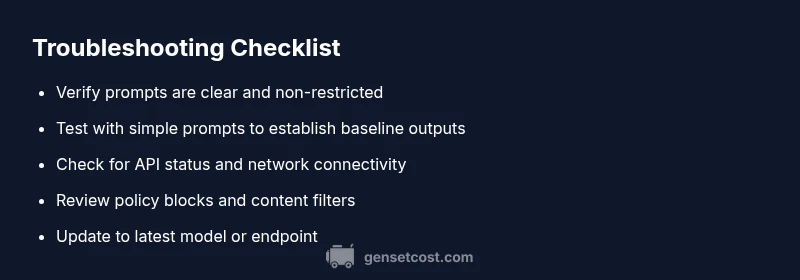
Adopt a structured diagnostic approach so you can reproduce issues, identify root causes, and implement fixes with confidence. Start with the simplest check (prompt clarity), then move to policy checks, then system health, and finally model updates. Keep a log of prompts and outcomes to detect patterns. When problems persist beyond basic steps, escalate to professional support for deeper investigation or API-level remediation.
Prevention and best practices: how to avoid repeat issues
Prevention is better than cure. Build a repeatable workflow that combines prompt engineering templates, a standard testing regimen, and a status-tracking process. Use versioned prompts, maintain a changelog of edits, and set guardrails to catch drift early. Schedule periodic reviews of prompts and model capabilities to stay aligned with evolving features. A proactive approach reduces downtime and improves reliability when you need visuals fast.
Steps
Estimated time: 30-45 minutes
- 1
Check the prompt for clarity
Review the prompt to ensure the subject, style, and mood are explicit. Remove ambiguity and keep the core intent intact. If results are off, refine one element at a time and run a quick test.
Tip: Use a prompt template to standardize language across projects. - 2
Test with a simple baseline prompt
Run a minimal prompt to establish a baseline; compare the output against expectations. If the baseline works but the complex prompt fails, the issue is likely added constraints or drift in the extended prompt.
Tip: Document baseline outputs for future comparisons. - 3
Check safety filters and policy flags
Look for warnings or refusals indicating policy constraints. Adjust wording to comply while preserving intent, and test incrementally.
Tip: Keep a copy of the original prompt for reference during iteration. - 4
Inspect model health and endpoint status
Verify that the service is up, there are no outages, and your access tokens are valid. Retry after a short cooldown if you see timeouts.
Tip: Subscribe to status alerts if available. - 5
Experiment with style and resolution
Ask for different styles or resolutions to assess model flexibility. If outputs are consistently off, consider alternative prompts or modes.
Tip: Use versioned prompts to track what works best. - 6
Escalate when needed
If issues persist beyond reasonable retries, contact support with your prompt samples, output IDs, and timestamps.
Tip: Provide exact error messages and user id so faster triage occurs.
Diagnosis: User reports ChatGPT image generator failing to produce any image or returning error messages.
Possible Causes
- highPrompt with restricted content
- highNetwork or API outage
- mediumRate limiting or token exhaustion
- lowModel version mismatch or deprecated endpoint
Fixes
- easySimplify prompt to non-restricted content and retry
- easyCheck API status page and retry after a few minutes
- mediumPause requests to avoid rate limits; rotate keys if applicable
- mediumUpdate to latest model version and reauthorize tokens
People Also Ask
Why is ChatGPT image generator not producing any image?
This can be due to a policy block, an input that violates constraints, or a temporary service outage. Start with a simple prompt, check for policy warnings, and verify service status. If still failing, test with a baseline prompt and retry later.
If you’re seeing no image, first check for policy blocks and test a simple prompt. Then verify service status and retry after a short wait.
How can I improve image accuracy to match the prompt?
Sharpen your prompts by defining subject, style, and composition clearly. Add constraints like lighting, color palette, and camera angle, then run iterative refinements to converge on the desired output.
Be explicit about subject, style, and composition, then refine the prompt step by step.
What should I do if outputs are slow or time out?
Check network connectivity and API status. If the service is healthy, implement a backoff strategy and space out requests to avoid rate limits. Contact support if timeouts persist.
Check connectivity and status, retry with backoff, and escalate if the problem continues.
Are safety filters personalizing my results?
Yes, safety filters can alter or block outputs. Rephrase prompts to stay within policy while preserving intent, and test multiple variations to find a compliant approach.
Filters can change results; adjust wording while keeping your goal in view.
When should I escalate to support?
If issues persist after testing baseline prompts, policy adjustments, and health checks, collect prompts, outputs, timestamps, and error IDs, then contact support for a deeper investigation.
If it still fails, gather details and reach out to support for help.
Can I automate troubleshooting for image generation?
Yes, create a lightweight checklist and script common prompts to compare results over time. Automation helps you detect drift and ensures consistent testing.
Automate checks to catch drift and maintain consistency.
Watch Video
Key Takeaways
- Identify prompts and policy constraints first
- Test with baselines to spot drift quickly
- Monitor service health and rate limits
- Escalate with evidence when needed
- Build a repeatable troubleshooting workflow