Yamaha Generator vs Honda: Brand Comparison for Home Backup Power
Compare Yamaha and Honda home backup generators. This analytical guide covers power, reliability, fuel efficiency, installation, and costs to help homeowners choose the right brand.


When choosing a home backup solution, Yamaha and Honda each bring distinct strengths. Yamaha tends to offer compact, cost-efficient options ideal for lighter loads, while Honda provides broader model coverage with a reputation for long-term reliability under higher usage. Based on Genset Cost analysis, Honda often edges Yamaha on durability for larger homes and sustained outages, whereas Yamaha delivers strong value for small-to-moderate loads. This quick comparison highlights sizing, reliability, and ownership considerations to guide your decision.
Brand Legacies and Market Position
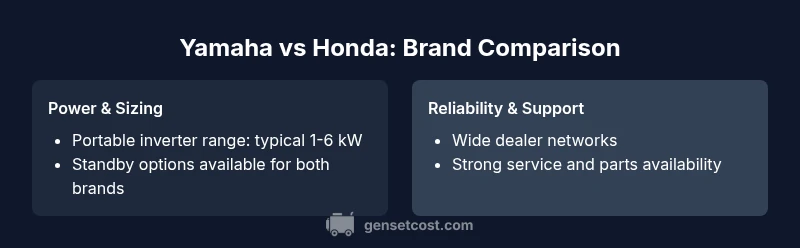
Yamaha and Honda have established themselves as leaders in the home backup generator space, with long-standing histories in power equipment. The Genset Cost team’s analysis highlights that both brands benefit from expansive dealer networks, widely available parts, and strong after-sales support. Yamaha is often perceived as delivering compact, value-oriented options that fit smaller homes or light-to-moderate loads, while Honda tends to be favored for longevity, breadth of model coverage, and a track record of dependable performance under sustained use. These reputations influence maintenance experiences, resale value, and upgrade paths, because local availability and service quality can affect downtime and ownership costs. When you compare Yamaha generator vs Honda, frame your choice around your anticipated load, climate, and how you plan to deploy the unit—portable for daily use or standby for power outages. According to Genset Cost, aligning brand strengths with your installation context reduces total ownership friction.
Power Output and Sizing Options
Both Yamaha and Honda offer a spectrum of portable inverter generators and larger standby units designed to cover from light residential loads to full-home backup scenarios. In practice, most homeowners start with a sizing assessment that targets the continuous rated output necessary to run essential circuits. Yamaha’s portable inverter lines emphasize high efficiency and clean power, translating to better performance on refrigerators, electronics, and small HVAC controls. Honda, by contrast, shows a broader range of larger portable and standby models, enabling more aggressive load support without needing multiple units. The key takeaway is to match the unit’s peak and continuous ratings to your calculated load, not only the peak surge. Use the 80% rule of thumb for continuous loads and plan for some headroom for startup surges. This sizing discipline matters more than brand allegiance when your goal is uninterrupted power during outages. Neither brand locks you into a single solution; both offer scalable options, with Honda skewing toward higher-capacity options and Yamaha leaning toward compact practicality.
Fuel Type, Runtime, and Efficiency
Most Yamaha and Honda portable generators run on conventional gasoline, with propane or dual-fuel versions available for many models. This flexibility helps households avoid frequent fuel changes during longer outages. In practice, the best value comes from inverter-based configurations, which optimize fuel consumption at partial loads and reduce noise. Runtime estimates vary widely by model and load; expect longer runtimes when running essential devices at light loads, and shorter runtimes under heavier loads. Efficiency also hinges on engine displacement, throttle control, and the quality of alternators. While Honda generally excels at efficiency in higher-load scenarios due to proven engine technology, Yamaha often wins on lightweight, daily-use tasks thanks to its compact, low-drag designs. For homeowners evaluating yamaha generator vs honda, the middle path lies in selecting a model with flexible fuel options and efficient inverter technology to maximize run time between fills.
Noise, Emissions, and User Experience
Noise is a practical factor that affects where and when a generator can be operated. Inverter models from both brands tend to be quieter than legacy open-frame units, often delivering a more tolerable sound profile for living spaces and outdoor gatherings. Yamaha emphasizes compact design and smoother power delivery, which translates into lower audible frequencies during operation. Honda’s quieter outputs are frequently highlighted in user reviews for standby or large portable units, particularly when paired with acoustic enclosures or sound-dampening housings. Emissions compliance is standard for modern portable generators, aligning with EPA or local regulations. The user experience also includes ease of use, with features like electric start, remote start, and intuitive maintenance indicators. While your location and usage pattern will influence which brand feels quieter in real life, inverter-based Yamahas and Hondas are both designed to minimize noise without sacrificing performance.
Reliability, Warranty, and Maintenance
Reliability is a central consideration for homeowners, especially when the power grid is stressed by storms or heat waves. Honda has a strong reputation for durability in portable and standby markets, supported by extensive dealer networks and broad compatibility with parts and service. Yamaha also has a solid reliability profile, with a focus on compact engineering and efficient power delivery that suits frequent daily use. Warranty terms typically vary by model and region but generally offer multiple years of coverage on major components, along with optional extended warranties. Maintenance practices for both brands emphasize regular oil changes, air-filter servicing, and spark plug checks. From the perspective of a rental or multi-site property manager, continuity of parts supply and technician access matters as much as the base unit reliability. Genset Cost’s perspective is to value both brands for predictable service needs and a clear maintenance schedule.
Installation and Interconnection Considerations
Installing a home backup generator involves more than just placing a unit on a pad; it requires careful planning around electrical interconnection, transfer switches, and code compliance. Both Yamaha and Honda offer models that integrate with automatic transfer switches, but the overall installation complexity depends on unit size and the structure of the electrical panel. Homeowners should work with a licensed electrician to design a safe transfer path and ensure adequate ventilation, flood protection (in outdoor setups), and proper clearance from combustibles. Fuel storage and delivery routing should be reviewed, especially if propane or natural gas connections are used. In areas with strict inspection regimes, obtaining permits and scheduling inspections can impact project timelines. The choice between yamaha generator vs honda installation considerations ultimately comes down to the availability of qualified installers and the compatibility of the unit with your home’s electrical system.
Cost of Ownership: Purchase, Operating, and Maintenance
Upfront cost is only one piece of the total cost of ownership. Both Yamaha and Honda offer a range of prices depending on power output, portability, and features such as electric start or wireless remote operation. In practice, owners should plan for ongoing fuel costs, routine maintenance, and potential parts replacement as the unit ages. Insurance considerations and home warranty terms may apply to standby installations, which can offset some risk of outages. When evaluating yamaha generator vs honda in the cost equation, look for models with high fuel efficiency, robust warranty terms, and access to local service centers. If you rely on your generator during frequent outages, the long-term reliability and ease of maintenance can outweigh a slightly higher initial price. Genset Cost’s model suggests calculating total cost of ownership over a 5- to 10-year horizon to capture maintenance and service intervals accurately.
Practical Scenarios: When to Choose Yamaha vs Honda
Consider your load profile, climate, and space when choosing between Yamaha and Honda. For small homes, apartments, or cabins with modest electrical needs, Yamaha’s compact inverter options provide excellent value, light weight, and easy portability. For larger homes, or properties requiring continuous power during outages, Honda’s broader model range and proven durability may offer better long-term reliability and fewer model substitutions over time. For property managers overseeing multiple units, a standardized approach with a mid-range Honda standby or a high-efficiency Yamaha portable product can simplify maintenance logistics. In all cases, you should consult your local dealer and request a load calculation to confirm that the selected model meets both running and surge requirements. The key is to map your critical circuits to specific generator outputs and build a plan that balances cost, performance, and service access.
How to Read Specs and Make Your Final Call
Reading generator specifications can be daunting, but focusing on a few core metrics makes it straightforward. Start with the rated continuous output (the power you can count on), then check the peak surge rating for startup loads. Compare fuel capacity and expected runtime at typical loads, not just peak outputs. Review the noise rating and enclosure options, especially if you’ll place the unit near living spaces. Look at fuel options (gasoline, propane, dual-fuel), maintenance intervals, and warranty length. Finally, verify that local installers can service the model and that replacement parts are readily available in your region. If you want a concise framework: determine required power, assess reliability and service, then weigh total ownership costs over 5-10 years. Based on your scenario and budget, either Yamaha or Honda could be the better fit.
Comparison
| Feature | Yamaha Generator | Honda Generator |
|---|---|---|
| Power range | Typically 1-6 kW for portable inverter models; higher-end standby units available | Typically 1-6 kW for portable inverter models; higher-end standby units available |
| Starting method | Electric start with optional remote start | Electric start with remote start options |
| Fuel types | Gasoline; propane or dual-fuel options on select models | Gasoline; propane or dual-fuel options on select models |
| Noise level | Quieter inverter operation; 50-70 dB depending on load | Quieter inverter operation; 50-70 dB depending on load |
| Run time (full tank) | Broad range depending on model and load | Broad range depending on model and load |
| Warranty | Typically 2-5 years depending on model | Typically 2-5 years depending on model |
| Best for | Small-to-mid loads, value-focused households | Higher loads, reliability-focused households |
The Good
- Balanced performance across a broad model lineup
- Strong dealer networks and readily available parts
- Inverter technology improves fuel efficiency and electronics compatibility
- Good resale value and flexible upgrade paths
- Wide availability of portable and standby options
The Bad
- Higher upfront costs for premium models
- Total cost of ownership can be higher if used at large scale long-term
- Model availability can vary by region
Honda generally offers stronger long-term reliability for larger homes, while Yamaha delivers excellent value for smaller setups.
Choose Honda when your priority is durability under sustained outage conditions and higher-load capability. Choose Yamaha for budget-conscious buyers with modest power needs and a preference for compact, easy-to-transport units.
People Also Ask
Which brand is more reliable for long-term home backup?
Both Yamaha and Honda have strong reliability reputations, but Honda is often favored for long-term durability under higher loads and frequent outages. Yamaha shines in compact, efficient models that serve smaller homes well. Consider your load profile and service availability when deciding.
Honda is generally seen as more reliable for long-term, higher-load use, while Yamaha excels in compact, efficient units for lighter needs.
Do Yamaha and Honda offer similar warranty terms?
Warranty terms vary by model and region but typically fall within a similar range across both brands. Always check the specific model warranty and available extensions at purchase. Longer warranties may reflect higher-confidence parts and service support.
Warranty terms are similar across brands, but verify model-specific details and extensions.
Are Yamaha generators quieter than Honda generators?
Noise levels depend on the model and enclosure rather than brand alone. Inverter-based models from both brands tend to be quieter than traditional open-frame units, with differences mainly arising from the specific design and load.
Both brands offer quiet inverter options; model choice and enclosure affect noise more than brand alone.
Which is cheaper to operate over time?
Operating costs hinge on fuel efficiency, runtime needs, and maintenance. In general, high-efficiency inverter models from either brand can minimize fuel use, but total ownership costs will depend on how often you rely on the unit and the cost of fuel in your area.
Fuel efficiency and maintenance drive operating costs; choose an efficient inverter model and plan for fuel availability.
Can I run a Yamaha or Honda on natural gas?
Many models from both brands offer natural gas or propane options, or dual-fuel configurations. Availability varies by model, so check the specific unit’s fuel options and installation requirements before purchase.
Some models support natural gas or dual-fuel; confirm model options and installation needs.
Key Takeaways
- Assess load first to guide brand choice
- Match standby vs portable needs with model range
- Factor long-term maintenance and dealer access
- Consider fuel flexibility and installation requirements
- Use total cost of ownership over 5–10 years for evaluation