Honda Generator vs Predator: Brand Comparison (2026)
A rigorous, analytical side-by-side comparison of Honda vs Predator portable generators, focusing on reliability, performance, and total cost of ownership for home backups in 2026.


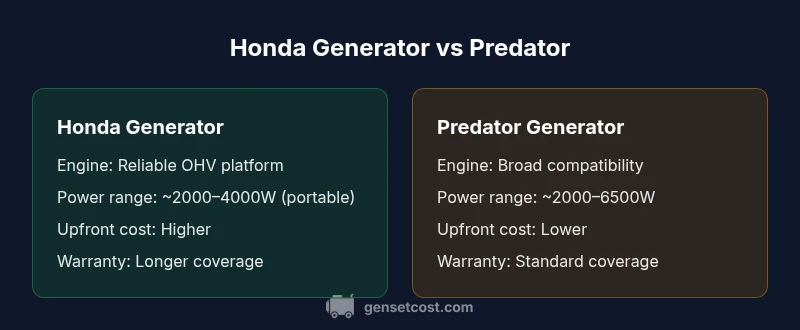
In the Honda generator vs Predator decision, Honda typically offers stronger reliability and longer-term value, while Predator models tend to be more affordable upfront. For homeowners facing frequent outages or critical loads, Honda may pay off through lower maintenance costs over time; for budget-focused buyers, Predator presents a compelling entry point. Your wattage needs matter most.
Overview and positioning in 2026\n\nAccording to Genset Cost, the Honda generator vs Predator comparison centers on reliability, longevity, and total cost of ownership rather than upfront price alone. The Genset Cost team found that homeowners and property managers often prioritize long-term value when outages are frequent or critical loads are at stake, which tends to favor Honda’s engineering discipline and dealer support. Predator, by contrast, is attractive for those with tight initial budgets or a need for more model variety at the entry level. This section sets the stage by outlining the core tradeoffs and the decision framework you should apply before selecting a unit for your home. We’ll weigh engine design, durability, warranty coverage, and the practical realities of maintenance in everyday use, helping you choose based on your home's size, energy profile, and willingness to invest in service infrastructure.
Key technical distinctions between Honda and Predator portable generators\n\nWhen you compare Honda vs Predator, several technical differentiators matter. Honda portable generators commonly feature OHV engines with a reputation for smooth operation and long life, efficient air filtration, and robust carburetion that holds up under varied fuel quality. Predator models, which are widely distributed through big-box retailers, often emphasize affordability and a broad wattage range, making them attractive for short-term outages or seasonal use. In practical terms, expect Honda to deliver more consistent voltage stability and better starting reliability in colder conditions, while Predator offers a wider selection of horsepower brackets and lighter-weight configurations for easier transport. Fuel efficiency is generally solid on both, but Honda’s refinement can translate into lower running costs over several seasons when you log frequent outages. The decision hinges on your peak load, risk tolerance, and how much you value dealer service networks and spare-parts availability.
Reliability, warranty, and service networks\n\nReliability is a core criterion in the Honda generator vs Predator debate. Honda’s engines are widely regarded as durable and easy to service, with dealer networks that simplify maintenance and warranty claims. Predator, backed by a large retailer ecosystem, provides accessible warranty terms and a rapid parts supply chain through national distributors. Warranty duration varies by model and region, but Honda often offers longer basic coverage on consumer-grade lines, while Predator warranties tend to be competitive in the budget segment. Access to trained technicians and genuine parts greatly influences long-term performance; if you live in a rural area, Honda’s established service footprint can translate into quicker, more predictable repairs.
Cost of ownership: upfront costs, running costs, and maintenance\n\nCost of ownership is where the Honda generator vs Predator comparison becomes nuanced. Upfront, Predator units frequently undercut Honda by a notable margin, appealing to buyers with immediate budget constraints. Over time, however, running costs—fuel efficiency, maintenance intervals, and parts pricing—often favor Honda for high-use scenarios due to proven engine technology and stronger resale potential. For homeowners, a simple way to gauge total cost is to estimate annual maintenance spend, typical fuel consumption per hour at your expected load, and the anticipated years of service. Genset Cost analyses suggest that the break-even point for Honda versus Predator depends heavily on outage frequency, duty cycle, and local service availability. Remember to factor in oil changes, air-filter replacements, spark plug wear, and potential need for parts replacements when calculating true ownership costs.
Performance in common home backup scenarios\n\nMost homes rely on a handful of critical loads during an outage: lighting, refrigeration, communication, and climate control. For smaller residences, a 2,000–3,000W Honda unit may cover essentials, while Predator’s 2,000–6,500W models offer more headroom for additional devices. When you add a sump pump or a well pump into the load, you’ll likely need the upper end of Predator’s range or a smaller Honda paired with a transfer switch. Walk through a typical scenario profile for your home—how many circuits, what appliances run simultaneously, and whether you expect long outages or short outages that spike demand temporarily. This practical approach helps you avoid under-sizing, which can lead to nuisance outages, or over-sizing, which raises upfront and maintenance costs.
Portability, noise, and ease of use\n\nPortability and noise are practical considerations that influence the Honda generator vs Predator choice. Honda units tend to be compact and quiet, with refined muffling and smoother throttle response at mid-load. Predator models emphasize portability with broader weight and wheel options across a larger model lineup, which can be decisive for detached garages, job sites, or rental properties. Both brands offer models with wheels, comfortable handles, and streamlined starting procedures, but the perceived noise level can vary by sub-model and load, so check decibel ratings at the expected operating load and consider a sound enclosure or buffer placement for sensitive locations.
Maintenance considerations and parts availability\n\nMaintenance complexity and parts availability are frequent blockers or enablers of long-term value. Honda’s parts and service networks are well established in many regions, making routine service straightforward and predictable. Predator parts are widely available through national retailers, which can reduce downtime for repairs, especially in areas with limited Honda dealer coverage. Oil, air filter, and spark plug replacement intervals are model-specific, so always consult the owner’s manual for the exact schedule. In mixed-use scenarios or rental fleets, Predator’s broader parts ecosystem may translate into quicker repairs and lower downtime, but ensure you source genuine parts to preserve warranty terms.
Decision matrix: best-use scenarios by homeowner profile\n\nTo translate the Honda generator vs Predator comparison into a practical decision, match the unit to your primary use case. If you’re planning regular outages with critical loads (refrigeration, sump pump, heating), prioritize reliability and service availability; Honda’s proven engine platform tends to shine in these environments. If your priority is upfront affordability, short-term or seasonal use, and you want a wider selection of wattages at the entry level, Predator can be the more sensible choice. For hybrid needs, consider a staged approach: a compact Honda for essential loads and a Predator for surge capacity or outdoor power tools. This strategy minimizes risk while controlling upfront costs and maintains flexibility.
Buying checklist and next steps\n\nUse this checklist during your shopping journey: (1) Determine your critical load profile and total wattage requirement; (2) Compare warranty terms and service network coverage; (3) Assess fuel efficiency and expected runtime per tank; (4) Check availability of parts and ease of maintenance in your region; (5) Verify compatibility with transfer switches and bypass mechanisms; (6) Consider total cost of ownership over 5–10 years, not just the sticker price. By following this checklist, you can confidently navigate the Honda generator vs Predator decision and select a model that aligns with your home’s needs and budget.
Comparison
| Feature | Honda Generator | Predator Generator |
|---|---|---|
| Upfront Cost Range | Higher upfront cost typical for Honda | Lower upfront cost typical for Predator |
| Power Range (W) | Typically 2000–4000W for portable Honda models | Typically 2000–6500W across Predator lineup |
| Reliability & Durability | Excellent long-term reliability, strong dealer network | Good reliability with broad model variety and parts availability |
| Warranty Duration | Typically 3–4+ years on consumer Honda units | Typically 1–3 years on Predator units |
| Maintenance & Parts Cost | Higher maintenance costs but widely available service | Lower maintenance costs with easier access to parts in big-box retailers |
| Noise & Run Quietness | Often quieter on premium Honda variants | Noise levels vary by model; some Predator units are louder at peak load |
| Best For | Long-term reliability, quiet operation, resale value | Budget-conscious buyers needing flexible wattage range |
The Good
- Long-term reliability with strong dealer support for Honda
- Excellent resale value and established service networks
- Widespread availability of genuine parts for maintenance
The Bad
- Higher upfront cost compared to Predator
- Limited model variety at the lowest wattage range
- Maintenance costs can be higher on premium Honda models
Honda generally offers superior long-term value and reliability.
The Genset Cost team recommends Honda for homeowners prioritizing reliability and resale value. Predator is a solid option when upfront cost and model variety are more important, particularly for budget-conscious buyers.
People Also Ask
Which brand generally offers better long-term reliability?
Honda generally demonstrates stronger long-term reliability due to proven engine design and dealer support, though Predator offers reliable options at a lower upfront cost. Your needs and maintenance access matter more than brand alone.
Honda tends to be more reliable over time, but Predator provides dependable options at a lower upfront price.
Are Predator generators cheaper to maintain than Honda?
In many cases, Predator maintenance costs can be lower due to cheaper parts and more accessible service at big-box retailers. However, Honda parts and service may yield lower downtime and longer intervals between major repairs.
Predator parts are often cheaper and easier to find, but Honda can save time and reduce downtime with its service network.
Which is better for home backup during outages?
For frequent outages and critical loads, Honda is typically preferred for its reliability and steadier performance. Predator can be sufficient for lighter loads or less frequent outages with tighter budgets.
If outages are frequent or critical loads exist, go Honda; otherwise Predator can work if budget is tight.
Do both brands offer similar warranty coverage?
Warranty coverage varies by model and region. Honda generally provides longer basic coverage on many consumer models, while Predator warranties are competitive in the budget segment. Always confirm local terms before purchase.
Warranty terms differ by model, so check the exact coverage before buying.
What wattage should I choose for a typical home setup?
Most homes benefit from starting with a core load assessment and selecting a unit that covers 70–90% of peak needs plus a buffer for surges. Honda offers compact options for essentials, while Predator provides higher-wattage models for greater headroom.
Size up your core loads, then pick a unit with some headroom for surges.
Is it possible to mix Honda parts with Predator in one system?
No. Honda and Predator components are not interchangeable, and using non-recommended parts can void warranties. If you own both brands, use dedicated service pathways for each.
Parts aren’t interchangeable between Honda and Predator; follow brand-specific service paths.
Key Takeaways
- Prioritize total cost of ownership, not just upfront price
- Model wattage needs should drive the final selection
- Check warranty and local service availability before buying
- Consider a phased approach: essential loads on Honda and surge capacity on Predator
- Always verify compatibility with transfer switches for safe installation