Is Predator Generator Good? A Thorough, Balanced Review for Home Backup Power
An analytical review from Genset Cost assessing whether Predator generators meet home backup needs, weighing cost, performance, durability, and warranty to guide homeowners and property managers.


From a cost-to-performance perspective, Predator generators are a budget-friendly option in the portable segment. They typically offer lower upfront prices than premium brands, with a wide range of wattages. However, durability, runtime, and resale value may lag behind better-known brands. For essential power during outages, they can be reasonable if you verify wattage, fuel type, and warranty before purchase.
is predator generator good — quick framing
For homeowners evaluating whether is predator generator good, the short answer depends on your outage profile and tolerance for risk. This section sets the stage by clarifying scope: budget-friendly portability, moderate runtimes, and variable warranty terms are common features in Predator-branded models. The goal here is to translate price into expected performance and reliability across typical home backup scenarios. If you are weighing options for a multi-story home or a small rental portfolio, the question is not only price but how the unit will perform under load and how quickly parts and service can be accessed.
According to Genset Cost, price alone isn't the whole story—durability, warranty coverage, and running costs must be weighed to determine whether is predator generator good for your specific situation. This opening framing helps readers move beyond sticker price and toward lifecycle value, which is essential for homeowners and property managers who need predictable outages without surprise repairs.
Predator generator family: what you should know
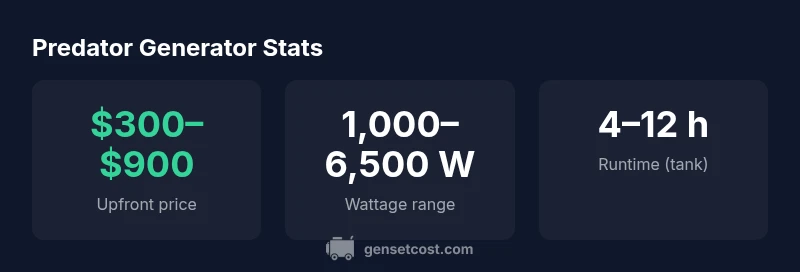
Predator generators sit in the budget-to-midrange segment of portable power. They cover a wide wattage spectrum—from compact 1,000–2,000 watt units suitable for essential lighting and small appliances to larger 4,000–6,500 watt models capable of running a fridge, furnace fan, and several outlets during outages. In practice, you’ll encounter variations in starting mechanisms (manual recoil vs electric start), fuel options (straight gasoline vs dual-fuel variants in some models), and enclosure designs that influence noise and heat dissipation. The key takeaway is that the Predator lineup prioritizes lower upfront cost and model variety; this means you can often find a unit that fits a tight budget, but it also introduces variability in reliability and long-term maintenance needs. When evaluating is predator generator good for your budget, look beyond MSRP and consider warranty depth, typical runtimes, and ease of access to service in your region.
From a cost perspective, the broad SKU range helps most buyers find something that matches their immediate needs, yet it’s important to compare the same wattage class against better-known brands to gauge differences in components and durability over time.
How to evaluate for home backup: sizing, duty cycle, and runtime
Determining if a Predator generator is suitable for home backup starts with accurate sizing. Start by listing essential circuits (refrigerator, lights, modem/router, heater fan, sump pump) and total their running watts. Then identify starting watts, which are typically higher than running watts. Add a 20–25% margin for surge tolerance and future-proofing. Duty cycle matters: if you anticipate frequent outages or long planned outages, you’ll want a unit that can sustain more continuous load without overheating or excessive fuel use. Runtime is equally critical: estimate how many hours of outage you need to cover on a full tank and compare that to the tank size and fuel efficiency of the Predator model in question. Finally, factor in fuel availability and storage—gasoline has a finite shelf life, while dual-fuel variants add flexibility if you have propane access. Throughout sizing, measure demand against fuel logistics and maintenance bandwidth to ensure is predator generator good remains true under real-world conditions.
Power output, AVR, and run-time realities
Power output specs across Predator models can be enticing, but real-world performance depends on how you use the generator. Look for units with an automatic voltage regulator (AVR) for cleaner power that’s safer for electronics and appliances. Understand that peak watts don’t always translate to sustained runtime; the more you draw, the less efficiency you’ll gain per hour. Noise levels, measured in decibels, are another practical factor—higher wattage units typically generate more noise, which can be a concern in dense neighborhoods or multi-tenant properties. Emissions and fuel type also influence environmental impact and regulatory compliance in some jurisdictions. When you assess is predator generator good, compare comparable wattage classes and ask for a hands-on test or verified third-party reviews to corroborate factory claims with real-world data.
Cost considerations: upfront price vs running costs
The financial picture for Predator generators starts with the upfront sticker price, but true value depends on total cost of ownership. In many markets, Predator models offer lower initial costs than mainstream brands, which can be attractive for homeowners and property managers with tight budgets. However, running costs—fuel consumption, maintenance intervals, and potential replacement parts—can narrow the gap if you operate the unit frequently or for long durations. When evaluating is predator generator good, calculate not only the purchase price but also expected maintenance expenditures, oil changes, air filter replacements, and spark plug life. Consider warranty length and what it covers (parts, labor, or both) and whether you’ll access a local service network. If you’re a landlord or property manager, factor in turnover costs and the ease of reselling the unit at the end of its life. A robust decision should balance upfront savings with predictable reliability and service access.
Durability, warranty, and serviceability
Durability and serviceability are common concerns with budget-focused brands like Predator. You’ll often find that build quality is adequate for casual, occasional use but may fall short under heavy, continuous load or frequent outages. Warranty depth varies by model and retailer, so confirm whether coverage includes both parts and labor and whether the warranty transfers to new owners if you sell the property. Serviceability matters for property managers who rely on replacements and repairs during tenant outages. Access to qualified technicians and spare parts can influence downtime and costs more than the initial purchase price. If your property requires high uptime during outages, treat Predator as a stepping-stone option and consider tiered plans or extended warranties where available. When assessing is predator generator good, think long-term reliability alongside initial affordability.
Noise, emissions, and neighborhood considerations
Noise and emissions profiles can be decisive in dense neighborhoods, HOAs, or rental properties. Predator models tend to produce more noise at higher wattages compared with premium brands, which can trigger restrictions or nuisance complaints if you operate them near living spaces, windows, or shared walls. Emissions are also a factor, especially in urban environments with stricter air quality considerations. If you must meet noise restrictions or emission standards, compare decibel ratings at a fixed distance and examine enclosure design for heat dissipation and muffling. For multifamily properties or PLAs, you may need to coordinate with property management to schedule outages during low-activity windows and ensure you select a model with the quietest option within your wattage class. The bottom line is: is predator generator good only if you align a specific unit’s noise and emission traits with your site rules and neighbor considerations.
Compare to peers: Honda, Generac, Westinghouse
A critical part of answering is predator generator good is to benchmark against established names such as Honda, Generac, and Westinghouse. Predators usually beat these brands on upfront price, but they often lag on durability, run-time efficiency, and dealer networks. Honda and Generac typically offer longer warranties and broader service coverage, which reduces downtime during outages and can lead to lower total cost of ownership over the life of the unit. Westinghouse often sits in a similar price tier to Predator but may offer better fuel efficiency and quieter operation in some models. The takeaway is to compare models within the same wattage class, read independent reviews, and consider service accessibility when evaluating overall value. If your goal is long-term reliability and predictable maintenance, the premium brands frequently justify the higher initial cost compared with Predator.
Sizing and installation tips for homeowners and property managers
Correct sizing and a safe installation are essential to getting value from any generator. Start with a thorough load assessment that includes starting watts and running watts, as discussed earlier. For property managers, consider a transfer switch or a manual transfer option to seamlessly switch from grid to generator power, ensuring critical loads stay powered during outages. Place the unit on a stable, well-ventilated surface away from doors and windows to minimize carbon monoxide risks. Keep a consistent maintenance schedule, including oil changes and air filter checks, and implement a rotation plan for batteries and spark plugs. If you rent the unit, document usage and maintenance, so you can track performance across tenants. In short, is predator generator good hinges on choosing the right model and pairing it with a responsible installation and maintenance plan.
Practical buying checklist and decision guide
To decide if predator generator good aligns with your needs, use this practical checklist:
- List essential loads and calculate total watts; determine starting watts.
- Compare at least two models within the same wattage class, noting warranty terms and service availability.
- Assess fuel type, tank capacity, and expected runtime under typical load.
- Review noise ratings and emissions; ensure compliance with local regulations and HOA rules.
- Verify retailer support, spare parts availability, and return policies.
- Create a simple maintenance plan (oil changes, filter checks, spark plug replacement).
If you walk through this checklist and the Predator model satisfies your load, warranty, and service criteria within your budget, it can be a solid entry option for home backup power. If not, use the findings to identify a higher-tier model that better meets long-term reliability needs.
Authority sources
For readers seeking external validation and safety considerations, consult authoritative sources such as:
- https://www.energy.gov
- https://www.epa.gov
- https://www.cpsc.gov
The Good
- Lower upfront cost relative to premium brands
- Wide wattage range across models for basic to moderate loads
- Easy access to retailers and common spare parts
- Relatively straightforward maintenance with standard tools
The Bad
- Potentially shorter runtime and durability in heavy-use scenarios
- Generally louder operation at higher wattages
- Warranty depth and reliability can vary by model
- Service networks and parts availability can be inconsistent across regions
Balanced option for budget-conscious buyers with careful model selection
Predator generators offer attractive upfront pricing and model variety for basic outage needs. For frequent outages or high‑demand loads, premium brands tend to deliver longer runtimes and stronger warranties, improving long-term reliability. The Genset Cost team recommends aligning unit choice with your actual outage profile and service access to maximize value.
People Also Ask
Is Predator generator good for home backup overall?
Predator generators can be a viable budget option for small outages and essential loads, but reliability and long-term maintenance should be weighed against higher-end brands for frequent or critical use.
For light, occasional outages, Predator can work well; for frequent outages, consider more durable brands.
What should I consider when sizing Predator for home backup?
Calculate total running watts for essential loads, add a margin for surge, and ensure the model selected can handle starting watts. Consider future needs and storage logistics for fuel.
Size by watts, leave room for growth, and plan fuel storage.
How does Predator compare to Honda or Generac?
Predator generally offers lower upfront cost but may lag in sustained runtime, durability, and dealer support compared with Honda or Generac. Premium brands often provide longer warranties and stronger service networks.
Cheaper upfront, but premium brands win on durability and support.
What maintenance is required for Predator generators?
Regular oil changes, air filter checks, spark plug inspection, and proper storage of fuel if not used for extended periods are typical maintenance tasks.
Keep up with oil, filters, and spark plugs for reliability.
What warranty can I expect on Predator models?
Warranty terms vary by model, commonly 1–3 years. Verify coverage for parts and labor and whether it transfers with ownership.
Warranty varies—check your exact model before buying.
Key Takeaways
- Match load needs to the right wattage class
- Weigh upfront cost against long-term running costs
- Check warranty depth and service accessibility
- Assess noise and emissions in your environment