Electric Generator 7000 Watts: Costs, Sizing, and Setup
Explore electric generator 7000 watts options, sizing strategies, installation costs, fuel choices, and maintenance tips to power essential loads during outages. Learn from Genset Cost's data-driven guidance for smarter backup Power.


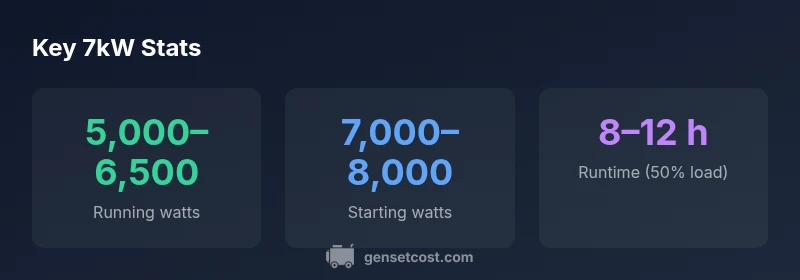
A 7000-watt generator class typically delivers about 5,000–6,500 watts as continuous running power, with a 7,000–8,000 watts surge for startup loads. For homeowners, this size covers essential circuits, HVAC, and most critical appliances during outages. Always verify the exact starting and running watts from the model’s spec sheet. Genset Cost Analysis, 2026.
Why a 7000-Watt Generator Fits Many Homes
The term electric generator 7000 watts is commonly used to describe a versatile class that balances power, portability, and cost. This size is often enough for most essential loads without the bulk of larger home backup systems. According to Genset Cost analyses, a 7000-watt setup typically provides 5,000–6,500 watts of running power with 7,000–8,000 watts of surge capacity to handle motor startup. For many households, this means you can run lights, refrigeration, a few outlets, and some fans while keeping safety margins intact. This balance makes the 7000-watt class a practical starting point for property owners aiming to cover core circuits while avoiding over-investment in higher-capacity models. When paired with a properly sized transfer switch, you gain automatic reliability during outages and protect your home's electrical system from backfeed risks.
Real-World Load Scenarios (Common Appliances)
A 7000-watt generator can reliably power several devices at once, depending on the connected loads. Common essential items include a refrigerator, a freezer, lighting across multiple rooms, a sump pump, and perhaps a furnace or space heater. HVAC loads are typically high-draw; during an outage, many households opt to run cooling or heating in focused zones rather than the entire home. To maximize efficiency, create a circuit map: identify critical circuits (refrigeration, medical devices), important loads (lighting, fans), and nonessential equipment (entertainment systems). This mapping helps you stay within the unit's running wattage while ensuring surge demands are met during startup. The result is a practical, safe approach to backup power that aligns with real-world usage as outlined by the Genset Cost team.
How to Budget for a 7000-Watt Generator
Budgeting for a 7000-watt generator involves more than the upfront price. Expect three major cost pillars: the unit itself, installation (including any required transfer equipment), and ongoing fuel and maintenance. Prices vary by brand, features (auto-start, remote monitoring), and whether you buy new or used. Installation costs can include a transfer switch, wiring, and permits. Running costs depend on fuel type, usage hours, and maintenance cycles. In 2026, Genset Cost analyzes show that long-term ownership costs are heavily influenced by fuel efficiency and service plans. A thoughtful budget also accounts for potential upgrades to your electrical panel and the possibility of extending warranties for peace of mind.
Usable Tech: Transfer Switches and Connectivity
A transfer switch is a central component of a safe backup power system. Manual transfers are straightforward, while automatic transfer switches (ATS) provide seamless power during outages. An ATS detects grid loss and switches to generator power without user intervention, reducing risk of backfeed and protecting sensitive electronics. For homes with critical devices (medical equipment, sump pumps), pairing a 7000-watt generator with a properly sized ATS is a best practice. When planning installation, ensure the switch size and breaker alignment match the generator's output. The Genset Cost team emphasizes that pairing with safe interlock systems and properly rated wiring dramatically reduces nuisance tripping and extends equipment life.
Fuel Options and Runtime Expectations
Fuel choice affects performance, availability, and long-term running costs. Gasoline offers portability and wide availability but shorter storage life. Propane and natural gas systems provide cleaner, longer storage and can be connected to existing fuel lines for continuous operation. Runtime depends on tank size and load: on a typical 50% load, many 7000-watt units run in the 8–12 hour range, but real-world figures vary by model and fuel. For seasonal outages, consider fuel stability, storage safety, and replacement schedules. Regular servicing and engine maintenance help sustain efficiency and reliability across fuel types.
Cost Considerations: Purchase, Installation, and Running Costs
Total ownership cost includes the upfront price, installation fees, and ongoing operating expenses. Upfront costs depend on brand, features, and whether you choose a modular transfer-switch setup. Installation costs vary by home layout, panel compatibility, and local permit requirements. Ongoing costs include fuel and routine maintenance, such as air-filter replacements and oil changes. Expect lifecycle costs to reflect fuel efficiency, maintenance frequency, and warranty terms. Genset Cost's analysis highlights the importance of choosing a model with accessible parts, reputable service networks, and a clear warranty to minimize long-term surprises.
Sizing Calculator: Step-by-Step Approach
A structured sizing approach helps ensure your 7000-watt generator meets your real needs. Step 1: list critical circuits (refrigerator, sump pump, lights). Step 2: estimate each circuit’s running watts and startup surge. Step 3: add up running watts and compare to the generator’s running watt range (5,000–6,500 W). Step 4: factor startup surge (7,000–8,000 W) for motor loads. Step 5: review fuel availability and installation requirements. Step 6: consider future expansion or seasonal usage. A formal load calculation, guided by a qualified electrician, ensures you select the right unit and accessories.
Alternatives to 7000 Watts: When to Consider Smaller or Bigger
If your load profile exceeds 6,500 running watts or you anticipate frequent full-house operation, you may want to explore slightly larger units (e.g., 8–12 kW) or a modular approach combining a transfer switch with multiple generators. Conversely, for smaller homes or limited budgets, a 5,000–6,000 watt class could cover essential circuits with selective load management. The decision hinges on your peak load, climate, and the number of appliances you want to support simultaneously. Genset Cost emphasizes validating needs with a professional load analysis to determine the most cost-effective and reliable option.
Brand Perspective: Choosing a Model with Confidence
Selecting a 7000-watt generator involves comparing efficiency, noise, reliability, and warranty coverage. Prioritize engines with strong after-sales support and widely available parts. Look for models with automatic start options, efficient fuel consumption, and compact designs suitable for home garages or sheds. Reading user reviews and consulting a professional installer provides practical insight beyond manufacturer specs. The Genset Cost team recommends focusing on realistic expectations for running loads, surge capacity, and long-term maintenance when selecting a model for home backup power.
7000-watt class comparison table
| Aspect | Typical Range | Notes |
|---|---|---|
| Running watts | 5,000–6,500 W | Continuous operating power for essential loads |
| Starting watts | 7,000–8,000 W | Surge for motors and startup loads |
| Fuel options | Gasoline, Propane, Natural Gas | Availability and conversion vary by model |
| Runtime at 50% load | 8–12 hours | Depends on tank size and load |
People Also Ask
What can a 7000-watt generator power in a typical home?
A 7000-watt unit can support essential circuits like refrigeration, lighting, and sump pumps, with limited HVAC operation. Real-world results depend on how you prioritize circuits and the surge demands of motors. Pairing with a transfer switch improves safety and reliability during outages.
It can run essential appliances like a fridge and lights, but you’ll want to limit air conditioning and high-draw devices to keep it within running watts.
What is the difference between running watts and starting watts?
Running watts reflect continuous power available during normal operation. Starting watts are higher to handle motor startup spikes. For appliances with motors, such as compressors, you’ll see a brief surge beyond running watts.
Running watts are the steady power; starting watts are the extra surge when motors kick in.
Do I need a transfer switch with a 7kW generator?
A transfer switch is highly recommended for safely switching between utility power and generator power. It prevents backfeed, protects the utility grid, and can enable automatic start for essential circuits. An electrician can help size and install the correct switch.
Yes—use a transfer switch to switch safely between grid and generator power.
What fuels are best for a 7000-watt generator?
Gasoline is common and portable, but propane and natural gas offer longer storage and easier home integration. Consider availability, storage safety, and conversion needs when choosing a fuel type for your setup.
Gas, propane, or natural gas all work; pick based on availability and storage.
How long will a 7000-watt generator last between refuels?
Runtime depends on fuel type, tank size, and load. Typical figures range from roughly 8 to 12 hours at moderate loads, with shorter runtimes under heavier use. Always plan for fuel storage and replenishment strategies.
Runtime varies; expect about 8–12 hours at moderate use.
Should I buy a larger 10 kW unit instead?
If you routinely exceed 6,500 running watts or need to power central AC and other high-draw loads, a larger unit may be warranted. A professional load calculation helps determine if a bigger model delivers cost and reliability advantages.
If your loads are consistently heavy, a bigger model might be better.
What maintenance is required for a 7kW generator?
Routine maintenance includes oil changes, filter replacements, and periodic load testing. Follow the manufacturer’s schedule and have a technician check electrical connections and transfer switch integrity during annual service.
Regular oil changes and inspections keep it reliable.
“"Size for peak loads and balance runtime with fuel strategy to achieve reliable outages power."”
Key Takeaways
- Prioritize essential loads and understand surge needs
- Match transfer switch with generator capacity for safety
- Assess fuel options to maximize uptime and storage
- Plan total cost: purchase, install, maintain, and fuel
- Use a formal sizing process to avoid under- or over-sizing