Generator 3500: Costs, Sizing, and Installation Guide
A data-driven, practical guide to 3500-watt generators, covering sizing, costs, fuel options, and safe installation for homeowners and property managers.


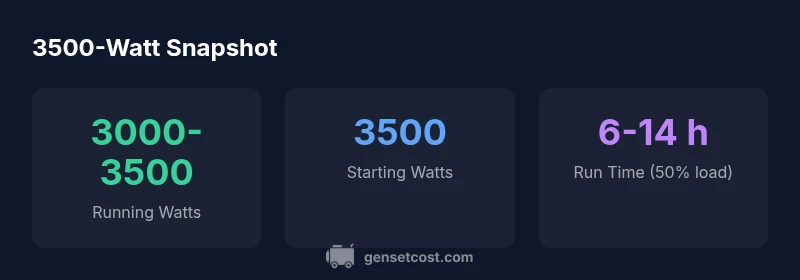
With a generator 3500, you typically get about 3000 running watts and 3500 starting watts, enough to power essential loads during an outage. This size balances portable convenience with real backup capability, letting a fridge, sump pump, and several lights run simultaneously. Homeowners should verify transfer-switch compatibility and expected run-time before purchase.
Understanding the 3500-Watt Benchmark
A generator labeled 3500-watt sits in a commonly used range for home backup power. At this size, most units provide roughly 3000-3500 running watts and around 3500 starting watts, depending on design. The distinction between running watts (continuous power) and starting watts (surge) matters for what you can run at once. This section explains how to interpret the numbers, why surge matters when starting motors, and how to estimate your home's essential load. When researching options, focus on usable running watts for the appliances you plan to power and verify that the unit can handle your heaviest startup loads without shutting down. The goal is to avoid overload while ensuring critical circuits stay energized during outages. As you compare models, consider how transfer switches, panel compatibility, and efficiency affect real-world performance. The generator 3500 category strikes a balance between portability and capacity, fitting many homes or small multi-unit properties that face occasional outages.
Load sizing and what a 3500-watt generator can power
Determining what a 3500-watt unit can run requires listing your essential loads and matching them to their wattage. A typical fridge runs around 600-800 running watts, with a startup surge that can reach 1200-1800 watts. A sump pump commonly draws 800-1200 watts when starting. LED lighting for a small living area might use only 100-300 watts total, while a modem, router, and streaming devices add another 40-100 watts. A well pump or ceiling fans add 200-600 watts combined. A window AC unit can vary widely, but most 5,000 BTU units run around 800-1200 watts. The key practice is to total your must-run items and compare that sum to the available 3000-3500 running watts. You’ll likely power a fridge, some lights, a router, and perhaps a sump pump, but you’ll limit heavy loads like an electric dryer or main air conditioner unless you step up to a larger unit or use load-shedding strategies. Plan for surge when several devices start together.
Fuel options, efficiency, and running costs
Most 3500-watt generators offer gasoline as the standard fuel, with propane or dual-fuel variants available. Gasoline tanks commonly provide enough fuel for 6-12 hours of operation at half-load, depending on tank size and engine efficiency. Dual-fuel models offer flexibility during supply shortages but may slightly reduce runtime or efficiency when switching fuels. Propane storage is easier in many homes and has long-term stability, but propane energy content per gallon is lower than gasoline, affecting runtime. Inverter-based units can offer cleaner power for electronics and often run quieter at light loads, though they may have higher upfront costs. To assess running costs, estimate your expected hours per outage and multiply by your local fuel price to obtain a rough annual or per-outage expense. Always use fresh fuel and follow manufacturer maintenance intervals to maximize efficiency and longevity.
Portable vs standby: choosing the right 3500-watt option
Portable 3500-watt generators are typically lighter, require manual setup, and run on fuel you refuel during outages. They are ideal for renters or limited storage space, and they scale well with a simple transfer switch for safe home connections. Standby or permanent-mount units wired into your electrical system provide automatic transfer and immediate power when the grid fails, but come with installation cost and permitting requirements. If you are evaluating costs, portable units often fall in the $500-$1,500 range, while dual-fuel portable options may stretch to $1,000-$1,500. Standby 3500-watt systems can range from $2,000 to $4,500 depending on terrain, wiring, and code requirements. Carefully consider your outage frequency, space, and how many circuits you want to support. A well-chosen 3500-watt model paired with a proper transfer switch offers a balance of resilience and affordability.
Installation considerations and integration with home electrical system
Choosing a 3500-watt generator is only part of the puzzle; you must plan for safe and code-compliant installation. A transfer switch or interlock kit is essential to prevent backfeeding the grid and to manage loads. Hire a licensed electrician to size the service panel, determine the appropriate breaker count, and verify available spare capacity. If you opt for a permanent standby unit, consider whether a manual or automatic transfer switch best matches your outage profile and how long the generator will take to start after a power loss. Keep in mind space for exhaust, proper venting, and fuel storage safety. When estimating total cost, include the cost of permits, wiring, transfer switches, and possible routine maintenance contracts. A careful installation reduces risk and ensures your 3500-watt setup provides reliable backup when you need it most.
Maintenance, longevity, and buying tips
Regular maintenance extends the life of any 3500-watt generator. Change the oil and filter at the manufacturer’s recommended intervals, replace spark plugs as needed, and keep the air filter clean for efficient combustion. Run the unit periodically to prevent fuel varnish buildup and to confirm mechanical operation. Store fuel in approved containers and rotate supplies to avoid stale fuel. When buying, compare warranties, available fuel types, run-time at typical loads, and ease of maintenance access. Look for models with integrated overload protection and low-oil shutdown. Finally, plan your sizing with a calculator or a sizing guide to ensure you pick a unit that meets your essential loads without overspending. By following best practices, your generator 3500 will serve as a dependable part of your home’s resilience strategy.
Comparison of 3500-watt generator types
| Model Type | Running Watts | Starting Watts | Fuel Type | Price Range | Run Time |
|---|---|---|---|---|---|
| Portable Gas 3500-W | 3000-3500 | 3500 | Gasoline | $500-$1,200 | 8-12 hours |
| Dual-Fuel 3500-W | 3100-3500 | 3500 | Gasoline/Propane | $800-$1,500 | 8-14 hours |
| Inverter 3500-W | 3200-3500 | 3400-4000 | Gasoline | $900-$1,700 | 6-10 hours |
People Also Ask
What can a 3500-watt generator run during a power outage?
A typical 3500-watt unit can support essential appliances like a refrigerator, lights, router/modem, and a sump pump, plus a few small electronics. It’s not enough for most central air or electric dryers unless load shedding or a larger unit is used.
A 3500-watt generator can power the basics like a fridge, lights, and a router, but not large appliances simultaneously.
Do I need a transfer switch for a 3500-watt generator?
Yes. A transfer switch or interlock kit is recommended to safely connect a generator to your home's electrical system and prevent backfeeding the grid.
Yes—use a transfer switch for safe, code-compliant connection.
What is the difference between running watts and starting watts?
Running watts are the continuous power a generator can provide, while starting watts are the surge needed to start motors. The starting wattage is typically higher for short bursts.
Running watts are continuous power; starting watts are the surge needed to start devices.
Can a 3500-watt generator run a central AC?
Most 3500-watt units cannot reliably run a central air conditioner. Some window units or small air conditioners may operate, but aggressive load management or a larger generator is usually required.
Typically not for central AC; you may run small units with careful load management.
What fuels are available for 3500-watt generators?
Common options include gasoline, propane, and dual-fuel configurations. Propane storage is cleaner and more stable, while gasoline generally provides longer run-time per gallon.
Gasoline, propane, or dual-fuel are common choices; each has pros and cons.
What cost range should I expect for a 3500-watt generator?
Expect portable units to range roughly from $500 to $1,500, with dual-fuel options closer to $1,000-$1,500. Standby systems can range from $2,000 to $4,500 depending on installation requirements.
Portable: $500-$1,500; standby: $2,000-$4,500, depending on installation.
“Sizing a 3500-watt generator around essential loads and surge needs minimizes outages while keeping costs reasonable.”
Key Takeaways
- Prioritize running watts for essential loads
- Understand surge requirements for starting motors
- Plan for transfer switch installation early
- Evaluate fuel options and maintenance needs