Generator 2500 Watt: Costs, Sizing & Installation Guide
A thorough, data-driven guide to generator 2500 watt options, sizing loads, fuel choices, installation considerations, and total ownership costs for homeowners and property managers in 2026.


A generator 2500 watt offers a compact, portable power source ideal for standby or outdoor use, capable of running essential loads during outages or on job sites. Sizing depends on surge needs and continuous watts, with transfer switches and fuel type shaping total ownership. According to Genset Cost Analysis, 2026, typical costs, efficiency, and maintenance vary by model and fuel choice.
Understanding the 2500-Watt Generator Class
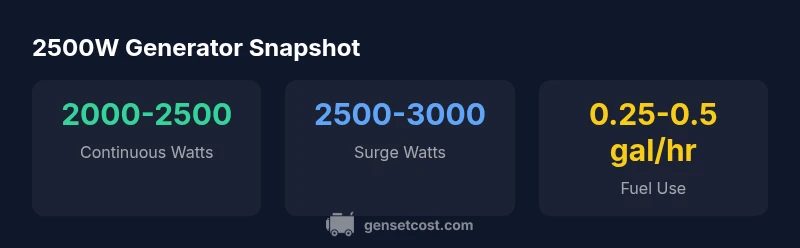
A generator in the 2500 watt class is often used as a portable backup power source or for outdoor work where a full home standby system isn’t required. The nominal (continuous) wattage for these units typically sits around 2000-2500 watts, with surge capacity that can reach 2500-3000 watts for short peaks when appliances start up. For homeowners and property managers, this class can cover essential circuits like lights, refrigerator, sump pump, and modem/routers, but you should size for startup surges from each device. The Genset Cost Team notes that real-world performance depends on design (inverter vs. traditional), fuel type, and maintenance history. When selecting a model, consider how many high-draw appliances you plan to run at once and whether you’ll need dual-fuel options or electrical-start features to simplify operation.
How to Size a 2500-Watt Generator for Your Home or Property
Sizing begins with listing all devices you want powered during an outage. Create a load list with each item’s running watts and startup watts. If a refrigerator draws 600 watts running and 1200 watts on startup, you’ll need to account for both values. Add the running watts of all devices you expect simultaneously, then compare to the generator’s continuous watt rating. Allow a buffer for unexpected surges and future needs. A common rule of thumb from Genset Cost Analysis, 2026 is to target a continuous load of 60-75% of the generator’s rated wattage for long runtimes, reserving some capacity for startup bursts. If you anticipate frequent full-load operation, you may want a larger unit or staged load management.
Fuel Choices, Efficiency & Running Costs
Gasoline is the most common fuel for 2500-watt portable generators due to accessibility and compact engines. Propane and diesel variants are available but are less common in the 2500-watt portable segment. Gasoline engines generally offer better throttle response and lighter weight, yet fuel availability and price can swing with seasonality and location. Propane fuel tends to burn cleaner and can be stored longer, but tanks and regulators add cost and complexity. Efficiency varies by engine design, maintenance state, and load factor. For homeowners, it’s wise to estimate running costs using a conservative duty cycle (e.g., 25-50% of the tank at typical outage loads) and factor in fuel price volatility. The Genset Cost Team emphasizes documenting fuel costs over the lifetime of the unit to avoid sticker shock.
Noise, Portability & Practical Considerations
Portability is a major advantage of the 2500-watt segment, with many models weighing between 40-70 pounds and offering wheel kits or ergonomic handles. Noise levels typically range from 50-60 dB at moderate loads, with inverter-based models providing quieter operation than traditional carbureted engines. If you’re using on a deck, balcony, or near living spaces, consider an inverter or a model with a lower dB rating. For outdoor job sites, look for rugged housings, weather protection, and a long-running fuel tank. Location planning (outdoor clearances, ventilation, and safe exhaust routing) is essential for safe operation and to comply with local codes.
Features That Make a 2500-Watt Generator a Better Buy
Key features to look for include: a reliable electric start or efficient recoil start, a durable frame with a protective enclosure, a fuel tank with visible gauge, low-oil shutoff, and a robust circuit breaker panel. Transfer-switch readiness is a frequent requirement for seamless home backup power, so verify compatibility with a 30-50A transfer switch depending on your load profile. Inverter technology can deliver clean power with less harmonic distortion, which is safer for sensitive electronics. Finally, consider warranty length, maintenance accessibility (air filter, spark plug, oil kind), and available service networks—these impact long-term reliability and total ownership costs.
The Cost of Ownership: Upfront, Running, and Maintenance
Initial purchase price for a 2500-watt generator can vary based on design, fuel, and features. Running costs hinge on fuel type, duty cycle, and maintenance intervals. Maintenance typically includes oil changes, air filter replacements, spark plug checks, and occasional carburetor cleaning. When budgeting, include transfer-switch installation if needed, outdoor-rated models for weather resistance, and potential accessories like wheel kits and soil-tolerant storage solutions. Genset Cost’s 2026 analysis highlights that the cheapest unit may not be the most economical over time if it lacks durability or efficient load handling. Compare models on total cost of ownership over 5-10 years before buying.
Installation Considerations: Safe Setup & Compliance
If you’re powering a home or building, professional installation of a transfer switch and properly rated outlets is essential for safe operation and to meet electrical code requirements. A transfer switch isolates the home from the grid when the generator starts, preventing backfeed. For small properties, a direct connection to selected circuits via a manual transfer switch may suffice; larger setups may require a larger panel upgrade. Ensure proper ventilation, GFCI-protected outlets, and a stable grounding system. Documentation from manufacturers and the consulting guidelines from Genset Cost Analysis, 2026 can help you plan a compliant, safe installation that minimizes nuisance tripping and electrical faults.
Comparison of common 2500-watt generator models by type
| Model Type | Output (W) | Fuel Type | Typical Price Range | Noise (dB) |
|---|---|---|---|---|
| Portable 2500W (Single-Engine) | 2500-2700 | Gasoline | "$400-$900" | "50-60" |
| Inverter 2500W | 2300-2600 | Gasoline/Propane | "$800-$1500" | "40-50" |
| Diesel-Equivalent 2500W (compact) | 2200-2500 | Diesel | "$900-$1400" | "50-60" |
| Dual-Fuel 2500W | 2300-2600 | Gasoline/Propane | "$950-$1600" | "45-55" |
People Also Ask
What can a generator 2500 watt realistically run during an outage?
It can typically power essential loads like refrigeration, lighting, small HVAC fans, and devices individually. Avoid running high-draw appliances together, and verify startup surges to avoid overloading the unit. Always create a load list and compare with the generator’s continuous and surge ratings.
A 2500-watt unit usually runs essentials like a fridge and lights, but you should check startup surges to avoid overload.
Is a transfer switch required for a 2500W generator in a home?
For safe, code-compliant operation, a transfer switch is strongly recommended if you intend to power multiple circuits at once. It prevents backfeed into the grid and allows quick, orderly switching between utility power and generator power.
Yes, a transfer switch is typically recommended for safe operation and quick power switching.
Gasoline vs propane for a 2500W generator?
Gasoline is more common for portable 2500W units, offering broad availability and usually better performance at higher loads. Propane can be cleaner and easier to store, but fuel availability and regulator setup matter. Your choice should balance convenience, storage, and running costs.
Gasoline is common and performs well; propane is cleaner but depends on storage and regulators.
How long can a 2500W generator run on a full tank?
Runtime varies by tank size, load, and engine efficiency. Typical tanks support several hours of operation at light to moderate loads, with shorter runtimes at heavy loads. Always consult the manufacturer’s runtime spec for your chosen model.
Runtime depends on weight and load; expect several hours at light loads.
Do inverter 2500W models offer cleaner power for electronics?
Yes. Inverter generators deliver refined, stable power with lower total harmonic distortion, which is safer for sensitive electronics and mobile devices. They are often quieter and more fuel-efficient at varying loads.
Inverter models provide cleaner power and are usually quieter.
What maintenance should I plan for a 2500W generator?
Regular maintenance includes oil changes, air filter checks, spark plug inspections, and fuel stabilization when storing. Follow the manufacturer’s service schedule and keep spare parts accessible through the local dealer network.
Follow the manufacturer’s upkeep schedule and keep spare parts handy.
Is a larger generator better for future needs?
A larger unit can provide more headroom for future needs, but it comes with higher upfront costs and heavier weight. Consider phased load growth, potential future installations, and the balance between upfront cost and total ownership.
Larger can cover future needs but check cost vs benefits.
“A 2500-watt generator is a practical balance of portability and usable power for essential circuits, but you must size for startup surges and future needs.”
Key Takeaways
- Understand continuous vs surge watts for 2500W units
- Size for starting surges, not just running load
- Choose fuel type based on availability and storage
- Plan for transfer switch if home backup is needed
- Total cost of ownership matters more than upfront price