Generator 2500 Costs, Sizing & Tips for Home Backup
A comprehensive, data-driven guide to generator 2500-class units: sizing, costs, fuel options, installation, and maintenance for homeowners and property managers.


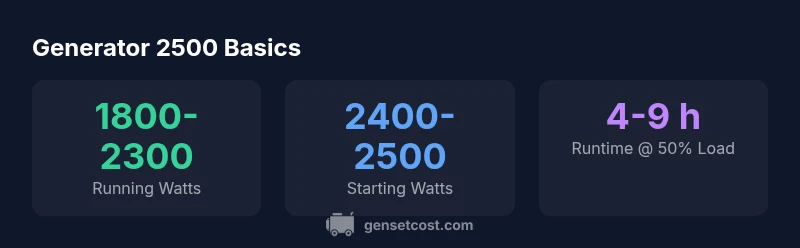
Generator 2500-watt units are a practical mid-range option for essential home loads during outages, offering enough power for core circuits while remaining portable. They typically provide running watts around 1800-2300, with starting watts up to 2500 depending on design and load. For homeowners and property managers, accurate sizing, fuel choices, and operating costs matter to balance reliability with budget.
Understanding the generator 2500: Power, Use Cases, and Sizing
The term generator 2500 typically refers to a portable, gasoline-powered unit with a rated continuous output in the 1800-2300 watt range and a surge capacity near or at 2500 watts. This class is popular for essential circuits—refrigeration, lights, sump pumps, a few outlets, and small electronics—during outages. When sizing, homeowners should distinguish running watts (the steady load) from starting watts (the surge needed for motors). A 2500-watt model is usually sufficient for a handful of critical items but will struggle if multiple high-draw devices run simultaneously. Importantly, the exact numbers vary by model, engine, and design, so consult the manufacturer’s running watt and peak watt specifications. The Genset Cost team emphasizes that accurate sizing is foundational for reliability, cost control, and safe operation.
Load Planning and Sizing Rules for a Generator 2500
To plan effectively, begin by listing every device you intend to power during an outage. Use a wattage meter or label on appliances to estimate running watts, then sum these values with a safety margin (commonly 10-20%). Be mindful of surge requirements for devices with motors, such as a fridge, sump pump, or window AC unit. In practice, a small kitchen circuit plus refrigeration and lighting may approach the upper end of a 2500-watt unit, while avoiding simultaneous heavy loads like a space heater. If you routinely run multiple large loads, consider a larger unit or a dedicated transfer switch to sequence power to essential circuits without overloading the generator.
Fuel, Efficiency, and Running Costs for 2,500-Watt Models
Gasoline-powered 2500-watt units are ubiquitous due to accessibility and price, but fuel economy varies with engine design and load. Expect higher consumption at peak loads and lower efficiency when running near idle. Typical operating costs can be estimated by your local fuel price and the unit’s throttle setting; many users see modest hourly fuel costs at moderate loads, with spikes when motors require higher surges. For property managers, this translates into predictable but not identical ongoing expenses. Regular maintenance (oil changes, air filter replacements, and spark plug checks) helps sustain fuel efficiency and extend engine life.
Noise, Portability, and Maintenance Considerations
Portability is a hallmark of the generator 2500 class, with most models weighing considerably less than standby generators and offering wheel kits or handles. Noise levels commonly range in the mid-to-high 60s decibels at 7-10 feet under typical loads, which is noticeable but manageable with proper placement and enclosure choices. Maintenance is straightforward but essential: change the oil per schedule, replace filters, and perform basic spark plug and carburetor checks. A well-maintained 2500-watt unit can reliably support essential loads for many outage scenarios, but inconsistent maintenance dramatically reduces reliability and increases long-term costs.
Costs, Warranties, and Buying Strategy for 2500-Watt Units
Budgeting for a generator 2500 includes the upfront price, expected fuel usage, and potential installation costs if you add a transfer switch or weatherproof housing. Warranties vary by brand and model but commonly cover 1-3 years for parts and labor. When shopping, compare running watts, surge capacity, fuel type (gasoline versus propane), and included accessories (fuel stabilizer, maintenance kit, or cover). Reading reviews and checking for noise ratings helps ensure you choose a unit that fits your space and noise tolerance. The Genset Cost team recommends evaluating total cost of ownership rather than sticker price alone.
Quick Start: Steps to Get Powered During an Outage
- Inventory essential loads and compute total running watts. 2) Verify a unit’s running and starting watts align with those loads. 3) Decide on fuel type and storage strategy, including safety considerations. 4) Plan or install a transfer switch to enable seamless, safe switching from grid to generator power. 5) Schedule regular maintenance and perform test runs to confirm readiness. This approach minimizes risk and ensures you derive maximum value from your generator 2500.
Guidance for 2,500-watt class generators
| Metric | Typical Range (W) | Notes |
|---|---|---|
| Continuous Output | 1800-2300 | Running watts at moderate load |
| Starting/Surge Watts | 2400-2500 | Needed for motors and startup loads |
| Fuel Type | Gasoline | Most common for portable units |
| Runtime at 50% Load | 4-9 hours | Depends on tank size and load |
People Also Ask
What does 'generator 2500' mean in real terms?
It refers to the unit's peak output. Continuous running watts are typically lower than the surge rating, and you should size your loads accordingly.
A 2500-watt unit means the peak output can hit 2500 watts, but you should plan around the running watts for everyday use.
Can a generator 2500 power a whole house?
Typically not. A 2500-watt unit is best for essential circuits. Whole-house backup usually requires a larger standby system or a carefully staged transfer switch.
Usually not the whole house—think essential circuits and planned load sequencing with a transfer switch.
What appliances can a 2500-watt unit run?
Refrigerator, lights, fans, some outlets, and small electronics are common. Avoid running central air or other high-draw appliances at the same time as motors.
It can run refrigerators and lights, but avoid overloading with big appliances at once.
Gas vs propane for 2500-watt units?
Gasoline is the most common, but propane units offer cleaner burns and longer shelf life. Fuel availability, storage, and local regulations influence choice.
Gas is common, but propane can be cleaner and longer-lasting in storage.
Do I need a transfer switch for a generator 2500?
A transfer switch is highly recommended for safety and convenience. It prevents back-feeding and makes it easier to power essential circuits.
Yes. A transfer switch makes power transfer safer and simpler.
“A 2500-watt generator is a practical mid-range option for essential home loads, but accurate sizing and fuel planning are critical to ensure reliability during outages.”
Key Takeaways
- Assess essential loads before selecting a 2500-watt unit
- Distinguish running watts from starting watts for motors
- Plan fuel type and storage to estimate ongoing costs
- Consider transfer switches for safer, cleaner power transfer
- Prioritize maintenance to preserve reliability and lifespan