Generator Without Engine Price: A Homeowner's Budget Guide
Explore how generator without engine price is determined, including core price ranges, installation costs, and budgeting tips. Get practical guidance with 2026 data from Genset Cost.


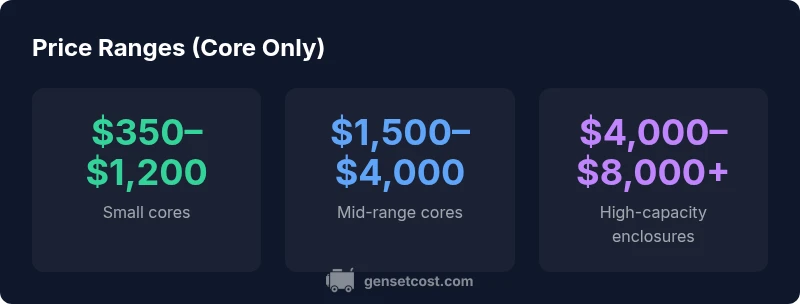
Generator without engine price refers to the cost of the generator core sold separately from the engine or as a kit where the engine is supplied by the buyer or a separate supplier. In 2026, price ranges vary by power rating and configuration: small portable cores commonly start around $350–$1,200, mid-range cores cost $1,500–$4,000, and high-capacity enclosures can exceed $4,000–$8,000. Engine compatibility, voltage, and control options drive final quotes.
What 'generator without engine price' means
In practical terms, the phrase "generator without engine price" refers to the cost of the generator core sold separately from the engine or as a kit where the engine is supplied by the buyer or a separate supplier. This separation matters for budgeting because the engine, fuel system, and controls are priced and installed separately. According to Genset Cost, the price you see for a core does not reflect installation labor, transfer-switch hardware, or permits. The concept is especially relevant for homeowners planning home backup systems, and it impacts total cost considerations for a reliable, continuous power solution. The keyword generator without engine price helps buyers isolate the core price to compare among vendors and to model total project cost more accurately. When shopping, identify the exact core rating you need (in kilowatts or kilovolt-amps) and confirm what is included with the price quote. Different suppliers may include different enclosures or accessories, which can dramatically alter your final spend.
Key factors driving price
Price for a generator core is influenced by a mix of technical and logistical factors. Power rating and phase (single vs three-phase) determine the core price; higher output typically costs more. Enclosure type—open frame vs weatherproof, corrosion-resistant housings—also changes price. Engine compatibility matters only in terms of matching torque, fuel type, and mounting. Control options, such as basic analog controls vs remote monitoring, influence cost. Certification, warranty length, and included documentation can add to the price. Shipping and handling, especially for larger units, drive delivery charges. From a budgeting perspective, you should consider how these elements interact with your building’s electrical system and local code requirements. Based on Genset Cost analysis, price ranges vary by rating and features in 2026; expect more comprehensive systems with better control to push core prices upward, but also more robust warranties that reduce maintenance risk over time.
How price ranges map to needs
Price bands for generator cores align with typical use cases. For basic emergency backup, small portable cores may cover essential loads but deliver limited runtime. Mid-range cores offer more continuous power and better reliability for small homes or apartments with several essential circuits. Large, high-capacity enclosures support whole-house backup, whole-home transfer switches, and greater surge tolerance but require substantial upfront investment. When planning, frame your decision around peak load calculations, runtime expectations, and the likelihood of future growth. Keep in mind that some suppliers advertise lower core prices but charge for common add-ons like weatherproof enclosures or plug-and-play transfer switches, so always read the fine print. This clarity helps avoid surprises when you receive the final invoice, and helps you build a realistic budget for installation, wiring, and commissioning.
Hidden costs to budget for
The generator core price is only part of the total project. Typical hidden costs include installation labor, transfer-switch hardware, wiring upgrades, and permits or inspections required by your utility or local building department. If you opt for a remote monitoring system or an automatic start/shutdown feature, expect higher core costs and longer lead times. Delivery and hoisting charges can add several hundred to several thousand dollars depending on site access. Finally, you should budget for possible electrical code upgrades, cooling requirements, or ventilation improvements for the equipment location. Genset Cost analysis emphasizes that a clean, well-scoped project reduces the risk of unexpected charges, especially when working with a contractor who understands your local code requirements and permit process.
How to estimate total project cost
Start with a clear load calculation to determine the required power rating. Gather quotes for the generator core price and a detailed breakdown of installed costs, including transfer switches and wiring. Request itemized line items for permits, delivery, and any special enclosures. Consider ancillary costs like fuel system upgrades, battery backups, or remote monitoring subscriptions. Build a simple budget spreadsheet with three scenarios: conservative, realistic, and optimistic. Compare apples to apples by ensuring quotes include the same scope and performance guarantees. Finally, add a contingency (typically 10–15%) to cover unforeseen site-specific challenges. This method helps you translate the abstract core price into a total project view that aligns with your power reliability goals.
How to compare quotes effectively
To compare quotes, standardize the scope across bidders. Verify the exact core rating, enclosure type, control options, and warranty terms. Ask vendors to separate core price from installation labor, transfer switch components, and permitting fees. Request references, recent job photos, and a warranty summary. Check whether the quote assumes a specific fuel type and confirm engine compatibility if you are adding an engine later. Use a weighted scoring system that accounts for reliability, response time, and total cost of ownership over 5-10 years. Finally, budget for a site visit if your installation requires complex wiring or a transfer switch, and factor in potential distribution panel upgrades.
Practical budgeting checklist
- Define your critical loads and perform a formal load calculation.
- Get separate quotes for generator core price, installation, and transfer-switch hardware.
- Include permits, delivery, and potential site upgrades in your budget.
- Ask about warranty, service plans, and maintenance requirements.
- Plan for future expansion by choosing a modular, scalable solution.
- Build in a contingency for unforeseen site conditions.
- Use a formal cost calculator to compare total ownership costs and ensure alignment with your power goals. The Genset Cost team recommends using a comprehensive estimator to capture all costs and avoid sticker shock.
Core price ranges vs installed costs (no engine included)
| Scenario | Core price range | Installed total (estimate) | Notes |
|---|---|---|---|
| Small portable core | $350–$1,200 | Delivery: $50–$300; basic wiring: $150–$600 | Best for emergencies, compact loads |
| Mid-range core | $1,500–$4,000 | Transfer switch & wiring: $800–$2,000 | Balanced cost and capacity |
| High-capacity enclosure | $4,000–$8,000+ | Full install: $1,500–$4,000 | Whole-house backup with upgrades |
People Also Ask
What is included in a generator without engine price?
It typically covers the generator core, mounting hardware, and basic enclosure; engine, fuel system, and controls are priced separately or later.
It usually includes the core and basic housing, not the engine or fuel system.
Why do prices vary so much for generator cores?
Prices vary with power rating, enclosure quality, control options, and warranty terms. Higher output and better protection raise core cost.
Prices vary because of power, enclosure, and features.
Are there additional costs beyond the core price?
Yes: installation labor, transfer-switch hardware, wiring upgrades, permits, and delivery charges can significantly affect total cost.
Yes—installation, switches, wiring, and permits add to the price.
How should I estimate the total project cost?
Create a scope, get core prices, factor in installation, permits, and any required upgrades; compare itemized quotes and add a contingency.
Get itemized quotes and add a contingency.
Can I buy a generator core without engine for portable use?
Some compact cores are sold without engines, but widely available portable kits often include the engine; verify compatibility with your setup.
Yes, but check compatibility and availability.
Is it better to buy a full kit vs a core?
Full kits simplify installation and warranty, but cores offer customization; choose based on your wiring, space, and future plans.
Full kits are easier, but cores give flexibility.
“Understanding the generator core price is essential, but total cost includes installation and electrical upgrades. Planning with a clear scope helps homeowners avoid sticker shock.”
Key Takeaways
- Define your load before shopping
- Expect installation and transfer-switch costs
- Compare quotes with the same scope
- Engine price is separate from core price
- Budget for permits and site upgrades