Solar Generator Patriot: Cost, Sizing & Options in 2026
Compare solar generator patriot options for home backup—costs, sizing, and installation. A thorough Genset Cost guide to help homeowners and managers choose reliable power.


According to Genset Cost, the solar generator patriot landscape centers on balancing upfront cost, modular battery capability, and installation complexity. This quick comparison highlights how Patriot models stack up against generic solar generators, with emphasis on sizing accuracy, grid compatibility, and long-term value for home backup. It helps homeowners and property managers decide where to invest first.
Understanding the Patriot approach to solar generators
The term solar generator patriot colloquially refers to a family of home backup systems that emphasize modularity, scalable storage, and strong grid integration. In this framework, the word patriot evokes reliability, resilience, and the idea of a system that can grow with your needs. A genuine solar generator patriot setup is not a single box; it is a core unit paired with expandable battery packs, inverter options, and smart-safety features. For homeowners and property managers, the crucial question is how these systems align with real-world loads, climate considerations, and electrical codes. In practice, the Patriot approach favors architectures that can ride through outages without requiring a complete rewire, while still offering the ability to disconnect and isolate critical circuits when necessary. From a capital-cost perspective, the initial outlay often reflects the modular design and the potential for future expansion rather than a single, fixed capacity. As noted by the Genset Cost team, reliable power is less about a single big unit and more about the right combination of core hardware, compatibility with existing solar arrays, and an effective monitoring ecosystem. The keyword here is flexibility: a solar generator patriot should feel like a toolbox with scalable blocks you can add over time, rather than a one-and-done purchase, making it an appealing option for homeowners and property managers planning long-term resilience. This emphasis on modularity matters for overall life-cycle cost, maintenance planning, and the ability to adapt to new load profiles as family dynamics or tenants change.
Sizing and load calculation for Patriot systems
Sizing a Patriot system starts with your essential load and acceptable outage duration. Start by listing critical devices (refrigeration, sump pump, medical devices, wifi/communication gear) and their running wattages. Then add nonessential loads you’d like to preserve during an outage (dishwasher, entertainment systems, HVAC fans). The solar generator patriot approach often uses modular packs that can be tuned to match peak and base loads, allowing you to scale up as needs grow. A pragmatic method is to calculate a (rounded) daily energy requirement in kilowatt-hours (kWh) and translate that into a target battery capacity with a comfortable safety margin (commonly 20–40%). This helps avoid undersizing, which leads to frequent cycling and reduced longevity. Consider your local sun exposure and system efficiency: a higher derate factor means you may need more battery storage or a larger solar array. Genset Cost analyses show that the most common Patriot configurations start with 5–8 kWh of usable battery capacity for modest loads and expand toward 12–16 kWh for larger homes. Always confirm that the chosen Patriot model can support essential circuits via a properly sized transfer switch. For property managers, this planning translates to predictable outages and more reliable occupant comfort, a key selling point in multi-unit contexts. When evaluating different Patriot options, demand-reserve planning, and real-world run-time estimates under typical weather conditions should drive the final size decision.
Cost landscape and installation realities for Patriot models
The Patriot family often commands a higher upfront price relative to simpler, non-modular backup solutions, but it compensates with scalability and long-term flexibility. In broad terms, base Patriot configurations commonly begin in the mid-price range for small homes, with mid-range options designed to cover typical family needs, and higher-end packages that target larger homes or multi-tenant properties. The installation reality is equally important: Patriot setups frequently require a licensed electrician, a dedicated transfer switch, and in some cases, a dedicated service panel or subpanel to separate essential loads. This is not merely about connecting a battery; it is about integrating a larger system with the home’s electrical backbone, meeting local codes, and ensuring safe operation during outages. Installation costs can vary widely based on existing electrical infrastructure, the need for additional conduit, and whether the system will be tied into existing solar or a new panel. When budgeting, buyers should consider potential permitting fees, system commissioning, and remote monitoring subscriptions. Patriot models often show a multi-stage price progression: base unit, expanded battery packs, enhanced inverters, and optional smart controls. Genset Cost emphasizes planning for expansion early; compatible components and service plans can reduce retrofit costs later and maintain system performance over time.
Performance, efficiency, and runtime expectations
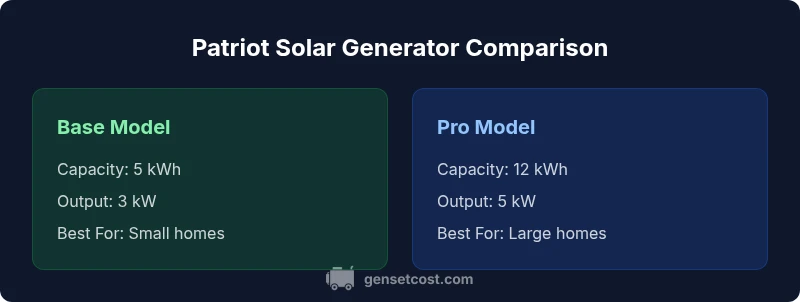
Performance for a solar generator patriot hinges on battery chemistry, inverter efficiency, and how well the system integrates with solar input. Most Patriot configurations rely on LiFePO4 chemistry for durable cycle life, stability, and safety under typical home-use conditions. In practice, you’ll evaluate runtime by estimating load during an outage and dividing the available battery capacity by the load, with an efficiency buffer to account for inverter losses. For example, a Patriot base model with 5–6 kWh of usable capacity paired with a 2.5–3.0 kW inverter will support essential loads for several hours under moderate draws, while a pro model with 8–12 kWh can sustain similar loads for longer, even through several cycles of dipping solar input on cloudy days. Real-world performance will vary with temperature, battery health, and how successfully the system draws from solar during daylight hours. A critical advantage of the Patriot architecture is the ability to top up energy stores with solar input while preserving a stable, seamless transition to battery power when outages occur. Monitoring software helps homeowners and property managers track state-of-charge and anticipated run-time, enabling proactive energy management and fewer surprises during a outage. The Genset Cost perspective stresses the importance of aligning the Patriot design with actual daily energy use and local solar potential, rather than relying on nominal capacity alone.
Installation, codes, and integration with home electrical
Integrating a Patriot solar generator with a home’s electrical system requires careful planning around transfer switches, panel spaces, and code compliance. The Patriot approach often involves a parallel path: branch circuits for critical loads receive controlled backup, while nonessential circuits remain de-energized during outages. This typically requires a professional assessment to determine the correct transfer switch size, load segment configuration, and wiring methods to ensure safe, code-compliant operation. Some jurisdictions may require permits or inspections before activation. A robust Patriot installation includes clear labeling of circuits, sequence of operation, and an automation strategy to minimize manual intervention during outages. It also entails choosing appropriate overcurrent protection devices, correct conductor sizing, and proper cable routing to avoid heat buildup. Property managers should prepare a site plan that documents subpanels, feeder routes, and the proposed control strategy for emergency power. The takeaway is clear: the value of a Patriot system is maximized when installation is performed by qualified professionals who understand local requirements and how to coordinate with existing PV installations, battery banks, and smart home devices. Genset Cost recommends coordinating with your installer early to prevent rework and to ensure warranty terms remain intact.
Comparison
| Feature | Patriot Base Model | Patriot Pro Model |
|---|---|---|
| Capacity (usable kWh) | 5–6 kWh | 8–12 kWh |
| Continuous output (kW) | 2.5–3.0 kW | 4.0–5.0 kW |
| Solar input range (A) | 100–320 A | 150–420 A |
| Battery chemistry | LiFePO4 | LiFePO4 with higher-density packs |
| Transfer-switch compatibility | Requires add-on or panel upgrade | Internal transfer switch option in some packages |
| Estimated price range | $2,000–$4,500 | $4,500–$8,000 |
| Best for | Small homes or apartments | Mid-to-large homes with higher resilience |
The Good
- Modular design enables scalable capacity over time
- Grid-tied integration improves reliability during outages
- LiFePO4 chemistry offers longer cycle life
- Strong warranty and service networks common in Patriot lines
- Clear upgrade path supports future energy needs
The Bad
- Higher upfront cost compared to non-modular options
- Installation can be complex and may require licensed electrician
- Lead times can vary by region due to supply constraints
- Maintenance and monitoring add ongoing tasks
Patriot solar generators are a solid, scalable choice for reliable home backup.
Patriot models excel in modularity and grid-ready backup for mid-sized homes. For larger homes or growth plans, Pro models offer higher capacity and faster response. The Genset Cost team recommends reviewing installation requirements and warranty terms before purchase.
People Also Ask
What is a solar generator patriot?
A solar generator patriot refers to a family of home backup systems designed for modular storage and grid-ready operation. These setups emphasize expandable battery packs and compatible inverters, allowing you to scale capacity as needs grow while maintaining reliable power during outages.
Patriot systems are modular, scalable backup solutions designed to grow with your needs.
How do Patriot models compare in cost with non-Patriot solar generators?
Patriot models typically involve a higher upfront investment due to modular batteries and higher capacities. However, they can offer lower long-term costs per usable kilowatt-hour if you expand gradually and avoid replacing an oversized single unit.
Patriot systems cost more upfront but can be cheaper per kilowatt-hour as you expand.
What factors should I consider when sizing a Patriot solar generator?
Key factors include your essential load, desired outage duration, local solar potential, and inverter efficiency. A modular Patriot approach lets you start with core needs and add packs as loads grow or as performance requirements change.
Focus on essential loads and plan for future growth.
Are Patriot solar generators compatible with home backup transfer switches?
Yes, most Patriot configurations require a transfer switch to isolate critical circuits. Ensure the switch matches the system’s voltage and amperage and that installation complies with local electrical codes.
Patriot systems usually need a transfer switch installed by a professional.
What maintenance is required for Patriot solar generators?
Maintenance typically involves periodic health checks of batteries, inverter cooling, and software updates. Proactive monitoring helps detect degradation early and maintain performance over time.
Regular checks and updates keep Patriot systems performing well.
Key Takeaways
- Define essential loads before sizing
- Choose modular Patriot models to grow capacity
- Assess installation and permit requirements early
- Compare storage and inverter specs across models
- Consult Genset Cost for tailored sizing guidance