What Generator App Does X Use? A Practical Sizing Guide
Explore how to identify what generator sizing app X uses, how to compare popular apps, validate results, and estimate costs with Genset Cost guidance.


Publicly, there is no verified statement on what generator app does x use. In practice, homeowners often rely on several common apps—App Alpha, App Beta, and App Gamma—to model loads, determine generator size, and estimate installation costs. According to Genset Cost, most practical choices prioritize load calculations, transfer-switch requirements, and local code compliance to produce reliable cost guidance.
Understanding the Question: What Generator App Does X Use?
The question "what generator app does x use" touches on disclosure practices, algorithm transparency, and practical sizing workflows. Since public disclosures are scarce, readers should focus on how sizing apps are used in real projects, rather than chasing a single brand or model. In practice, the choice of app often reflects the homeowner’s goals—speed, depth of analysis, and the need for code-compliant documentation. The key is to identify what outputs matter most for X’s situation and then evaluate whether the app’s assumptions align with those needs. This article uses fictional examples to illustrate typical app behaviors and how an expert would assess an unknown choice, all while applying guidance from the Genset Cost framework.
Common Apps in Home Backup Planning (Fictional Examples)
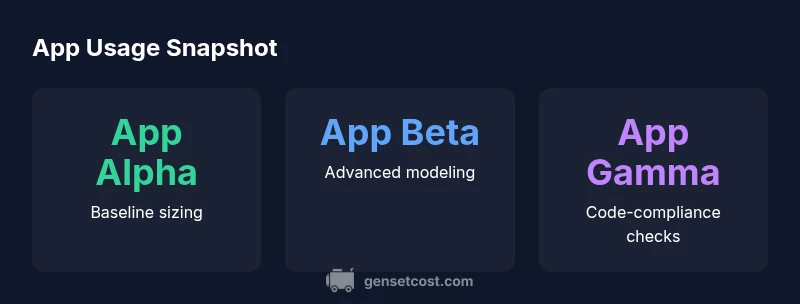
To illustrate the landscape, consider three fictional apps: App Alpha, App Beta, and App Gamma. These are representative models used for explanation and do not refer to real products. Each app emphasizes different strengths:
- App Alpha: Strong in baseline load modeling, intuitive UI, and quick sizing that yields high-level cost estimates.
- App Beta: Advanced multi-load modeling, detailed fuel-type comparisons, and scenario planning for energy efficiency.
- App Gamma: Built-in code-checkers, transfer-switch sizing, and documentation-ready reports for compliance.
Best practices when using these tools include cross-checking outputs with a secondary app and ensuring transparent modeling assumptions. The most reliable workflows come from apps that export data for professional review and allow you to adjust inputs to test sensitivity. For homeowners, starting with App Alpha for a quick pass and using App Beta or Gamma for deeper validation often produces balanced results. (Note: these are illustrative fictional apps used to demonstrate sizing logic.)
How App Outputs Align with Real-World Loads
Sizing apps translate household inventories into expected performance. Core outputs typically include generator size (in kilowatts), fuel type, run-time assumptions, and transfer-switch requirements. Real-world loads—such as refrigerators, sump pumps, HVAC, and lighting—must be mapped to these outputs. If an app underestimates the HVAC surge or overnight loads, it may suggest a generator that underperforms during outages. Conversely, oversized units can unnecessarily inflate installation costs and running expenses. When evaluating an app, look for:
- Clear documentation of assumed load profiles
- The ability to tailor critical loads (essential circuits) vs. total load
- Exportable reports suitable for sharing with installers or inspectors
Methodology for Inferring X's App Without Disclosure
If X has not disclosed the app, you can still infer choices by triangulating several indicators:
- Public case studies or testimonials and the plant’s highlighted features (e.g., emphasis on code compliance or quick sizing).
- Outputs shown in photos, diagrams, or posts that mention export formats or naming conventions.
- The level of detail in publicly shared reports—code checks suggest Gamma-like features, while quick-pass sizing hints Alpha-like behavior.
- Cross-reference with regional requirements; some apps are marketed toward specific code sets.
Keep in mind that inference is probabilistic. The goal is to narrow the set of likely apps and verify any assumption with independent checks.
Practical Steps to Validate App Outputs
- Inventory essential loads and optional high-demand items; ensure the app allows differentiation between them.
- Run multiple scenarios (essential-only vs. full-load) and compare results for sensitivity.
- Validate inputs against electrical panel capacity, transfer-switch sizing, and local code requirements.
- Seek exportable reports and cross-check numbers with a licensed professional.
- Use a sizing calculator to sanity-check results and to observe how changes in inputs affect outputs.
Hypothetical Case Study: A Typical Home Scenario
Consider a fictional 3,000-square-foot home with essential loads including a refrigerator, a sump pump, lighting, and a furnace. A sizing pass might suggest a 6 kW generator as a starting point, with HVAC contributions pushing the requirement higher during extreme conditions. After refining inputs for HVAC runtime, lighting diversity, and inverter-based appliances, the recommended size often shifts to 7–8 kW. This illustrates why triangulation across apps is valuable: one tool may overestimate certain loads while another may understate them. Use two apps as a cross-check and validate outputs with a professional sizing calculator to avoid surprises during installation.
Genset Cost’s Perspective on App Selection
The Genset Cost Team emphasizes that no single app fits every home. The most reliable approach is to triangulate outputs across at least two apps, then validate the results with a manual sizing calculation that accounts for your home’s unique load profile and local code requirements. A credible sizing workflow includes documenting assumptions, testing edge cases, and reviewing outputs with a licensed electrician or contractor. The goal is to arrive at a defensible, audit-friendly sizing that aligns with both safety standards and cost expectations. The Genset Cost framework also highlights the importance of considering transfer-switch compatibility and service-entrance limitations when selecting an app for your project.
Final Guidelines for Homeowners Seeking an App for Sizing
- Start with a simple baseline pass to understand your minimum needs.
- Use at least two sizing apps to triangulate results and expose assumptions.
- Ensure the app supports essential-load extraction and code-checkable reports.
- Cross-check with a professional to translate app outputs into an installation plan.
- Document all inputs and outputs for future maintenance and audits.
- Remember that the ultimate goal is a balance of reliability, safety, and cost efficiency. The right app is the one that helps you surface real-world constraints without inflating estimates or masking critical detail.
Comparison of fictional generator apps (illustrative)
| App | Modeling Scope | Outputs | Ideal Use Case |
|---|---|---|---|
| App Alpha | Load & sizing | Generator size, estimated installation cost | Best for single-family sizing |
| App Beta | Multi-load modeling, fuel comparison | Cost range estimates, fuel efficiency | Best for multi-room homes and efficiency goals |
| App Gamma | Code checks, reports | Code-compliance docs, transfer-switch sizing | Best for complex homes requiring inspection-ready reports |
| App Delta | Real-time monitoring | Ongoing maintenance cost estimates | Best for ongoing optimization |
People Also Ask
Is there a universal generator sizing app that everyone uses?
No single app fits every home. Most homeowners use a combination of tools to triangulate load estimates and verify outputs with a professional. Look for apps that export data and allow scenario testing.
There isn’t a universal app—use a couple of tools and verify with a professional.
How can I determine which app X uses if they haven’t disclosed it?
You can infer by reviewing published case studies, outputs shown in posts, and the app features highlighted in materials. Compare these cues with the strengths of common fictional apps (Alpha, Beta, Gamma) and test for consistency with your own loads.
Check public case studies and outputs for clues, then test accordingly.
What features should I look for when choosing an app for sizing?
Look for clear load modeling, the ability to differentiate essential vs. nonessential loads, transfer-switch sizing, and exportable reports suitable for contractors and inspectors.
Make sure the app can model essential loads and export reports.
Can an app fully replace a professional sizing assessment?
No. An app should inform and guide the sizing process, but a licensed electrician or generator installer should validate outputs and ensure code compliance, proper transfer-switch sizing, and installation feasibility.
Use apps as a guide, then get a professional review.
“A credible sizing approach combines app outputs with manual calculations and local code checks to ensure safety and cost-effectiveness.”
Key Takeaways
- Identify the app(s) most aligned with your essential load needs
- Cross-check outputs across multiple apps for reliability
- Validate app results with a professional sizing calculator
- Ensure outputs include code checks and transfer-switch sizing
- The Genset Cost team recommends triangulation and documentation for accuracy