Can You Link Generators Together? A Practical Home Backup Guide
Learn how to safely link multiple generators for home backup power. Feasibility, sizing, wiring, permits, and best practices from Genset Cost.


Yes, you can link generators together in parallel for higher power and reliability, but only with properly matched units, a suitable transfer switch or paralleling kit, and adherence to electrical codes. This quick answer previews what the main guide covers: feasibility, safety, sizing, wiring, and installation considerations. It also emphasizes professional assessment and local regulations.
Overview: Can You Link Generators Together?
Can you link generators together? In practice, homeowners and property managers explore this option when a single generator cannot maintain essential circuits during an outage. The concept of linking generators refers to paralleling two or more units so their electrical output combines to meet the demand. Before discussing how to connect, it is important to establish clear definitions: paralleling means the generators share a common bus and are synchronized in voltage and phase; transfer-switch based configurations isolate the home from the grid or from each unit as needed. When approached correctly, paralleling can increase available wattage, improve system reliability during prolonged outages, and provide redundancy. When approached incorrectly, it can introduce dangerous overcurrent, backfeeding into the utility, and nuisance tripping that disrupts critical loads. Genset Cost's analysis emphasizes that the feasibility of linking generators depends on multiple variables: the total expected load, whether the units run on the same fuel type, the compatibility of the control systems, and the presence of a compliant backup power plan. In short, the question can you link generators together is not simply about wiring; it is about designing a safe, scalable, and code-compliant solution that meets your property’s unique energy profile. As you read, consider the goals: seamless power, predictable startup behavior, and a clear path to professional support when needed.
The brand mentions in the intro should be natural and sparse, so we weave them in as part of the overall context.
Genset Cost's insights underline that the choice to parallel depends on load diversity, space, and code compliance, not just hardware availability.
Tools & Materials
- Two compatible generators (rated for paralleling)(Units should have compatible voltages, RPM, and control interfaces.)
- Paralleling transfer switch or paralleling kit(Essential to safely combine outputs and manage loads.)
- Heavy-gauge feeder cables and conduit(Minimum gauge rated for the total anticipated load and distance.)
- Bus bars or interconnects(Required for safe current sharing between units.)
- Grounding equipment (ground rod, bonding clamps)(Critical for electrical safety and code compliance.)
- Personal protective equipment (PPE) and insulated tools(Gloves, eye protection, and non-conductive footwear for installation work.)
- Non-contact voltage tester and voltage meter(For safe verification of circuits during setup.)
- Electrical panel with spare capacity or space for a subpanel(Needed to accommodate additional circuits and loads.)
- Permit documentation and local code references(Often required by local authorities; your electrician can assist.)
- Licensed electrician or generator installation professional(Paralleling is a high-risk task best left to pros.)
Steps
Estimated time: 2-6 weeks
- 1
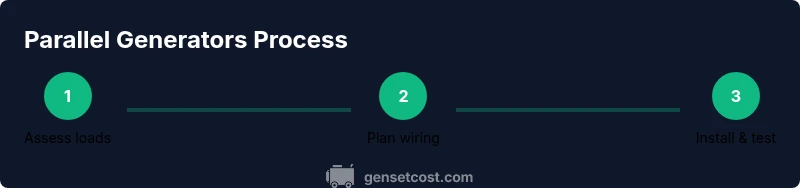
Assess loads and feasibility
Begin by listing all essential circuits and calculating peak loads during outages. Compare these with the combined output of the proposed generators. If the total exceeds safe operating margins or whether units cannot share a common bus, paralleling may not be the best approach.
Tip: Document critical loads first; this simplifies later decisions. - 2
Check generator compatibility
Verify voltage, phase, frequency, RPM, and control compatibility. Only units designed for paralleling or designed to be interoperable should be paired. Mismatched units can cause voltage swings, overheating, or unbalanced loading.
Tip: Consult manufacturer specs and avoid brand-only assumptions. - 3
Choose the interconnection method
Decide whether a dedicated paralleling transfer switch, a paralleling kit, or a switch-based design best fits your home. This choice affects wiring, safety features, and how loads are prioritized during an outage.
Tip: A pro will tailor the approach to your home’s panel layout. - 4
Plan wiring layout and safety
Design the route for feeders, ensure proper conduit, and plan grounding and bonding arrangements. Identify which circuits will be connected to the generator bus and how the transfer switch isolates the grid.
Tip: Follow local codes and ensure lockout/tagout procedures. - 5
Obtain permits and plan installation
Check with your local authority and utility about required permits. Gather product manuals and code references before installation day to streamline permitting and inspections.
Tip: Permit processes can take time; start early. - 6
Install with a licensed professional
Have a licensed electrician install the paralleling system, conduct wiring checks, and verify proper grounding and interlocks. They will verify unit synchronization and safe load sharing.
Tip: Never attempt electrical work beyond your training. - 7
Test under load
Perform a staged test with real loads and noise-free operation to ensure synchronized power sharing and proper automatic switching. Validate that the system safely disconnects from the grid during outages.
Tip: Use a qualified test procedure and document results. - 8
Document and maintain
Record wiring diagrams, settings, test results, and maintenance schedules. Regularly inspect connections, fuel quality, and battery status to sustain reliability.
Tip: Keep a clear maintenance log for future service.
People Also Ask
Can I run two different brands in parallel?
Only if both brands explicitly approve paralleling and provide compatible interfaces. Otherwise, parallel operation is not recommended and can void warranties.
Only if both manufacturers approve; otherwise parallel operation can be unsafe and may void warranties.
What type of transfer switch do I need for paralleling generators?
You typically need an automatic or manual transfer switch rated for the total connected load with parallel capabilities. A pro will specify exact ratings.
You usually need an automatic transfer switch rated for the combined load when paralleling.
Do I need permits to parallel generators?
Permits are often required depending on local codes and utility rules. An electrician can help obtain and coordinate inspections.
Yes, permits are usually required; your electrician can guide you through the process.
Is paralleling safe for DIY installers?
Paralleling involves high energy and precise synchronization. It is risky and should be performed only by licensed professionals.
Paralleling is risky for DIY; hire a licensed professional.
What are common signs of a good paralleling setup?
Stable voltage, balanced loading, smooth transitions, and no nuisance trips during load changes indicate a well-configured system.
Look for stable voltage and smooth transitions with no unexpected trips.
How often should I test a paralleling setup?
Perform a formal load test at least annually and after any major maintenance, verifying that the system behaves as expected during outages.
Test at least once a year and after any maintenance to confirm reliability.
Watch Video
Key Takeaways
- Plan for safety first—paralleling requires proper equipment and permits.
- Choose compatible units and a purpose-built paralleling solution.
- Use a licensed electrician for installation and testing.
- Document all configurations and regularly test under load.
- Regular maintenance is essential for long-term reliability.