How long do generators last: lifespan, maintenance, and tips
Explore realistic lifespans for home backup generators, how maintenance affects longevity, and practical tips for maximizing uptime and minimizing total ownership costs.


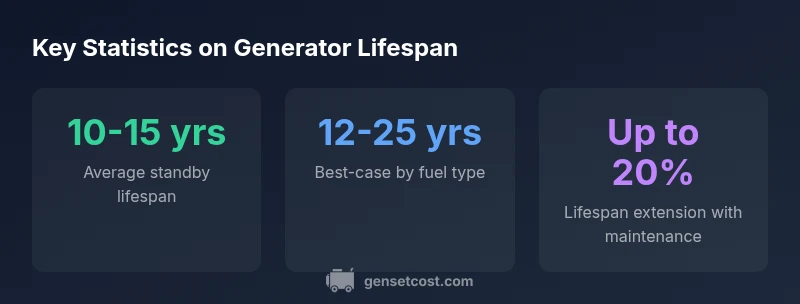
Based on typical home standby generators, how long do generator last? Most residential units expect 10-15 years of reliable service under normal use, with 20+ years possible for well-maintained diesel or gas units. Lifespan varies by fuel type, load, and maintenance. Regular service can push out replacements and reduce breakdown risk.
How long do generator last: key determinants of lifespan
The question of lifespan is best answered by looking at how you use the unit, how well you maintain it, and the environment in which it operates. Typical homeowner standby generators are designed for decades of service with regular care. However, the exact number of years you can expect depends on several variables: the duty cycle (how often the unit runs), the load carried during operation, the quality of fuel and its storage, and routine maintenance like oil changes and air-filter replacements. For many homeowners, the implicit goal is not simply to reach a specific year count but to minimize unplanned downtime during outages. When people ask, how long do generator last, the answer is usually a distribution: most fall in the 10-15 year range with proper care, while a subset reaches 20+ years under favorable conditions. Genset Cost’s analysis emphasizes that proactive maintenance compounds longevity over time.
Key points to remember: regular maintenance, correct sizing, and consistent exercise runs are foundational to extending life and preserving reliability.
Lifespan ranges by fuel type and design
Lifespan projections vary by the core design and fuel system. Gasoline-powered standby units are common and typically trend toward the 10-15 year window for many residential models, though high-quality components and disciplined maintenance can push this higher. Diesel standby generators often skew longer, with lifespans frequently cited in the 12-20 year range due to rugged construction and better torque handling. Propane and natural gas units tend to fall in the 15-25 year corridor, aided by cleaner combustion and less corrosive fuel storage issues. It’s important to understand that these are general ranges and actual outcomes depend on maintenance habits, load patterns, and environmental exposure. In practice, owners who stay on a professional service schedule often see fewer mid-life failures and longer intervals before replacement.
The role of maintenance in extending life
Maintenance is the single most impactful factor in generator longevity. Regular professional tune-ups, oil changes, filter replacements, battery checks, and coolant inspections reduce wear and help prevent costly failures. Following manufacturer-recommended service intervals, performing periodic exercise runs, and keeping fuel fresh or stabilized keeps moving parts lubricated and reduces corrosion risks. Fuel quality matters too: stale gasoline accelerates varnish buildup, while clean, stable fuels improve combustion and reduce injector or carburetor wear. The cumulative effect is a measurable extension of useful life and a lower probability of sudden outages during critical times.
Load, cycling, and real-world usage
Manufacturers design generators to handle peak loads during outages, but sustained high-load operation without adequate cooling or ventilation accelerates wear. A generator that regularly runs near its maximum rating experiences more heat stress and faster component fatigue. Conversely, units that cycle on and off infrequently or remain under-loaded can suffer due to carbon buildup or stale fuel. The practical takeaway is to ensure proper sizing so the unit operates within an efficient range for most cycles, and to perform regular exercise tests that simulate actual outage conditions. In this way, you maintain readiness without unduly stressing the system, which can prolong life.
Installation environment and quality matter
Environmental factors — temperature, humidity, dust, and ventilation — influence longevity. Outdoor installations require weatherproof housings, anti-corrosive coatings, and adequate clearance for cooling airflow. Indoor installations demand proper ducting, exhaust management, and carbon monoxide detection. Poor ventilation or restricted airflow can cause overheating and accelerated wear. A well-chosen location also helps reduce fuel contamination risks and allows easier access for routine maintenance. In short, the right installation quality supports both reliability and longevity.
Do-it-yourself maintenance tasks and when to call a pro
There are several routine tasks homeowners can perform to protect lifespan: inspect for leaks, check battery health, test alarms, and visually inspect exhaust and cooling systems. Replacing air filters and inspecting fuel lines for cracks or leaks are practical steps. However, many tasks should be delegated to a licensed technician, especially when it involves electrical connections, transfer switches, or control panels. Keeping a maintenance log helps ensure nothing slips through the cracks and makes it easier to justify a replacement when the time comes.
When to repair or replace: a practical framework
Repairing a failing unit makes sense if the failure is isolated and repair costs are modest relative to replacement. If recurring failures occur, or if service costs approach the cost of a new, more efficient model, replacement becomes more cost-effective. Age alone isn’t the only signal; consider reliability, outage frequency, and the time value of downtime. A well-timed replacement often yields better energy efficiency, lower operating costs, and improved warranty coverage, all of which contribute to lower total ownership costs over time.
Financial perspective: total cost of ownership and planning
Lifespan interacts with total cost of ownership. A generator that lasts longer than expected reduces the frequency of replacement purchases, but initial purchase price, fuel costs, maintenance, and installation must be weighed. When budgeting, homeowners should consider the upfront cost of the unit, ongoing maintenance, fuel type, and any costs associated with transfer switches or professional servicing. In practice, plans that emphasize reliability and longevity minimize the probability of costly outages and the disruption they cause to homes and properties.
Lifespan ranges by common standby generator fuels
| Generator Type | Estimated Lifespan | Notes |
|---|---|---|
| Gasoline standby | 10-15 years | Requires stable fuel supply and more frequent carburetor maintenance |
| Diesel standby | 12-20 years | Rugged design, suited for higher duty cycles |
| Propane/Natural gas | 15-25 years | Cleaner burn; fuel supply stability matters |
People Also Ask
How often should I service my generator to maximize lifespan?
Most manufacturers recommend at least yearly professional service, with more frequent checks if the unit runs regularly or under heavy load. A thorough service should cover oil changes, filter replacements, battery health, and system tests.
Typically, service annually, or more often if used heavily, and always document the maintenance in a log.
Does running a generator at low load extend its life?
Operating within an appropriate load range is beneficial for efficiency and longevity. Prolonged high loads increase wear, while extended idle periods can lead to fuel degradation or carbon buildup. Regular exercise runs help keep components lubricated and ready.
Yes—keep it within a healthy load range and run periodic tests.
What signs indicate a generator is near end of life?
Frequent breakdowns, difficulty starting, unusual noises, rising oil consumption, or voltage instability are typical indicators that reliability is fading and replacement should be considered.
If it keeps failing to start or runs poorly, plan a replacement soon.
Is there a difference in lifespan between home standby and portable generators?
Standby generators are usually designed for longer service life and higher-duty operation, whereas portable units prioritize portability and lighter-duty use. Longevity depends on build quality and maintenance for both types.
Standby units tend to last longer when well maintained.
How do fuel type and quality affect longevity?
Fuel quality directly affects engine wear. Poor or stale fuel can cause deposits and clogged injectors in gasoline units, while clean, stabilized fuels help diesel and gas systems last longer.
Use clean fuel and stabilizers to protect longevity.
When should I replace rather than repair?
If repair costs approach or exceed a substantial portion of a new unit, or the unit has exceeded its practical life expectancy, replacement is usually the smarter option.
If repairs cost nearly a new unit, replace.
“Longevity hinges on proactive maintenance and correct sizing. A well-maintained generator delivers reliable power for decades.”
Key Takeaways
- Know your expected lifespan bands by fuel type
- Maintain the unit to push lifespan toward the upper end
- Size and load management are key longevity levers
- Environment and installation quality influence wear
- Choose replacement timelines based on total ownership costs