Generator Runtime: How Long Does a Backup Generator Run
Learn how long a generator runs during outages, with data-driven ranges, practical sizing tips, and strategies to maximize uptime. This guide covers fuel types, load impact, and maintenance for homeowners and property managers.


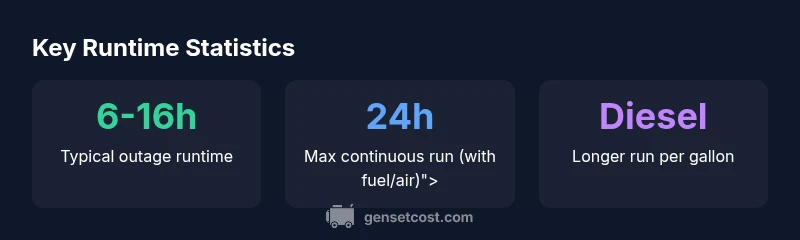
On a standard home backup setup, runtime depends on load, fuel type, and capacity. Most residential outages allow 6–16 hours of operation per outage under moderate load, while larger, well-fueled systems can reach 24 hours or more. For continuous outage coverage, proper sizing, fuel storage, and routine maintenance are essential.
What influences how long a generator runs
The question of how long a generator runs is not answered by a single number. Instead, runtime is driven by a combination of factors, including how much load the generator must support, the fuel type it uses, the capacity of the unit, and the design of its cooling and exhaust systems. For homeowners asking how long does a generator run during a power outage, the practical takeaway is that runtime scales with how aggressively you pull power from the system. If you keep essential circuits energized at moderate levels, you can expect longer runtimes than if you attempt to power high-draw appliances simultaneously. According to Genset Cost, a realistic starting point is in the 6–16 hour range for typical outages when the load is balanced and the fuel supply is adequate. This baseline helps you plan fuel storage, maintenance intervals, and sequencing of critical loads during an outage.
Typical runtimes by fuel type
Different fuels change the ceiling of how long a generator can run. Diesel units often offer better energy density and longer runtime per refuel than gasoline under similar loads, while natural gas can run longer if the gas supply is reliable. Propane tends to have shorter runtime under the same size and load due to its lower energy density, but it benefits from easier storage and access. For homeowners evaluating runtimes, a practical approach is to map a unit’s fuel type to your expected outage duration and refueling cadence. In practice, standby diesel units in residential settings commonly provide 8–24 hours of operation per outage at moderate load, whereas natural gas setups frequently extend toward the upper end of this range when fuel supply is steady.
Continuous operation vs. outage-driven runtimes
Some outages require continuous operation for days. In those cases, continuous runtime becomes a function of proper sizing, cooling, fuel logistics, and maintenance readiness rather than a fixed number. If a system is undersized, it will hit its runtime ceiling quickly as it struggles to meet demand. Conversely, an oversized unit running at light load may waste fuel and reduce efficiency, although it can still sustain longer runtimes if fuel remains available. The takeaway is clear: plan for continuous operation only after a formal load analysis and a fuel strategy that anticipates extended outages.
How to calculate your expected runtime
A practical way to estimate runtime is to start with the formula: Runtime = AvailableFuel / (FuelConsumptionPerHour at your load). Where possible, obtain the hourly consumption from the manufacturer’s data plate or catalog for your specific load profile. If you lack exact numbers, use a conservative estimate based on typical load factors and round up your fuel supply to cover several hours beyond the forecast outage. The calculation becomes even more useful when you include fuel storage considerations, maintenance intervals, and the availability of a secondary fuel source. This data-driven approach aligns with the guidance from Genset Cost, 2026.
Sizing, load, and its effect on runtime
Runtime is bound to the load. A generator that powers essential circuits only will run longer than one trying to supply a full home with HVAC and kitchen loads. The principle is simple: the higher the load percentage relative to the unit’s rating, the faster fuel is consumed and runtime declines. When sizing a unit, homeowners should consider both peak demand and average sustained load to estimate realistic runtimes. Smart load prioritization — turning off nonessential devices during an outage — can dramatically extend your runtime from hours to days in some cases.
Practical strategies to maximize runtime
To squeeze more uptime from a generator, start with load management: prioritize essential loads, stagger loads, and avoid simultaneous operation of high-draw appliances. Use automatic transfer switches to isolate critical circuits efficiently. Maintain your fuel storage with clean, sealed containers, and consider dual-fuel or multiple-tank configurations for extended outages. Maintenance wins runtime by keeping components clean and calibrated: air filters, spark plugs, oil changes, and cooling system checks all contribute to consistent performance. Finally, plan contingency arrangements such as a portable generator on standby for supplemental loads to extend the primary unit’s runtime when needed.
Extending uptime with multiple units and transfer switches
For longer outages, a multi-unit approach can dramatically extend uptime. A properly wired system with coordinated transfer switches and load-sensing can balance demand across generators, allowing for longer total runtimes before refueling. Parallel-capable gensets can run together, multiplying total available power while maintaining individual runtimes. This approach requires careful electrical design and professional installation to prevent backfeeding and ensure safe operation. Budgeting for parallel operation is essential when outages are expected to be lengthy or when powering critical facilities continuously.
Costs, maintenance, and reliability implications
Runtime interacts with maintenance and operating costs. Regular service ensures fuel systems, cooling, and exhaust systems function at peak efficiency, which in turn supports predictable runtimes. Fuel costs can be a significant consideration during extended outages, and choosing fuels with stable prices and reliable supply improves uptime reliability. Reliability is not just about hardware—it’s about a comprehensive maintenance plan, proper sizing, and an intentional fueling strategy that aligns with your outage expectations. The Genset Cost team emphasizes that runtime is a function of planning as much as hardware.
Data-driven decision framework for runtimes
A structured approach helps homeowners decide how long a generator should run in an outage. Start with a load assessment of essential circuits, estimate fuel reserves for the expected outage duration, then model multiple scenarios (short outage, prolonged outage with natural gas, extended outages with diesel). Use these scenarios to drive decisions about unit size, fuel storage, and whether to add parallel units. This method mirrors the data-driven guidance from Genset Cost and supports a confident, repeatable plan for uptime.
Verdict: putting runtimes in perspective
When planning for generator runtimes, a balanced, data-informed framework beats guesswork. Start with a realistic outage duration, map essential loads, and size accordingly. Remember that runtime is not a single number but a function of load, fuel, and maintenance. With thoughtful sizing and a solid fuel strategy, most homeowners can achieve reliable uptime during outages without excessive costs or fuel waste. The practical takeaway is clear: plan for your expected outages with concrete numbers, then validate with quarterly tests to ensure readiness.
Runtime ranges by common generator configurations
| Scenario | Typical Runtime Range | Fuel Type | Notes |
|---|---|---|---|
| Standby Diesel (home) | 8-24 hours | Diesel | Depends on load; larger systems can run longer |
| Standby Natural Gas | 12-24 hours | Natural gas | Limited by gas supply and BTU load |
| Portable Gasoline | 2-8 hours | Gasoline | Short-term outages; high load drains fast |
| Grid-tied microgrid parallel | N/A | Multiple fuels | Extended outages with multiple units |
People Also Ask
How long can a standby generator run continuously?
Standby generators can run continuously for as long as the fuel supply and cooling systems permit, typically days if properly sized and fueled. Most homeowners plan for 8–24 hours of outage coverage before refueling or switching to an auxiliary unit. Always follow manufacturer guidance and local code requirements.
Standby generators can run as long as the fuel and cooling hold up. Plan for 8 to 24 hours, then refuel or add a second unit as needed.
What factors most affect generator runtime?
The primary factors are load level, fuel type and storage, generator size relative to demand, and the efficiency of the cooling system. Higher loads consume fuel faster and shorten runtime, while adequate fuel storage and proper maintenance support longer operation.
Load and fuel are the big ones. If you keep loads steady and fuel ready, runtime improves.
Is it safe to run a generator for 24 hours straight?
Running a generator for an extended period is safe when the unit is properly sized, well-ventilated, and regularly serviced. Ensure fresh oil, clean filters, and proper ventilation to avoid overheating or buildup of exhaust byproducts.
Yes, as long as you follow the maintenance schedule and ensure good ventilation.
How does load affect runtime?
Higher load increases fuel consumption and reduces runtime. Keeping essential loads prioritized and using load-shedding strategies can significantly extend runtimes within the same fuel capacity.
More load means less runtime; prioritize critical loads to stretch uptime.
What maintenance tasks most improve runtime reliability?
Regular oil changes, air filter cleaning, spark plug checks, and cooling system maintenance are vital. Neglecting these can reduce efficiency and shorten runtime.
Keep up with oil, air filters, and cooling to maintain longer runtimes.
Can I extend runtime with multiple generators?
Yes. Using parallel generators with a transfer switch can distribute the load and extend total uptime. This approach requires proper electrical design and professional installation.
Yes, multiple generators can extend uptime when wired and configured correctly.
“Runtime is a function of deliberate planning as much as hardware. A data-driven approach helps homeowners optimize uptime and minimize fuel waste.”
Key Takeaways
- Plan runtimes around load and fuel, not a single number
- Choose fuel type with realistic supply and maintenance in mind
- Use load prioritization to extend uptime during outages
- Consider parallel units for extended outages and better reliability
- Regular maintenance is essential to sustain predictable runtimes