How Long Can a Generator Run? A Practical Runtime Guide
Learn how long a home backup generator can run, what factors affect runtime, and how to estimate fuel needs across gasoline, propane, natural gas, and diesel for reliable outages.


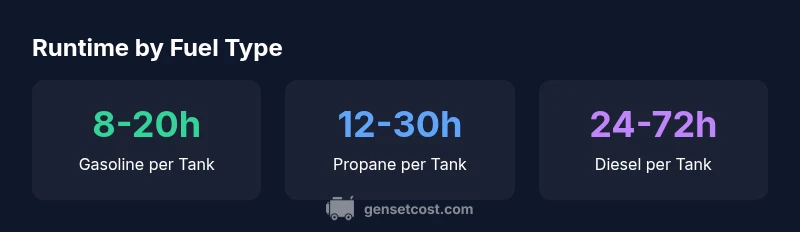
Determining how long a generator can run depends on fuel type, tank size, load, and efficiency. In practice, most home generators provide many hours of service; gasoline units often run roughly 8–20 hours per full tank under moderate load, while larger tanks or better efficiency extend that range. Always calculate based on your unit’s fuel consumption curves.
Understanding runtime basics
If you search for 'generator can run how long', you're asking for a practical method to estimate runtime based on fuel type, tank size, and load. Runtime means how many hours a generator can operate between refuels or fuel deliveries under a defined duty cycle. The core formula is simple: runtime = fuel capacity / burn rate at the expected load. Start with your fuel tank size and the manufacturer’s burn rate for the anticipated load, then adjust for surges from high-draw devices. Remember that standby generators and portable units behave differently: standby systems typically feature larger fuel reserves and automatic operation, while portable units rely on manual refueling. In 2026, the Genset Cost team emphasizes validating runtime with real-world data rather than brochure claims and tailoring estimates to your specific load profile.
Key factors shaping runtime
Runtime is not a fixed number; it shifts with several factors. First, fuel type and availability set the ceiling: different fuels burn at different rates and are stored in different tank sizes. Second, load or duty cycle determines how hard the engine runs: powering a few essential devices yields slower fuel consumption than running air conditioning and well pumps simultaneously. Third, engine efficiency and age matter: older units with worn components may burn more fuel to deliver the same power. Fourth, ambient conditions such as temperature and altitude influence performance and fuel burn. Fifth, fuel quality and storage duration matter: stale gasoline loses octane and volume; diesel or propane degrade differently. Sixth, the installation setup, including transfer switch sizing and parallel operation, affects effective runtime by changing how power is drawn. Finally, seasonal usage patterns (e.g., winter heating vs. summer cooling) determine typical load profiles. The takeaway: runtime depends on hardware and usage patterns. Genset Cost's analysis highlights the value of collecting real-world data from your home to refine estimates and avoid overreliance on generic tables.
How to estimate runtime by fuel type
Different fuels have different energy contents, storage options, and burn characteristics. Gasoline generators carry a finite tank; the runtime depends on the unit’s published burn rate (gallons per hour) at your expected load. For propane, larger or multiple tanks can extend operational hours, but efficiency depends on pressure and regulator performance. Natural gas can offer long runtimes as long as the gas supply remains uninterrupted; the limiting factor is the load and the regulator’s delivery capacity. Diesel units typically provide longer runtimes per tank at steady loads, with more predictable burn rates and larger fuel options. When comparing fuels, consider energy content, refueling logistics, and reliability during outages. Use model-specific fuel curves and your expected load profile to compute runtime, and verify estimates with a controlled load test. Genset Cost advocates validating runtime with real-world testing to avoid surprises during outages.
Sizing considerations: standby vs portable and continuous use
Standby generators are designed for extended outages and often include fixed installation with a transfer switch, enabling automatic startup and a larger fuel system. Portable units depend on user refueling and commonly have smaller tanks, so runtimes are shorter unless you add extra tanks. When sizing for runtime, estimate your essential circuits and duration needs. A practical approach is to match runtime to the expected outage duration in your area, supported by a formal load calculation to determine watts required and the corresponding fuel burn rate. For critical loads, consider dual-fuel options or a fixed natural gas connection to minimize refueling events. Maintenance also matters: a well-tuned engine burns fuel more efficiently and reliably, while neglect can increase burn rates. The bottom line: longer run times require careful sizing of both the generator and the fuel system, including tanks, lines, and regulators.
Practical tips to maximize runtime
To extend usable runtime without sacrificing reliability, start with larger tanks or parallel generator configurations to share the load. Implement load management: shed nonessential circuits during outages and stage critical loads to optimize burn rate. Consider dual-fuel configurations or a natural gas connection to reduce refueling events during prolonged outages. Schedule regular maintenance to keep burn rates low and ensure clean fuel systems. Store fuel properly and rotate stock to avoid stale fuel. Finally, perform periodic runtime tests under controlled conditions to confirm that your anticipated hours align with real performance.
Common pitfalls and checks before an outage
Avoid assuming a full tank always equals the stated hours. Real runtimes depend on actual load, surges, and the unit’s condition. Before an outage, verify that the transfer switch and any parallel system are correctly configured, fuel lines are free of leaks, and the regulator is delivering the required pressure for propane or natural gas. Run a pre-outage test to observe fuel consumption at your expected load and adjust expectations if necessary. Keep replacement parts and fresh fuel on hand, and document your test results to refine your future planning.
Runtime ranges by fuel type for typical home backup generators
| Fuel Type | Typical Runtime per Tank | Notes |
|---|---|---|
| Gasoline (portable) | 8-20 hours | Dependent on load and tank size |
| Propane (LPG) | 12-30 hours | Tank size varies; efficiency depends on regulator |
| Natural Gas (mains) | 30-100+ hours | Continuous supply; limited by load |
| Diesel (standby) | 24-72 hours | Tank size and load govern runtime |
People Also Ask
How long can a home generator run on a full tank under typical loads?
Runtime depends on fuel type and load. Gasoline units commonly run about 8–20 hours per full tank under moderate loads. Always consult your model’s burn rate and factor in startup surges for a precise estimate.
Most gasoline home generators run roughly 8 to 20 hours per full tank under typical outages.
Does runtime improve or worsen as load increases?
Higher loads generally reduce runtime because the engine consumes fuel faster. Moderate loads can improve efficiency, but surges from high-demand devices may shorten runtime temporarily. Plan for peak scenarios when sizing.
Runtime usually goes down as you pull more load; plan for peak use when sizing.
How do I estimate runtime for a given generator?
Use the unit’s burn rate at your expected load and divide your fuel capacity by that rate. Add a reserve and consider startup surges. Manufacturer curves and real-world tests improve accuracy.
Check the burn rate for your load and divide fuel capacity by that number.
Can I extend runtime without refueling?
Yes. Use a larger fuel tank, improve efficiency, or operate at a steadier, lower load. Dual-fuel options and natural gas connections also help reduce refueling events.
You can extend runtime with a bigger tank or a steadier load.
What’s the difference between standby and portable runtimes?
Standby generators usually have larger fuel reserves and automatic operation, delivering longer runtimes. Portable units depend on manual fueling and smaller tanks, resulting in shorter runtimes unless you add tanks.
Standby units tend to run longer due to bigger fuel supplies and automatic start.
“Runtime estimates are most reliable when you use model-specific fuel consumption curves and your expected load profile. Validate runtimes with your unit’s actual fuel curve.”
Key Takeaways
- Assess your load before selecting fuel type.
- Plan for fuel reserves based on outage probability.
- Use a sizing calculator to tailor runtimes to your home.
- Differentiate standby vs portable for true uptime.