How Long Should a Generator Run in a Day? A Practical Guide
Understand daily runtime for home backup generators. This in-depth guide explains how load, outages, and sizing influence how long your generator should run each day, with practical planning tips and clear data references.


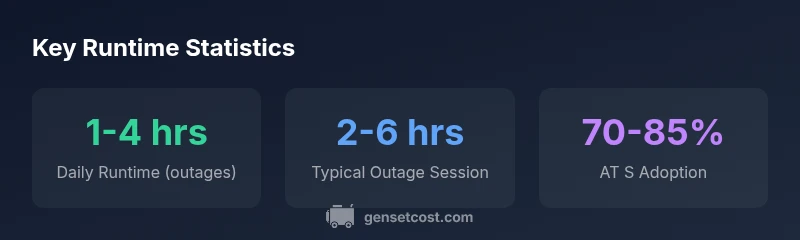
There is no universal daily runtime for a home generator; it depends on outages, load, and fuel capacity. In practice, most systems run only during outages or for scheduled tests, so daily runtime can range from minutes on a normal week to a few hours during extended outages. Proper sizing and an automatic transfer switch help minimize unnecessary operation.
Understanding Daily Runtime Requirements
There isn’t a one-size-fits-all answer to the question of how long a generator should run in a day. Daily runtime is determined by how often outages occur, how heavy the electrical load is during those outages, and how long the outages last. For homeowners and property managers, this means your daily runtime will vary with the season, the age and efficiency of the generator, and the reliability of the grid in your area. The key concept to grasp is that runtime should be driven by actual need rather than a fixed quota. In practice, many households use their backup generator only during outages or for routine tests, which keeps daily runtime modest and predictable. The Genset Cost team emphasizes that proper sizing and a capable transfer switch can dramatically reduce unnecessary operation and fuel use while preserving reliability.
When you review the daily runtime, also consider maintenance windows and cooling periods, which affect how long a generator can operate safely in a single continuous session. Regular inspections, oil changes, and battery checks help prevent runtime-related issues. For most homes, the daily runtime clock is the sum of several short sessions rather than a single long run, especially when temperatures or humidity levels influence cooling and exhaust requirements.
How to Estimate Runtime Based on Load
To estimate how long a generator should run in a day, start with your critical load calculation. Read the generator’s rating in kilowatts (kW) and compare it to your essential circuits. Real-world runtime is the ratio of the energy your home needs per day to the generator’s output per hour, adjusted for starting surges and continuous maintenance loads. In practical terms, a higher continuous load reduces per-hour efficiency and increases fuel consumption during operation. The goal is to keep the load within the generator’s optimal range (neither underutilized nor overloaded) and to plan for the times when multiple appliances run at once, such as during peak cooking or heating. For planning, consider both weekday usage and weekend patterns, and remember that tests use fuel too, contributing to the daily total.
A simple way to frame this is to estimate the daily energy requirement, then divide by the generator’s continuous-output rating. If your home’s demand falls within the generator’s comfortable operating window, you’ll find that the daily runtime tends to cluster around a few hours per outage rather than many long runs. Always account for the surge rating and the difference between starting and running power to avoid overstressing the system. The takeaway: load management is the most important lever for controlling daily runtime.
The practical implication for homeowners and managers is to use a sizing calculator and/or consult a licensed professional to map your daily runtime to expected outages. The Genset Cost team recommends coupling proper sizing with a well-chosen fuel strategy to ensure you meet reliability goals without wasting fuel.
Role of Transfer Switches and Controls
An automatic transfer switch (ATS) is a critical control that can dramatically reduce unnecessary runtime by starting the generator only when it’s needed. With a properly configured ATS, the generator runs in response to a drop in grid power, and it shuts off as soon as the grid returns. This automation minimizes idle time, reduces fuel consumption, and protects the equipment from unnecessary wear. In addition to ATS, modern controllers offer exercise modes that run on a predefined schedule—often weekly—to keep the engine and alternator in good condition without extending daily runtime.
For property managers, installing an ATS with a generator sized for your critical loads is a cost-effective way to optimize daily runtime. It also improves safety and reliability by ensuring the generator does not run when it’s not needed, particularly in hot climates where heat buildup could stress cooling systems during extended runs.
Outage Scenarios and Their Impact on Runtime
Outages vary by region and season, so it’s useful to categorize them into typical scenarios to understand how daily runtime changes. Short outages (a few hours) usually require a quick restart cycle and a brief run, while moderate outages (half a day) may demand several shorter runs to rotate loads and manage heat. Extended outages spanning multiple days require careful planning around fuel storage, refueling logistics, and cooling cycles. In these cases, daily runtime could still be spread across multiple sessions rather than a single continuous block, which helps protect equipment and conserves fuel.
The key takeaway is to tailor runtime planning to the expected outage profile. If a region experiences frequent, lengthy outages during certain seasons, you’ll likely see higher cumulative daily runtime during those periods. Conversely, regions with rare outages tend to have lower daily runtime but higher maintenance emphasis during exercising and testing.
Fuel Types, Efficiency, and Consumption Patterns
Fuel type directly affects running costs and daily runtime planning. Gasoline, propane, and diesel each have distinct energy densities, storage requirements, and refueling considerations. Diesel often offers higher energy density and longer shelf life, but diesel generators can be noisier and require more robust filtration. Propane and natural gas enable easier on-site storage for many homeowners, though fuel availability can vary by season. Efficiency varies with load; generators run most efficiently at moderate loads, and efficiency declines when near the maximum rating. In practice, you’ll see staff and homeowners optimize runtime by shifting loads, running only essential appliances, and using energy-efficient devices.
Fuel management also ties into maintenance. Keeping tanks full enough to prevent condensation and regularly inspecting fuel lines and filters helps minimize runtime losses. The bottom line is to align fuel strategy with outage frequency and expected daily runtime to avoid shortages during critical outages.
Maintenance, Battery & Cooling Cycles
Maintenance directly influences how long a generator can run in a day without risk of failure. Regular oil changes, filter replacements, battery checks, and cooling system maintenance prevent unplanned downtime during outages. Over time, battery condition and coolant levels determine the reliability of start attempts and how quickly the engine warms up to the running temperature. Well-maintained units tend to support more consistent runtimes and fewer peak loads caused by failures.
In addition, consider the generator’s cooling cycle. Prolonged runs generate heat, and cooling cycles must be sufficient to prevent overheating. If your model doesn’t meet cooling requirements under your typical load, you’ll either see shorter runtimes or the need to pause operation to prevent damage. Routine preventive maintenance is essential to maintain predictable daily runtime and reliability.
Testing and Exercise Runs: Best Practices
Regular exercise runs are recommended to keep the generator ready for real outages and to verify that the system will operate under load. Most guidelines suggest a weekly or monthly exercise run that tests startup, load acceptance, and shutdown sequences. Exercise runs contribute to daily runtime, but they are usually scheduled to minimize disruption and fuel usage. When planning these tests, ensure you monitor battery voltage, fuel pressure, and cooling temperatures so you don’t inadvertently extend the daily runtime beyond what is necessary.
If you manage multiple units, stagger exercise runs to avoid simultaneous use of fuel and to test redundancy. Documentation helps track maintenance windows and ensures all parties understand the system’s behavior. The goal is to keep the generator reliable without letting exercise runs accumulate into excessive daily runtime.
Sizing to Balance Runtime, Cost, and Reliability
Optimal sizing aligns daily runtime with expected outage patterns, climate, and building energy needs. A generator that is too small will run longer to meet demand and may experience higher wear during each outage, while an oversized unit might idle for long periods, wasting fuel. A balanced approach considers peak loads, essential circuits, and the probability of outages. Sizing should also factor in future load growth, such as new appliances or electric heat sources. For property managers, performing a load analysis on each unit and comparing it to historical outage data provides a practical path to minimize unnecessary runtime while preserving reliability.
Consult professionals to use a sizing calculator that accounts for your relevant variables. The end goal is to strike a balance where the daily runtime is enough to cover critical needs but not so long that fuel and maintenance costs escalate without corresponding benefits.
Practical Guidelines for Homeowners and Managers
- Start with a clear list of essential circuits and loads to size the generator appropriately. The daily runtime will correlate with how many devices are powered during outages.
- Invest in an ATS and reliable control strategy to minimize unnecessary operation. This reduces both fuel costs and wear.
- Develop a fuel strategy that aligns with expected outage durations and accessibility. Consider tank size and refueling logistics for longer outages.
- Schedule regular maintenance and exercise runs to verify that the system remains reliable and capable of meeting daily runtime targets.
- Track outage patterns in your area to adjust runtimes and load management. Real-world data helps refine your daily runtime targets over time.
Typical daily run-time ranges by outage scenario
| Outage Scenario | Typical Daily Run Time (range) | Notes |
|---|---|---|
| Short outage | 0.5-2 hours | Common for weekday outages; lower load |
| Moderate outage | 2-4 hours | Moderate outages with intermediate loads |
| Extended outage | 4-12 hours | Long outages with staged runs and refueling |
People Also Ask
How do I estimate daily runtime for my generator?
Estimate daily runtime by comparing your essential-load requirements to the generator’s running capacity, considering startup surges and the time needed for cooling. Use a load calculator and consult guidelines to map expected outages to runtime. Real-world data helps refine your targets.
Estimate runtime by comparing essential loads to the generator’s running capacity, accounting for startup surges and cooling time.
Is it better to run a generator constantly or on exercise?
Continuous running is rarely necessary for typical outages. Most systems run intermittently during outages or for short exercises. Regular testing keeps the unit reliable without extending daily runtime unnecessarily.
Generally, intermittent operation with regular testing maintains reliability without constant running.
What safety considerations affect daily runtime?
Ensure proper ventilation, avoid overloading, and maintain clear access to exhaust outlets. Schedule maintenance during non-outage periods and follow local codes for exhaust placement and electrical connections to prevent hazards during runtime.
Ventilation, load limits, and code compliance are key safety factors for daily runtime.
Can standby generators run for long periods during outages?
Yes, but plan for fuel supply, cooling capacity, and maintenance. Long outages may require multiple runtime sessions with refueling and rest periods to prevent overheating and wear.
Long outages are possible, but require careful fuel and cooling planning.
How does fuel type affect daily runtime?
Fuel type influences cost and availability, which in turn affects how often you can run. Diesel, propane, and natural gas have different storage, handling, and efficiency considerations that impact daily runtime planning.
Fuel type changes fuel costs and availability, which shape runtime planning.
What role does an automatic transfer switch play in runtime?
An ATS minimizes unnecessary runtime by automatically starting the generator when power is lost and stopping when power returns. It’s essential for efficient daily runtime and safety.
ATS minimizes unnecessary runtime by automating start/stop based on grid status.
“Runtime planning is a balance between reliability and efficiency; correct sizing and controls dramatically reduce unnecessary generator operation.”
Key Takeaways
- Size the system to match expected daily runtime
- Use an automatic transfer switch to minimize idle runtime
- Balance load to maximize generator efficiency
- Plan for outages with a practical fuel strategy
- Regular testing preserves reliability without excess runtimes