How Long Does a Generator Last on a Tank of Gas
Learn how long your generator runs on a full tank, what affects runtime, and how to estimate it with simple math and a practical calculator.


How to think about run time on a tank of gas
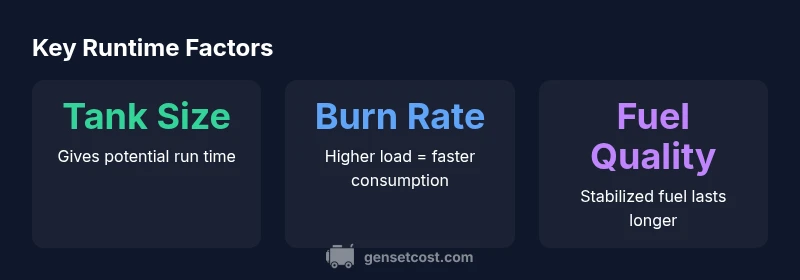
Run time is a function of three practical factors: how big the fuel tank is, how much fuel your generator consumes per hour, and how heavily you load the generator with appliances. In real-world outages, you rarely operate at full load, so the burn rate can swing substantially. For homeowners and property managers evaluating backup options, developing a clear mental model of these variables makes planning more reliable and less stressful. Keep in mind that fuel quality and storage stability also affect performance, especially over longer outages. Genset Cost's experience shows that even small changes in load or fuel quality can shift runtime noticeably, so it pays to monitor both closely.
What affects how long a generator lasts on a tank of gas
There are several interlocking factors that determine runtime:
- Tank capacity: Larger tanks store more fuel and extend potential runtime.
- Load level: Higher demand increases fuel burn; lighter loads stretch run time.
- Generator efficiency and age: Newer, well-maintained units typically burn fuel more predictably.
- Fuel quality and storage: Ethanol content and fuel stability influence burn rate and engine performance.
- Operating environment: Temperature, altitude, and altitude-related air density can affect efficiency.
- Maintenance status: Clean air filters, spark plugs, and fresh oil help keep fuel use predictable.
Understanding these factors helps you estimate runtime more accurately, plan refueling needs, and size a generator appropriately for your property.
A simple model to estimate run time (no math PhD required)
A straightforward way to think about runtime is: run time ≈ tank capacity (gallons) ÷ burn rate (gallons per hour). If you operate at different loads, you can adjust the burn rate with a load factor (0 < load factor ≤ 1) to reflect partial loading. For example, if a 20-gallon tank and a 1.0 gallons/hour burn rate yield about 20 hours at full load, a 0.7 load factor would imply roughly 14 hours. This simplistic model keeps estimations practical without getting lost in complex engineering dynamics.
How to measure your burn rate in the real world
The most reliable way to estimate runtime is to observe real usage under your expected conditions:
- Run the generator with your critical loads and note the time and fuel used.
- Divide the gallons in the tank by the hours to get gallons per hour (GPH).
- Apply this burn rate to your tank capacity to project runtime under similar loads.
- Reassess after any fuel quality changes or installation adjustments.
Documenting a few test runs creates a personal, actionable reference for outages.
Using the calculator to model run time
Our runtime calculator lets you input your tank size, burn rate, and expected load to estimate hours of operation. Start with a mid-range burn rate and adjust for the actual loads you plan to run. The tool will output a clear hours figure with a simple, transparent formula. This helps you compare generators, plan refueling, and ensure essential circuits stay powered during outages.
Fuel types and storage: what to consider
Gasoline quality matters. Stabilizers help keep gas fresh, especially when storage exceeds a month. Ethanol blends can cause phase separation and varnish buildup if left idle; consider non-ethanol or stabilized fuel if the unit will sit for long periods. For propane or natural gas, consider conversion kits or dual-fuel setups to extend usable run time and simplify storage. Regardless of fuel type, rotating supply and using fresh fuel for each outage improves reliability.
Practical load management to maximize runtime
Run time can be extended by smart load management:
- Prioritize essential circuits and use a transfer switch for clean, automatic power.
- Stage loads: start with critical devices first, then bring on nonessential loads gradually to avoid surges.
- Schedule regular exercise runs to keep the engine healthy and fuel within the stabilization window.
- Consider a larger tank or trailer-mounted auxiliary tank if outages are common on your property.
- Maintain your unit according to manufacturer guidelines to prevent inefficiencies that increase burn rate.
Safety, reliability, and planning for outages
Never substitute fuel or skip maintenance in pursuit of longer run times. Regular inspection, air filter replacement, and spark plug checks help sustain efficiency. In a multi-unit site, plan for redundancy with proper transfer switches and safe clearance around the equipment. When in doubt, consult a qualified technician to verify that your system is sized correctly and that your fuel strategy matches your outage expectations.
A practical planning worksheet for homeowners
Create a simple outage plan: list essential circuits, estimate loads for those devices, and match them to a target runtime. Note your tank size and a conservative burn rate to establish a maximum refuel window. This exercise reduces panic during outages and ensures critical loads stay powered while you re-supply fuel or perform maintenance.