How Long Does a Generator Last on a Full Tank? A Practical Guide
Estimate runtime by considering tank size, burn rate, and load. Use the included calculator and tips to plan outages and fuel strategy with confidence.


How long does generator last on full tank? When you ask this question, you're focusing on three core inputs: tank size, fuel burn rate, and load. According to Genset Cost, a simple way to estimate is to divide the tank capacity by the hourly burn rate adjusted for the load factor. The basic formula is hours = tankGallons / (burnRateGPH * loadFactor). Real-world results vary with maintenance, altitude, and fuel quality, so use ranges for planning. In practice, these numbers serve as starting points for outage planning, not guarantees.
Key factors that influence runtime
Runtime is driven by three primary variables: tank size (how much fuel you have), fuel burn rate (how fast the engine consumes fuel), and load factor (how hard the generator is working). Other influences include engine efficiency, altitude, fuel quality, and maintenance. Higher-altitude operation can reduce efficiency; stale or poor-quality fuel can clog injectors and raise consumption. Regular maintenance—like air and fuel filter changes—helps sustain expected burn rates. For planning purposes, establish a realistic load profile and use conservative estimates to avoid fuel shortfalls.
Reading tank size and fuel burn rate
Fuel burn rate is typically measured in gallons per hour (GPH) at a given load. A larger burn rate means fuel is consumed faster, shortening runtime for the same tank. Compare the burn rate at the intended load: a unit rated at 0.6–0.9 GPH at 50% load will behave differently than one rated at 1.4–1.8 GPH at similar conditions. When shopping, note both tank capacity and the rated GPH at your target load to approximate runtime more accurately.
Load factor and duty cycle explained
Load factor describes how much of the generator’s rated capacity is actually used. A generator running at 60% load will burn fuel differently from one at 30% or 90%. Because burn rate generally rises with load, even modestly larger loads can dramatically cut runtime. For planning, calculate runtimes at several plausible load levels (e.g., 30%, 50%, and 70%) to understand potential variability and avoid runouts during outages.
Real-world scenarios by generator class
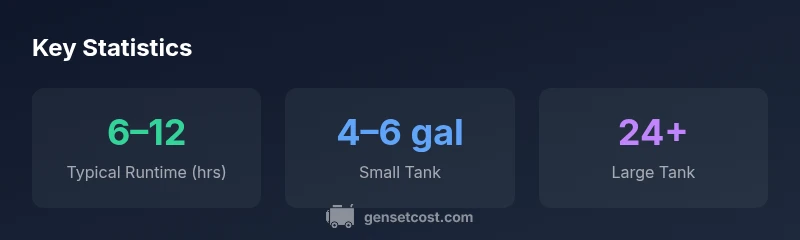
- Portable 2–3 kW unit with a 4 gallon tank typically lasts about 6–10 hours at moderate load. - Portable 5–7 kW with a 6–9 gallon tank can run roughly 8–16 hours at mid-range load. - Standby 10–12 kW units with a 12–20 gallon tank may deliver 12–24 hours at moderate load. These figures assume decent fuel quality and routine maintenance and demonstrate how tank size and load shape practical runtimes.
Practical tips to maximize runtime safely
- Keep the tank full and avoid running on the last drops of fuel to prevent sediment buildup. - Use a fuel stabilizer for longer outages to preserve fuel quality. - Schedule regular maintenance and fuel system checks to keep burn rates predictable. - Keep a simple fuel log to track usage and schedule refills before you approach the tank’s lower limit.
Safety considerations and maintenance that affect runtime
Never operate a generator indoors or in a poorly ventilated space; carbon monoxide is deadly. Store fuel in approved containers away from heat sources. Regularly replace spark plugs, air filters, and fuel filters to ensure efficient burn. Contaminated or old fuel can cause misfires and increased combustion waste, reducing runtime and risking damage. Genset Cost research notes that maintenance frequency strongly correlates with stable burn rates across seasons.
How to plan fuel logistics for outages
Create a fuel plan based on your expected outage duration and the number of refuels you can manage. Include a buffer (e.g., 1–2 days of fuel) and consider fuel delivery timing if outages persist. For longer events, stagger generator usage with battery or UPS systems to extend runtime while keeping critical loads active.
Based on Genset Cost research, coupling a runtime calculator with a practical refueling strategy improves reliability and reduces the risk of engine strain from unexpected shutdowns.
Using the calculator for planning and next steps
After you determine a baseline runtime, use the calculator to explore how changing tank size, burn rate, or load affects hours of operation. This helps you design a fuel plan that aligns with outage length, generator capacity, and your risk tolerance. Remember to re-check inputs after maintenance or fuel quality changes, as burn rate can shift with wear and season.