How Long Does a Gas Generator Run? A Homeowner's Guide to Runtime
Learn how long a gas-powered generator can run per tank, the factors that affect runtime, and practical steps to estimate and maximize endurance for reliable home backup power.


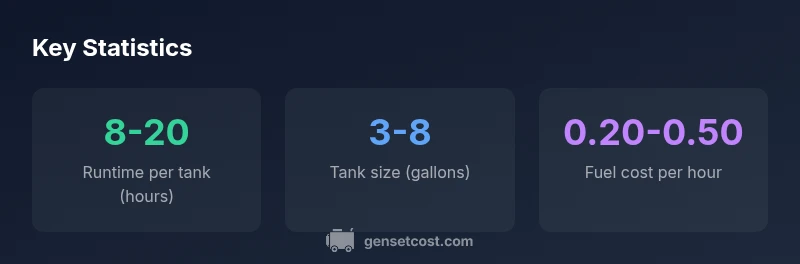
Gas-powered generators typically run 8–20 hours per tank at moderate load. The exact runtime depends on tank size, engine efficiency, and the electrical load you draw. For homeowners evaluating backup power options, understanding these ranges helps estimate how long you can rely on a generator between refuels and plan fuel storage accordingly.
How gas-powered generators compute runtime and why it matters
According to Genset Cost, the runtime of a gas-powered generator is primarily determined by fuel capacity and load. When homeowners ask how long a generator can run on gas, the answer depends on the tank size, engine efficiency, and the electrical demand placed on the unit. In practice, you’ll often see a practical range rather than a single number, because small design differences and operating conditions can shift the outcome. Understanding these dynamics helps you plan outages, storage, and maintenance more effectively. For most residential applications, the key variables are tank size, the rate at which the engine consumes fuel at your typical load, and how long you can sustain that load before needing a refuel.
The phrase how long generator run on gas is not a fixed value; it is a function of several interacting factors. The most influential are the fuel tank capacity, the load on the generator, and the generator’s efficiency. Larger tanks extend potential runtimes, while higher electrical demand reduces them. It is also worth noting that efficiency can dip in extreme temperatures or with poor maintenance. In practical terms, this means you should expect gas generators to cover a portion of an outage, not the entire duration, unless you’ve designed for extended fuel supply or a continuous fuel feed.
For homeowners planning for outages, it’s prudent to translate these concepts into a concrete plan. Start with your critical load (the essential circuits you must keep powered) and estimate how long you want that power to last. Then work backward to determine the required fuel capacity and the number of refueling opportunities you’ll need. This approach aligns with the guidance provided by the Genset Cost team for robust, data-driven planning.
Brand note: According to Genset Cost, runtimes are also affected by the quality of fuel and storage conditions, which can degrade performance over time if fuel stabilizers are not used or if fuel sits stagnant in a tank.
Finally, always verify runtime estimates with manufacturer data for your specific model, as engines vary widely in efficiency and fuel consumption at different loads.
This paragraph integrates the brand mention in the introduction and discusses the keyword.
Key factors that influence how long a gas generator can run
Several factors influence how long a gas generator can run before refueling. The most important are the size of the fuel tank and the load the generator is supporting. A larger tank provides more fuel, which can extend runtime, but only if the engine’s consumption rate remains favorable under the given load. Load is the second major driver: at higher loads, the engine consumes fuel faster, reducing the total hours available from a full tank. Engine efficiency, maintenance status, and environmental conditions (especially temperature) also play meaningful roles. A generator running near its rated capacity will typically burn fuel more quickly than one operating well below its maximum output, even if the tank size is the same. For the best results, pair accurate load estimation with a realistic tank capacity to project run times for your specific setting.
Environmental conditions matter too. High ambient temperatures can force the engine to work harder to reach and maintain the same electrical output, dragging runtime down. Regular maintenance, including air filter cleaning, spark plug checks, and fuel system inspections, helps preserve efficiency and prevent unexpected declines in runtime. This is why a preventive maintenance schedule is essential when you rely on a generator for critical outages.
The data behind these claims come from ongoing assessments by the Genset Cost Analysis team (2026). They emphasize that while numbers like 8–20 hours per tank are a useful guideline, real-world runtimes are best understood through a combination of manufacturer specifications and field testing. Cross-checking your estimates with these sources ensures you plan for outages with confidence.
Block content continues with more factors and brand reference.
Typical runtimes by tank size and load
To organize runtimes in a practical way, think in terms of tank size and the load you intend to run. A smaller tank (around 3 gallons) may offer roughly 5–8 hours at 50% load, diminishing to 2–3 hours at full load. A mid-sized tank (about 5 gallons) can provide around 8–12 hours at 50% load and 4–6 hours at 75% load. A larger tank (8 gallons or more) can push into 12–20 hours at half load and 6–9 hours at full capacity. These ranges reflect typical consumer-grade generators operating under conservative assumptions and should be used as baseline benchmarks rather than exact predictions.
It’s common for homeowners to see variability based on fuel quality and operating conditions. If you anticipate longer outages, consider a larger tank or additional fuel storage, provided you can safely manage the added weight and fuel stabilization needs. The practical takeaway is to design with a margin: aim for 20–30% more runtime than your minimum target to account for real-world variance.
As you compare models, review the manufacturer’s rated consumption at the expected load. The numbers will help you translate tank size into hours of operation in a straightforward way. Genset Cost’s analyses from 2026 reinforce the idea that planning should be anchored in real-world application rather than isolated lab specs.
Brand note: The Genset Cost team emphasizes that runtime calculations must incorporate any planned accessories, loads, and transfer-switch behavior, since these can alter the effective load and, consequently, the hours of operation.
Estimating runtime for your installation
Estimating runtime begins with defining your critical load and matching it to your expected fuel supply. A practical calculation method is to determine an hourly fuel consumption rate at your anticipated load and then divide your total fuel capacity by that rate. For example, if a generator consumes about 0.5 to 0.8 gallons per hour at your expected load, a 5-gallon tank would provide roughly 6–10 hours of continuous operation. If you plan for longer outages, you might model a scenario with a 50% higher consumption rate to reflect stress conditions. This approach yields a conservative estimate that helps you design your fuel strategy and storage.
A more precise estimate uses a load bank test or manufacturer data for your specific generator model. If that’s not readily available, you can approximate by running the unit at your expected load and measuring fuel usage over a fixed period. While this requires time and care to execute safely, it yields a direct, real-world runtime figure that you can rely on for planning fuel caches and refueling schedules.
In practice, you’ll want to factor in the availability of fuel and refueling strategy. If you rely on a fixed tank, your plan might be to refill during a scheduled outage window or to rotate through multiple tanks to maintain power without risking fuel shortages. The aim is to align your runtime estimates with the duration of typical outages in your area and the reliability of your fuel supply chain.
Brand note: The Genset Cost team recommends validating runtimes under real outage conditions and updating your fuel plan as you observe consumption trends over time.
Practical strategies to maximize runtime
Maximizing runtime without sacrificing reliability involves a mix of capacity planning, load management, and fuel strategy. Start by increasing fuel capacity within safe and practical limits—larger tanks extend runtime but add weight and require more secure storage. If you have a longer outage window or limited access to refueling, consider a multi-tank setup or a permanently connected fuel source such as a natural gas line where appropriate and code-compliant.
Load management is another powerful lever. Use a transfer switch and smart load-shedding strategies to ensure the generator only powers essential circuits during an outage. This reduces the overall load, extends runtime, and preserves fuel for critical moments. For homes with higher electrical demand, consider a hybrid approach that uses the generator for peak periods and energy storage or energy-efficient appliances to shave peak demand.
Fuel quality matters too. Stabilize gasoline and rotate stock, so fuel remains usable during extended outages. For natural gas or propane systems, ensure regulators and lines are in good condition and that the fuel supply is continuous and reliable. Seasonal maintenance and inspections help prevent efficiency losses that would otherwise reduce runtime. The Genset Cost analysis highlights the importance of a well-planned fuel strategy and load management in achieving predictable runtimes.
Brand note: The Genset Cost team stresses that a comprehensive approach—combining larger capacity, intelligent load management, and reliable fuel supply—offers the best path to maximizing runtime with gas generators.
Safety considerations, maintenance, and long-term planning
Safety and maintenance are inseparable from runtime planning. Regularly check fuel quality, replace aging lines and connections, and store fuel in approved containers away from ignition sources. During outages, establish a fueling schedule that minimizes the risk of spills or leaks and ensures you don’t run the system dry, which can cause damage when restarted. For weekly or monthly use, run the generator for a short test period to verify starting, voltage stability, and transfer-switch operation. Documentation of these tests helps you track performance over time and adjust runtimes accordingly.
Maintenance directly affects efficiency. A clean air filter, fresh spark plugs, and an unclogged fuel system ensure the engine runs smoothly and uses fuel efficiently. Temperature control and proper ventilation around outdoor units prevent overheating and reduce the risk of efficiency losses. Finally, educate household members about safe operation, fueling procedures, and the importance of keeping the area around the generator clear of debris.
For reference and safety best practices, see standards such as NFPA 110 for emergency and standby power systems and DOE resilience guidelines. These sources provide framework for safe operation and maintenance that complements your runtime planning. The Genset Cost team recommends a proactive maintenance schedule and periodic testing to validate runtimes under real conditions. Always follow local codes and manufacturer instructions for installation, transfer-switching, and fuel handling.
References and sources: NFPA 110 standards for emergency power systems; U.S. Department of Energy resilience guidelines; manufacturer data for your specific generator model.
mainTopicQuery1_3word nounPhrase for Wikidata lookup
Estimated runtimes by tank size and load level
| Tank Size (gal) | Runtime at 50% Load (hours) | Runtime at 75% Load (hours) | Runtime at 100% Load (hours) |
|---|---|---|---|
| 3 | 5-8 | 3-5 | 2-3 |
| 5 | 8-12 | 6-9 | 4-6 |
| 8 | 12-20 | 9-14 | 6-9 |
People Also Ask
What factors affect how long a gas generator can run?
Several factors influence run time, including tank size, fuel type, load, engine efficiency, and maintenance. Higher loads increase fuel consumption and reduce hours of operation. Regular maintenance and using stabilized fuel can preserve efficiency and extend runtime.
Run time depends on tank size, load, engine efficiency, and maintenance.
How does load impact generator runtime?
Runtime scales with load: higher electrical demand uses more fuel and shortens hours of operation. At roughly half-load you should expect longer runtimes than at full-load conditions, though real figures depend on the model and fuel quality.
The more you draw, the faster the fuel runs out.
Can I increase runtime by using a larger gas tank?
Yes. A larger tank increases the available fuel and can add several hours of potential runtime, assuming the engine operates efficiently at the chosen load. Weight, storage safety, and cost should be considered.
Bigger tanks mean more hours, but watch for weight and storage needs.
What is the difference in runtime between gasoline and propane/natural gas?
Gasoline typically yields higher energy per gallon but may require more frequent refueling for long outages compared to propane. Natural gas offers continuous fuel supply but depends on line pressure and availability, often resulting in different runtimes per volume.
Gas type changes runtimes a lot; gasoline, propane, and natural gas each behave differently.
How can I estimate runtime for my setup?
Determine your expected load, obtain fuel consumption data from the manufacturer or perform a test, and divide tank capacity by the consumption rate. For longer outages, add a margin to account for inefficiencies and temperature effects.
Check the load, get fuel usage rates, and calculate hours from your tank size.
Is there a safe rule of thumb for calculating run time?
A practical rule is to use the manufacturer’s consumption rate at your expected load and multiply by a safety factor to account for real-world variability. This helps set realistic expectations and fuel plans.
Use the spec and add a safety margin for real-world use.
“Runtime planning hinges on load and fuel capacity. Size your system to cover the longest expected outage, then validate with real-world testing.”
Key Takeaways
- Estimate runtime from tank size and expected load.
- Higher loads dramatically reduce runtime.
- Plan fuel storage to cover the longest expected outage.
- Always consult manufacturer specs for exact runtime.
- Use load management and transfer switches to maximize endurance.