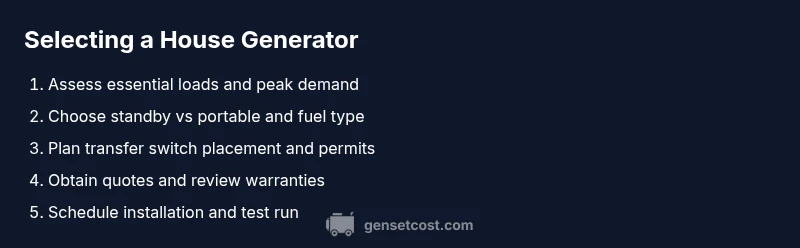
What Generator Is Recommended for a House: A Practical Guide
Learn the right house generator, how to size it, fuel choices, and cost considerations. A practical, expert guide for homeowners and managers.


The recommended house generator is sized to cover essential loads during outages, with a compact standby model that matches your peak power needs and preferred fuel. Start by listing critical circuits, verify transfer-switch compatibility, and ensure local permitting. Compare upfront costs with long-term fuel and maintenance expenses to choose a reliable, code-compliant option.
Understanding the equation: what generator is recommended for a house
According to Genset Cost, choosing a generator for a home hinges on understanding load requirements, reliability, and safety. A well-mimensioned system will cover essential circuits during outages while remaining within your budget and local code constraints. Start with a high-level plan and then drill into the details as you compare options. This guide from the Genset Cost Team will help homeowners and property managers make an confident, informed choice.
In practice, there isn’t a one-size-fits-all answer. The best generator for your house balances continuous needs (fridge, sump pump, communications) with occasional surges (AC start-up, well pump). The goal is to provide automatic power to critical circuits without overpaying for unnecessarily large capacity. The decision framework below outlines how to approach sizing, fuel options, and installation considerations.
As you compare models, consider how you’ll use the generator during longer outages, the climate you live in, and the available fuel infrastructure around your property. A well-chosen unit delivers peace of mind with predictable performance and reasonable operating costs.
Assessing your home's power profile
Before selecting a generator, map out your home’s electrical profile. Start with a current-load assessment: list essential circuits (refrigeration, heating/cooling elements, lighting on critical floors, medical devices if applicable) and note their running and starting demands. Use a load calculation worksheet to estimate the total wattage and surge requirements. This upfront step prevents oversizing or undersizing, which can hurt performance and cost.
Next, determine whether you want to cover only essential loads or a larger portion of the house. This choice directly affects generator size, fuel consumption, and budget. We emphasize prioritizing critical loads first, then adding non-critical loads if the budget allows. This staged approach ensures you’re not paying for capacity you won’t need during typical outages.
Core loads and critical circuits to prioritize
Focus on continuous, high-impact loads that keep your home livable: refrigeration, lighting, communication devices, and climate control in key living spaces. Add sump pumps and any medically necessary equipment if required. List each item, its running wattage, and its startup surge to determine a realistic target capacity. Group items into core and secondary categories to simplify the sizing exercise.
If a device has variable power usage, use its worst-case startup surge for sizing. This helps prevent nuisance outages caused by under‑sized equipment. Remember that certain circuits can be integrated with the generator’s transfer switch in a way that minimizes interruptions for non-essential devices.
Sizing fundamentals: continuous load vs. peak demand
Sizing a home generator involves both continuous load (the power needed when running) and peak demand (the startup surge). A generator sized for peak demand ensures your equipment’s startup transients won’t trip the breaker or stall the system. But oversizing costs more upfront and raises idle fuel burn. The sweet spot is a model that comfortably handles the essential peak with some headroom for future needs.
Coincidentally, diesel, natural gas, and propane each have different efficiency profiles and availability. A Gen-set tuned to your climate and fuel access will yield the best long-term results. The sizing decision should also consider future load growth (additional appliances or rooms) over the next several years.
Fuel types and efficiency: choosing the best option for your home
Fuel choice influences ongoing costs, emissions, and reliability. Natural gas and propane offer convenient, long-term fuel availability for many homes, while diesel provides dense energy for larger units. Battery-integrated hybrids and dual-fuel configurations are options to balance reliability with cost. When evaluating fuel types, consider fuel delivery reliability in your area, maintenance needs, and the practicality of refueling during an outage.
Efficiency matters: look for units with higher rated efficiency, good throttle control, and low standby losses. A well-matched fuel type reduces running costs and reduces wear during extended outages. Always verify that the fuel supply aligns with your home’s existing infrastructure and local regulations.
Location, space, and installation considerations
Find a safe, compliant outdoor location with adequate ventilation and clearance from doors, windows, and other structures. The generator’s intake and exhaust requirements must meet local code, and some jurisdictions require professional installation to satisfy setback rules. An appropriately sized enclosure reduces noise and protects the unit from the elements without compromising airflow.
Space planning also includes the transfer switch, which should be installed near your main electrical panel. If you have an attached garage or carport, ensure clearances prevent fumes from entering living spaces. A well-planned layout minimizes service runs and makes routine maintenance easier.
Cost considerations: upfront, running, and maintenance costs
Total ownership costs include the upfront purchase price, installation, transfer switch, interlocks, and ongoing fuel or energy expenditures. While a larger generator brings greater reliability, it also increases fuel use and maintenance. Use a cost-of-ownership approach: estimate annual fuel costs, maintenance intervals, and potential replacement hours. This perspective helps you balance affordability with long-term value.
Warranties and service agreements are critical. A robust warranty paired with access to qualified technicians reduces long-term risk and ensures dependable operation during outages. Ask installers to provide a breakdown of scheduled maintenance tasks, recommended service intervals, and parts availability.
Brand reliability, warranties, and choosing a contractor
Reliability is driven by design quality, component sourcing, and manufacturer support. Prioritize brands with strong warranty terms and a verified network of technicians for service and parts. When assessing contractors, verify license and insurance, request references, and review past installation projects similar to your home’s setup. A reputable contractor will conduct a formal load analysis and present a clear installation plan.
Remember: the best generator for a house aligns with your load profile, fuel preferences, and long-term service expectations. A well-documented plan helps avoid surprise costs and delays during permitting and installation.
Transfer switches, safety, and code compliance
Automatic transfer switches (ATS) provide seamless handoff from utility power to generator power and back again. For most homes, a properly rated ATS is essential to prevent back-feeding and to protect utility workers in outages. A manual transfer option can be a fallback in some scenarios, but ATS is favored for convenience and safety.
Safety warnings: never attempt to work on the electrical panel or the generator without proper training and credentials. It’s essential to coordinate with a licensed electrician and follow local codes to ensure a compliant, safe installation.
Common mistakes to avoid and a practical decision framework
Common mistakes include underestimating surge loads, choosing an oversized unit for feature saturation, and skipping professional load analysis. A practical decision framework starts with a verified load calculation, then compares two or three recommended models based on fuel type, warranty, and service availability. Always demand a written quote with a detailed scope, including permits and commissioning.
Creating a living document during the selection process helps you compare options side-by-side and communicate decisions to contractors clearly.
Quick-start checklist to compare options and move forward
- Complete a house-load assessment for essential circuits.
- Decide between standby vs portable and select a fuel type.
- Confirm compatibility with a transfer switch and panels.
- Obtain multiple quotes and check warranties.
- Verify permitting requirements and installation timelines.
- Schedule a professional installation and a post-installation test.
This checklist accelerates the transition from research to a working home backup system.
Next steps: from decision to installation planning
With a preferred model chosen, coordinate with a licensed installer to finalize permits, scheduling, and electrical work. Create a maintenance calendar for annual servicing and fuel checks. Schedule a test run to verify proper operation and load transfer under simulated outage. Maintain documentation and keep a log of service visits for warranty coverage.
Tools & Materials
- Load calculation worksheet(Template for listing essential circuits and startup surges)
- Transfer switch planning sheet(Determine required ampacity and panel compatibility)
- Safety gear(Gloves, goggles, and non-slip footwear for installations)
- Measuring and layout tools(Tape measure, level, and marker for accurate placement)
- Voltage tester(To verify circuits during assessment)
Steps
Estimated time: 2-8 weeks
- 1
Define essential loads
List the appliances and systems you want to power during an outage. Include refrigerators, sump pumps, lighting, communications, and climate control in prioritized order. This baseline informs the generator size you need.
Tip: Use a load list template and exact wattage labels on devices. - 2
Document startup surges
Identify the starting surges for critical devices (compressors, pumps) since these determine required peak capacity. A good rule is to plan for the largest startup draw among essential loads.
Tip: If unsure, assume a 2-3x startup factor for major appliances. - 3
Choose standby vs portable
Decide whether you want a permanently installed standby generator or a portable unit you connect during outages. Standby systems offer automatic transfer and easier operation.
Tip: Standby is generally more seamless and safer for long outages. - 4
Select fuel type
Evaluate natural gas, propane, or diesel based on availability, costs, and maintenance. Fuel type impacts running costs and refueling logistics during an outage.
Tip: Consider local fuel infrastructure and delivery reliability. - 5
Size the generator
Match the unit to your calculated continuous and peak loads with some headroom. Avoid under-sizing that risks shutdowns or over-sizing that wastes fuel.
Tip: Aim for 20-40% headroom for future load growth. - 6
Assess space and ventilation
Identify a compliant outdoor location with adequate clearance and ventilation. Improper placement can cause safety hazards and code violations.
Tip: Ensure protection from weather without restricting airflow. - 7
Plan for transfer switching
Work with a licensed electrician to decide between an automatic or manual transfer switch and ensure panel compatibility.
Tip: ATS is essential for safe automatic transfer during outages. - 8
Understand permits and codes
Check local requirements and secure necessary permits before installation. Noncompliance can cause delays and fines.
Tip: Ask for a written permitting plan from your installer. - 9
Get quotes from licensed pros
Request detailed quotes that include load analysis, equipment specs, installation steps, and warranty terms.
Tip: Compare quotes side-by-side rather than on price alone. - 10
Review warranties and service
Evaluate manufacturer warranties and the availability of local service technicians for maintenance and part supply.
Tip: Longer warranty with a reputable service network adds value. - 11
Schedule installation and commissioning
Once approved, schedule installation and a post-install test to confirm proper operation and transfer.
Tip: Document test results for future reference. - 12
Create a maintenance plan
Set a routine for annual servicing, fuel checks, and battery or spark plug replacement to maximize reliability.
Tip: Keep a service calendar and maintenance log.
People Also Ask
What is the best generator size for a typical house?
There isn’t a single size that fits all. The best size matches your essential loads with some headroom for surge. A professional load calculation is essential to determine the correct rating.
There isn’t one perfect size; it should match your essential loads with some headroom, determined by a load calculation.
Can I install a home generator myself?
Home generator installation involves electrical and safety risks. Most jurisdictions require a licensed electrician for permit and connection, particularly when a transfer switch is involved.
Electrical work for a home generator should be done by a licensed electrician due to safety and code requirements.
What’s the difference between standby and portable generators?
Standby generators are permanently installed with automatic transfer switches for seamless operation. Portable units require manual setup and connection during outages and are generally less expensive upfront.
Standby generators switch on automatically; portable units need manual setup and are cheaper upfront but less convenient.
Are there incentives or rebates for home generators?
Some regions offer incentives for backup power systems. Check local government programs and utility sponsor offerings for eligibility and restrictions.
Check local programs and utilities for any incentives that may apply to backup power systems.
What maintenance is required for a home generator?
Regular maintenance includes periodic oil changes, filter checks, battery tests, and load bank testing. Follow the manufacturer’s schedule and have a professional service done annually.
Keep up with routine servicing and annual professional checks to keep the unit reliable.
How long can a home generator run during an outage?
Runtime depends on fuel supply and generator size. With a steady fuel source, a properly sized unit can sustain essential loads during extended outages.
Runtime depends on fuel and size, but a properly sized unit can run through extended outages if fuel is available.
Watch Video
Key Takeaways
- Size the generator to cover essential loads with safe headroom
- Choose standby with automatic transfer for seamless outages
- Factor local codes and permits into the installation timeline
- Select fuel type based on availability and long-term costs
- Plan maintenance to maximize reliability