Generator Size for House: A Practical Sizing Guide
Learn how to size a home standby generator with a clear, step-by-step method. We cover load calculations, essential circuits, fuel choices, safety margins, and installation considerations to choose a reliable generator for your house.


This guide helps homeowners determine the right generator size for their house by teaching load calculation, essential circuit assessment, and margin planning. You will learn a step-by-step method, common pitfalls, and ways to balance reliability with cost. According to Genset Cost, most homes benefit from sizing that covers essential loads plus a conservative margin to handle startup surges and future needs.
Why sizing matters
Sizing a generator is not merely picking the largest unit you can afford. An undersized generator will struggle during peak loads, trip breakers, and fail to sustain critical systems like heating or refrigeration. An oversized generator wastes fuel, shortens equipment life, and increases upfront and operating costs. Getting the generator size for house right improves reliability, reduces wear on equipment, and lowers long-term energy costs. According to Genset Cost analyses, homeowners who size their system to cover essential loads plus a conservative margin report fewer outages and more predictable performance in outages. Use a clear, repeatable method to quantify loads and apply a safety buffer. This article walks you through practical steps to determine the appropriate generator size for your climate, home size, and daily routines.
How load calculation works
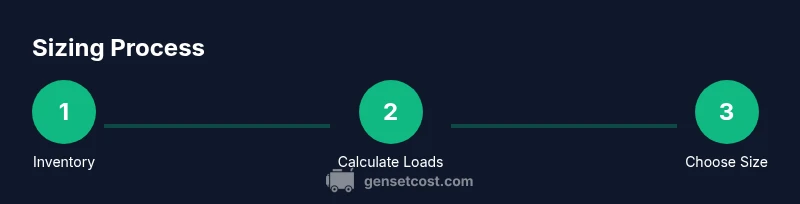
Understanding load calculation is the backbone of proper sizing. Start by listing every device and its running watts, then account for starting watts for motors and compressors. The running watts indicate ongoing energy use, while starting watts capture surge demands when equipment starts up. A common approach is to sum running watts for essential appliances and use a conservative multiplier to cover surges (often 1.2x to 1.5x for a practical margin). Remember that certain loads, like air conditioners, heat pumps, and well pumps, have higher starting requirements. After you estimate running and starting watts, apply a safety margin and compare against standard generator sizes. This process helps you avoid both under- and over-sizing while balancing cost and reliability. Genset Cost recommends validating your numbers with a professional calculator or contractor to ensure accuracy.
Appliances and circuits to include
To size accurately, include the most energy-intensive and essential loads first. Typical items are the refrigerator, freezer, well pump, furnace or heat pump, water heater, space heating in colder climates, central air conditioning, electric ranges, and clothes dryers. Don’t forget circuits for sump pumps, security systems, and home offices with multiple high-demand devices. Some lights and electronics draw minimal power but can accumulate during an outage. Create a structured list with appliance type, running watts, and starting watts if known. If a device’s wattage isn’t listed, use manufacturer manuals, a watt meter, or a conservative estimate. This comprehensive inventory ensures the sizing exercise reflects real home energy behavior. This is also the moment to consider energy efficiency upgrades that could reduce required generator size.
Fuel types and efficiency considerations
Generator efficiency depends heavily on the fuel type and the load profile. Natural gas and propane units have different fuel costs, availability, and efficiency characteristics than diesel units. In homes with ready access to natural gas, a larger, continuous-duty unit may be cost-effective because fuel is readily supplied and does not require refueling during extended outages. For homes without natural gas, propane or diesel may be alternatives, each with storage and maintenance considerations. Fuel type also influences startup performance, noise, and emissions. When evaluating options, compare running costs over typical outage durations, not just upfront price. Genset Cost’s analysis highlights how fuel type and efficiency influence life-cycle costs, encouraging homeowners to weigh immediate cost against long-term reliability and convenience.
Sizing strategies for different home sizes
Most houses fall into broad sizing bands, influenced by climate, insulation, and appliance efficiency. Smaller homes with simple layouts often require roughly 5–12 kW to cover essentials like refrigeration and lighting. Medium-sized homes with moderate heating/cooling and multiple baths may need 12–20 kW. Larger homes with central air, high-efficiency HVAC, multiple refrigerators, or electric heat can require 20–40 kW or more. These are general ranges observed in the market and should be refined with a load calculation. Remember that local climate and electrical codes can affect final sizing. The goal is to reliably power critical loads during outages while avoiding excessive oversizing that wastes fuel and money.
Safety margins, transfer switches, and code considerations
A key part of sizing is planning for safety margins and proper installation. A typical backup system should include a transfer switch to isolate the home from the grid during an outage, preventing backfeed and ensuring safe generator operation. Check local electrical codes and permits, as requirements vary by jurisdiction. An undervalued margin can result in frequent nuisance trips or unacceptable loss of critical loads, while over-sizing may lead to unnecessary fuel use and higher installation costs. Engage a licensed electrician to verify wire sizes, panel capacity, and transfer-switch compatibility. This collaboration helps ensure your generator size for house aligns with safety standards and long-term reliability.
Case studies: typical scenarios
Scenario A describes a small, single-story home in a temperate climate with a compact kitchen and one bathroom. In this case, a compact, reliable unit around 8–12 kW often covers the fridge, well pump, lights, receptacles, and basic HVAC controls. Scenario B covers a larger, two-story home with central AC, multiple baths, a high-end kitchen, and electric heating. Sized appropriately, this home may require a 20–40 kW system to sustain essential loads, including heating and refrigeration, during outages. Both scenarios illustrate the principle: identify essential loads first, add a conservative margin, then verify against available generator sizes. Genset Cost emphasizes tailoring each sizing decision to actual loads and local conditions.
Steps to verify your sizing (checklist)
- Create an appliance inventory with running and starting watts where possible.
- Sum essential loads to establish a base running wattage.
- Add a conservative surge factor for startup loads.
- Determine a target generator size range that accommodates future needs.
- Confirm panel space, space for installation, and transfer-switch requirements.
- Consult a licensed electrician or use a reputable load calculator for final validation.
- Review fuel options, availability, and long-term operating costs.
- Plan for maintenance and service access during outages.
Planning for future needs and upgrades
Your home may evolve: a new HVAC system, a second refrigerator, or an electric vehicle could change the load profile. A future-proof sizing approach considers modular expansion, ease of adding circuits, and compatibility with a larger panel if needed. Look for generators that support outdoor installation, quiet operation, and reliable cold-weather performance if you live in a climate with severe winters. Budget for future upgrades in the initial plan, and factor in regular maintenance, fuel storage, and periodic testing to ensure reliability when outages occur. A thoughtful plan minimizes future disruptions and simplifies any later expansion.
Tools & Materials
- Digital load calculator software or app(Use per-appliance wattage data sheets and real-time sum calculations to avoid manual errors)
- Multimeter and clamp meter(To verify circuit loads and amperage on critical circuits)
- Appliance wattage references or owner manuals(Includes running and starting watts for motors and compressors)
- Installation access plan (panel layout, transfer-switch location)(Essential for contractor planning and code compliance)
- Paper or spreadsheet for load inventory(Helpful for organizing data before entering into calculators)
Steps
Estimated time: 2-3 hours
- 1
Gather appliance wattages and circuit details
Collect running watts for every essential device and note any high-draw appliances. Include lights, outlets, and electronics. If data isn’t available, use manufacturer manuals or a watt meter to estimate conservatively.
Tip: Having manuals handy speeds up accurate gathering and reduces estimation errors. - 2
Estimate running vs starting watts
Differentiate between running and starting watts, especially for motors like refrigerators and air conditioners. Use starting watts for surge calculations and add a buffer for safety.
Tip: Start with motor-heavy loads first to capture peak surges early. - 3
Apply diversity/demand factors
Apply a modest diversity factor to avoid overestimating peak demand. This reflects that not all loads run at full power simultaneously. Use 1.0–1.3x for safety-critical analysis, adjusting for climate and usage patterns.
Tip: Conservatism pays off when outages last longer than expected. - 4
Add a safety margin
Add at least a 10–20% margin to cover future needs and unexpected surges. This reduces the likelihood of nuisance trips and ensures stable operation.
Tip: If you expect future upgrades, tilt the margin toward larger capacity. - 5
Choose a size range and fuel type
Match your calculated load to a generator size range that aligns with the available models and your preferred fuel (natural gas, propane, or diesel). Consider climate, fuel costs, and storage needs.
Tip: Natural gas often supports larger, continuous-duty units with minimal refueling. - 6
Plan installation details
Check panel space, converter or transfer-switch needs, and clearance for outdoor installation. Confirm any local permit requirements and plan for professional installation.
Tip: Hire a licensed electrician to ensure code compliance and safe operation. - 7
Validate with a calculator or contractor
Cross-check your results with a reputable load calculator and, if possible, a licensed contractor’s assessment. It helps confirm the final size and avoids oversights.
Tip: Get a written sizing recommendation to compare with real-world model options.
People Also Ask
What is a good rule of thumb for generator size for a small house?
For small houses, a size range around 8–12 kW typically covers essential loads like refrigeration, lighting, and basic HVAC controls. Always validate with a load calculation to account for climate and upgrades.
For small houses, a typical range is 8 to 12 kilowatts, but run your numbers to confirm.
Do I need a transfer switch for a backup generator?
Yes. A transfer switch isolates the house from the grid and prevents backfeeding, which protects utility workers and your equipment during outages. It’s a standard safety requirement for most installations.
Yes, you should have a transfer switch to safely connect the generator.
Can I size by running watts only?
Running watts give ongoing load, but sizing should also account for starting watts of motors and surge loads. Failure to consider starting watts can lead to an undersized system that trips during startup.
Running watts alone isn’t enough; you must include starting watts for motors.
How does climate affect generator sizing?
Climate affects heating and cooling needs, influencing peak loads. Colder or hotter climates may require larger units to maintain comfort and essential functions during outages.
Climate can push you toward a larger unit to handle heating or cooling surges.
Should I consider future upgrades when sizing?
Yes. If you anticipate buying an electric vehicle, adding space heating, or expanding the living area, plan for a larger system or modular expansion. This reduces future retrofits and adds resilience.
Yes—plan for future upgrades to avoid costly changes later.
Watch Video
Key Takeaways
- Size based on essential loads first
- Include a conservative margin for surges
- Account for fuel type and availability
- Plan for transfer switches and code compliance
- Validate with professional tools or contractors