What Size of Generator Do You Need to Run a House? A Complete Sizing Guide
Learn how to estimate the right home backup generator size by calculating continuous and surge loads, adding overhead, and validating with a professional. A clear, step-by-step approach for homeowners and property managers.


Understanding the sizing question
When homeowners and property managers ask what size of generator to run a house, they’re really asking how to translate electrical load into a practical unit like kilowatts (kW). The question is not just about a number, but about a system that maintains essential comfort and safety during outages. According to Genset Cost, the most reliable sizing starts with a thorough load assessment: identify what must run during an outage, and separate it from optional luxury loads. This helps ensure you don’t under-size and risk nuisance outages, or over-size and incur unnecessary upfront and ongoing costs. For a typical residence, understanding this sizing framework is the first step toward choosing the right generator size. The goal is a balance between reliability and cost, with room to expand later if needed.
Key factors that determine generator size
Generator sizing isn’t just a single number; it’s a synthesis of several interrelated factors. Here are the core elements to consider:
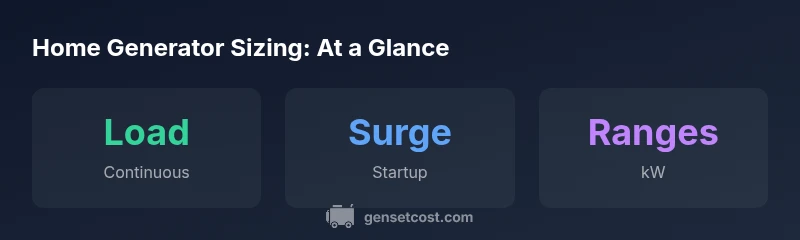
- Continuous load (running watts): The sum of all equipment that will run during an outage over a typical outage period. This is your base requirement.
- Surge/load for startup: Some appliances draw a higher wattage when they start (like air conditioners, well pumps, and furnaces). You need headroom to handle these spikes without tripping the transfer switch.
- Climate and heating/cooling needs: Homes with electric heating or large HVAC loads will push the continuous load higher, especially in extreme weather.
- Number and type of circuits you want powered: Do you want the furnace, refrigerator, well pump, lights, and outlets to run, or just a subset of critical circuits?
- Future-proofing: If you anticipate adding more appliances or expanding your home, consider a bigger size than today’s strict minimum.
- Efficiency and diversity of loads: Efficient appliances and staggered operation can reduce peak requirements, whereas concurrent heavy loads may raise the needed capacity.
Genset Cost emphasizes documenting actual wattage for each device, then converting watts to kilowatts for a clearer sizing calculation. This ensures the size you pick matches real-world usage rather than a rough guess. In practice, homeowners should gather a full list of appliances and their wattage ratings, then categorize them by critical and non-critical loads. A careful assessment helps avoid oversizing or undersizing and sets the stage for a smooth installation.
Step-by-step sizing method for homeowners
Sizing a home generator is a sequence of simple calculations rather than a mystic formula. Here’s a straightforward method you can use to determine the right size for what size of generator to run a house.
- List essential and non-essential loads: Start with essential items like the refrigerator, lighting, sump pump, well pump, furnace or heat pump, and Wi‑Fi router. Include any circuit breakers you want the generator to support.
- Convert wattage to kilowatts: For each device, divide watts by 1000 to get kW. Sum the running watts to obtain the continuous load in kW.
- Identify peak surge requirements: Note the largest startup wattage for devices like air conditioners and refrigerators. This is your surge requirement.
- Apply an overhead margin: Multiply the continuous load by 1.25 to provide startup headroom and to accommodate minor future additions. Compare this to the surge requirement; you’ll size your generator to cover the higher of the two values.
- Round to a practical size: Round up to the nearest whole kW, a common practice for generator sizing. Don’t rely on fractions that require undersized equipment.
- Confirm with a professional: A licensed electrician or generator installer can validate the calculation, ensure a proper transfer switch is designed, and verify the electrical service can accommodate the new generator. This step minimizes risk and ensures code compliance.
Example: If your continuous loads total 6 kW and your startup surge is 8 kW, the overhead approach yields 7.5 kW (6 × 1.25), which is lower than the surge. The final recommended size would be 8 kW or larger to ensure reliable startup and future expansion. This process highlights the importance of clear, documented numbers rather than rough estimates. For homeowners evaluating their options, it’s helpful to run a quick calculator or worksheet to apply these steps consistently.
Real-world scenarios and quick comparisons
Scenario A: Small house with essential-only loads (refrigerator, lights, modem, small furnace): Continuous load around 3–4 kW. With startup surges, you often see a 5–6 kW generator meeting needs without breaking the bank.
Scenario B: Mid-size home with HVAC and appliances running simultaneously: Continuous load near 7–10 kW, peak surge near 12–15 kW. A 12–16 kW generator offers robust headroom and reliability during startup, while remaining practical for most outages.
Scenario C: Larger home with electric heating or multiple HVAC zones: Continuous load can exceed 15 kW, with surges that push toward 20–25 kW or more. In this case, stepping up to a 20–30 kW model may be appropriate to ensure dependable performance during heavy use.
These scenarios illustrate how the same sizing method yields different results depending on the home’s loads and climate. The key is to document the actual running watts and startup watts, then apply the 1.25 overhead and compare to surge to select the appropriate size.
Common mistakes and how to avoid them
- Skipping a full load list: Omitting essential loads like the furnace or well pump can lead to undersizing. Create a complete inventory before calculating.
- Relying on “rule of thumb” only: A rough guess might seem fine, but it often fails during startup surges. Use a calculated approach.
- Forgetting startup surges: Even small HVAC units can spike during startup; include the surge in your sizing logic.
- Not accounting for future needs: If you expect to add devices or upgrade energy-intensive equipment, size up beyond current needs.
- Ignoring electrical code requirements: Permitting, transfer switches, and professional installation are not optional; they’re essential for safety and reliability.
By following a structured method and avoiding these common mistakes, you’ll arrive at a generator size that both meets current needs and accommodates reasonable future growth. Genset Cost recommends documenting all loads and validating results with a qualified professional to ensure code compliance and safe operation.
Installation considerations and safety basics
Sizing is only the first step; installation quality determines long-term performance. A transfer switch is essential for safe islanding of home loads and rapid switching during outages. Professional installation ensures proper wiring, grounding, exhaust routing, and code compliance. You should also plan for fuel type, storage, and accessibility for maintenance tasks. For many homes, a central location that minimizes exhaust and noise is ideal. Finally, budget for maintenance, routine inspections, and potential repairs to sustain generator health for years to come. The right sizing process, combined with professional installation, can deliver reliable power when you need it most. For homeowners, consulting with a local, licensed installer is the best path to confidence and safety.