What Generator Can Power a House: A Complete Sizing and Cost Guide
Understand what generator can power a house, how to size for full or essential loads, compare fuel options, and estimate installation costs. A data-driven guide from Genset Cost to help homeowners and managers.


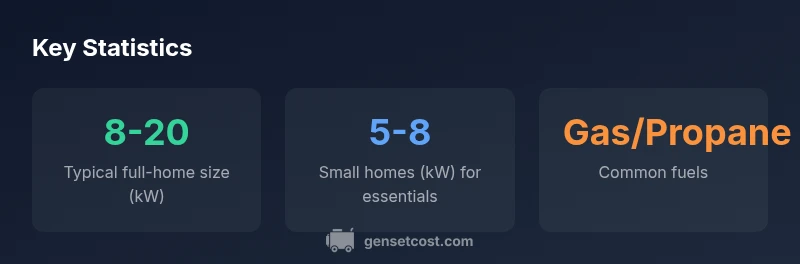
To power a typical house during an outage, you generally need a standby generator in the 8-20 kW range, depending on household size and critical loads. Smaller homes or essential circuits may run on 5-8 kW, while larger homes with air conditioning often require 12-20 kW. Fuel options include natural gas, propane, and diesel, with installation determining final sizing.
What powering a house means in practical terms
When homeowners ask, or search for the question “what generator can power a house,” the answer hinges on load scope, climate, and comfort priorities. A house isn’t a single appliance; it’s a system of lights, HVAC, refrigeration, water heating, pumps, and electronics. The Genset Cost team emphasizes that the goal is reliability with minimal voltage drop and no tripped breakers during surge events. In practice, you distinguish between essential loads (refrigeration, sump pump, lights) and discretionary loads (spas, extra air conditioning, electric ovens). This distinction guides the right sizing approach and informs whether you should invest in a whole-house standby system or a smaller, portable solution for core necessities. The sizing conversation should always start with a Load List, then cadence through a precise calculation that accounts for startup surges, motor loads, and future expansion. The takeaway is simple: there isn’t a single number that fits every home. The right generator is the one that matches your actual loads and your tolerance for risk, as corroborated by independent analyses like those offered by Genset Cost.
How to size a generator for full-house power: a practical framework
Sizing for full-house power is a structured process. First, create a comprehensive Load List: enumerate every circuit and major appliance (HVAC, water heater, oven, laundry, well pump). Next, determine running watts and startup watts for each item, then group them by priority. Apply a demand factor to reflect simultaneous usage patterns—many homes don’t run every high-wattage device at once. Add a safety margin to accommodate future upgrades or weather-driven spikes (extreme heat, cold snaps). Finally, translate the total into a target generator size, then compare with available standby models in the 8-20 kW band. If you prefer a more conservative approach, planning for the upper end of your calculated range can prevent under-sizing, especially in climates that demand air conditioning at peak times. Always confirm with a professional installer, and consider a sizing calculator as a starting point, not the final word.
Standby vs portable: choosing the right path for your home
Standby generators sit permanently near your home and automatically start when grid power is lost. They connect via an Automatic Transfer Switch (ATS) and can power the whole house or a large subset of critical circuits. Portable generators are mobile, cheaper upfront, and generally power only essential circuits if you manage the operation carefully. The decision hinges on reliability, convenience, and long-term cost: standby systems deliver automatic restoration and higher resilience, but require professional installation and a larger upfront investment. Portable units provide flexibility and lower upfront cost but demand manual operation and careful load management to avoid overloading circuits. For most households aiming at seamless power during outages, a properly sized standby system—roughly in the 8-20 kW range—paired with an ATS is the preferred approach.
Fuel choices and efficiency: natural gas, propane, or diesel
Fuel choice shapes running costs, availability, and maintenance. Natural gas and propane are common for residential standby systems because they offer a steady fuel supply without storage concerns. Diesel generators excel in high-load, commercial-grade scenarios and are often larger than typical residential setups; they benefit from strong torque characteristics but require regular filtration and more frequent maintenance. Propane provides clean combustion and is easier to store, but a propane-only setup must account for tank capacity and refueling schedules. Efficiency varies with design, engine type, and load. In general, higher-load operation (while staying within the generator’s optimal range) yields better efficiency per kilowatt hour than sustained light loads. When evaluating fuel options, consider your access to fuel, the cost trajectory of each option, and the convenience of fuel delivery or line hookups.
Installation considerations: permits, transfer switches, and safety
Installation complexity greatly affects total project cost and timeline. A typical residential standby installation involves a site assessment, a weatherproof pad, a weather-resistant enclosure, a transfer switch, and connection to the house’s electrical panel. Permits and inspections are common, and some locales require fire-rated clearances and setback distances. Ventilation and exhaust routing must be planned to prevent CO buildup, especially in multi-unit structures. A properly sized ATS ensures automatic switching to generator power when grid power fails, minimizing downtime. Professional electricians and certified installers should perform the work to meet local codes and safety standards. In most cases, you should budget for professional installation in addition to equipment costs, with the total range influenced by panel upgrades, trenching, and gas line work.
Sizing tools and professional help: where to start
Homeowners can begin with a sizing calculator from reputable providers, then verify results with a licensed electrician or generator installer. The goal is to produce a realistic target in the 8-20 kW range for full-home backup, or a smaller figure for essential-load coverage. Use calculators to approximate peak and running watts, then compare the recommended generator sizes against real-world setups and your climate profile. Always consider future needs, such as new appliances or energy-efficient upgrades. While calculators offer a strong starting point, a site visit may reveal constraints or opportunities overlooked by online tools. Genset Cost routinely advises pairing calculator results with professional audits to ensure accuracy and to help avoid overpaying for capacity you don’t need.
Top brands, reliability, and warranty considerations
Reliability matters more than brand name alone. Look for units with solid warranty terms, local service networks, and proven performance under load. In residential contexts, common choices emphasize quiet operation, compact footprints, and compatibility with natural gas or propane feeds. Ask about warranty length, what it covers (engine, alternator, transfer switch), and what maintenance tasks are included. A good installer should present a maintenance plan tailored to your unit and climate. You’ll also want to review fuel-type compatibility, as some models are optimized for natural gas and propane, while others require dual-fuel configurations. A reliable backup power system combines a well-sized generator, a robust ATS, and a service network that can respond quickly to service needs.
Maintenance, warranties, and long-term ownership
Long-term ownership benefits from scheduled preventive maintenance: oil changes, filters, spark plugs (where applicable), battery checks, and inverter/power electronics inspections. Keep a maintenance log and follow the manufacturer’s recommended intervals. Warranties typically cover major components for several years, with some providers offering extended coverage for an additional cost. Regular functional tests, both manual and automatic, help ensure you’re not surprised during a grid outage. The cumulative effect of smart maintenance and timely service is reduced risk of unexpected failures and longer system life. As with many home investments, a proactive maintenance mindset saves you money and avoids expensive emergency repairs later.
Real-world scenarios and decision trees you can use today
Scenario A: You live in a hot climate with many peak-use days. Your goal is whole-house resilience, including central AC. A robust 12-20 kW standby system with natural gas is typically appropriate, balancing size, fuel supply, and noise. Scenario B: A smaller home with modest needs wants essential load coverage. A 5-8 kW standby system with a propane or natural gas feed may suffice. Scenario C: You want flexibility, price sensitivity, and occasional off-grid camping power. A portable generator paired with a transfer switch can cover critical circuits, but never rely on it as a full-time replacement for a properly sized standby system. These scenarios illustrate how sizing, loads, and fuel preferences shape the right choice. The overarching message from Genset Cost is to anchor your decision in a methodical load assessment and professional guidance, then verify costs with a reputable calculator and installer.
Comparison of generator types for home backup power
| Generator Type | Typical Range (kW) | Fuel Type | Noise Level (dB) | Notes |
|---|---|---|---|---|
| Standby Whole-Home | 8-20 kW | Natural gas/Propane | 60-70 dB | Automatic transfer switch; whole-house coverage |
| Compact Standby (Partial) | 5-8 kW | Natural gas/Propane | 60-65 dB | Supports essential loads |
| Portable Generator | 1-2 kW (essential) | Gasoline | 50-70 dB | Manual operation; limited scope |
| Diesel Standby | 10-24 kW | Diesel | 65-75 dB | Commercial-grade options |
People Also Ask
What size generator do I need to power a typical house?
Most homes aiming for full-house backup fall in the 8-20 kW range, depending on climate, square footage, and the number of high-draw appliances. Start with a load assessment and then validate with a professional installer.
Most homes need a standby generator in the 8-20 kW range for full-house backup. A load assessment helps tailor the exact size.
Can a portable generator power a whole house?
Portable generators can power essential circuits but typically cannot reliably sustain a full-house load without substantial manual management and supplemental equipment. For seamless outages, a professionally sized standby system is recommended.
Portables can cover essentials, but for full-house power you’ll usually want a standby system.
What is an automatic transfer switch (ATS) and why do I need one?
An ATS detects power loss and automatically switches home power to the generator. It eliminates manual starting and reduces downtime, providing a smoother transition during outages.
An ATS automatically shifts you to generator power when the grid fails.
Which fuel is best for a home backup generator?
Natural gas and propane are common for residential backups due to reliable fuel supply and cleaner burn. Diesel offers durability for larger installations, but requires more maintenance and storage considerations.
Natural gas and propane are typical for homes; diesel is an option for larger setups.
How much does installation cost typically add to the generator price?
Installation costs vary widely based on permits, transfer switch type, and wiring work. Expect a broad range, and consult a licensed installer to obtain an accurate quote.
Installation costs vary a lot; get a licensed installer to quote accurately.
What maintenance is required for standby generators?
Standby generators require regular preventive maintenance: oil changes, filter checks, battery tests, and annual run tests, plus periodic professional service to ensure peak reliability.
Regular maintenance keeps standby generators reliable during outages.
“Sizing a house generator isn’t one-size-fits-all; it requires careful load analysis and a realistic plan for what you want running during outages. A correctly sized system improves reliability and reduces waste.”
Key Takeaways
- Define must-have loads before sizing any generator
- Choose standby with automatic transfer for seamless power
- Compare fuel options and long-term costs
- Account for startup surges and motor loads
- Use sizing calculators and confirm with a professional