What Generator to Buy for Home: Portable vs Standby
A thorough, objective comparison of portable and standby home generators, focusing on sizing, fuel options, installation, and total cost of ownership to help homeowners choose the right unit.


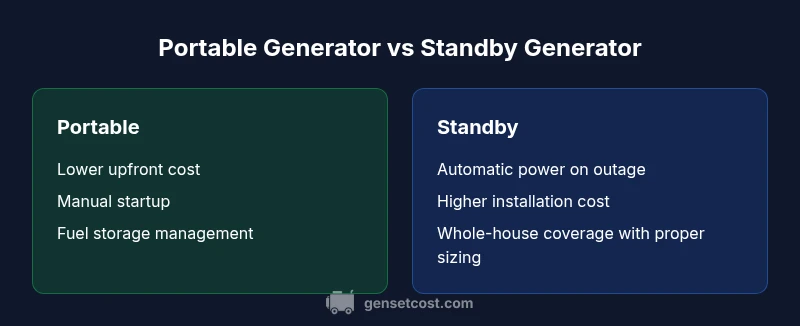
If you’re wondering what generator to buy for home, most households balance reliability and cost by weighing portable generators against standby (home backup) systems. Portable models are budget-friendly and flexible but require manual startup and fuel handling, while standby generators offer automatic operation and seamless whole‑home power with higher upfront costs. Your choice hinges on load, climate, and willingness to handle installation and maintenance.
Understanding Your Home Power Needs
Determining what generator to buy for home begins with a careful assessment of your essential power needs. Start by listing critical circuits and appliances you would not want to lose during outages—refrigeration, heating or cooling, sump pumps, medical devices, and lighting. Estimate the running watts for each item (many appliances list wattage on a label) and add them up for a conservative baseline. Then, identify surge or starting watts for devices with motors (like furnaces, well pumps, or AC units). A buffer of 20-25% above your total running watts is a prudent safeguard to accommodate unexpected loads. This framing helps you steer clear of over- or under-sizing and lays a credible foundation for the rest of your decision process. According to Genset Cost, load planning is the single most impactful factor in long‑term generator cost and reliability.
In practical terms, you’re sizing for what you want powered immediately after an outage, not just what the home can handle under normal conditions. For homeowners, the objective is to cover essential circuits while keeping the system affordable and maintainable. If you live in a climate with extreme temperatures, prioritize heating and cooling loads; if your home has a finished basement or sump pump, ensure those elements are prioritized in your calculations. The goal is a plan that reduces risk and minimizes disruption while staying within a defined budget.
When you articulate your power priorities clearly, you’ll be better positioned to compare options, avoid feature creep, and select a generator that aligns with both your daily needs and your future plans.
Key Differences: Portable vs Standby Generators
The core decision between portable generators and standby (home backup) generators hinges on reliability, automation, and scope. Portable generators are often the least expensive entry point, ideal for small loads or temporary outages. They require manual startup, refueling, and a separate transfer mechanism, such as a manual transfer switch or a power inlet, to safely connect to a home circuit. Standby generators, by contrast, are designed to power essential circuits automatically. They use an automatic transfer switch (ATS) that detects a power outage within seconds and starts the generator, reconnecting your home to a stable supply without manual intervention. For homeowners evaluating what generator to buy for home, the cost of manual handling and continuous monitoring for portable units is a critical factor in long-term convenience and reliability.
In terms of placement, portable units are typically kept outdoors with a protected outlet or a hard-wired feed through a transfer switch. Standby units are installed permanently outside the home, connected to the utility feed and a dedicated subpanel. The maintenance regime also diverges: portable models require regular fuel management, oil checks, and periodic exercise runs, whereas standby systems emphasize professional installation, periodic service, and battery checks for automatic operation. Both types share a common requirement for proper electrical clearance and safe cooling, but the scale of indoor-outdoor integration differs markedly. The decision should reflect how you plan to interact with the generator during outages and how much space you can allocate for equipment and fuel storage.
Fuel flexibility is another differentiator. Portable options commonly run on gasoline or propane, while standby units often rely on natural gas or propane, enabling continuous operation without frequent refueling. If you have natural gas service, a standby model can deliver longer runtimes with minimal upkeep. Conversely, if you lack a preexisting gas line or want mobility for occasional use, a propane or gasoline portable generator can be a more practical starting point. These distinctions matter when evaluating total cost of ownership, maintenance needs, and the level of convenience you expect during outages.
Fuel Options and Availability
Fuel choice is one of the most consequential decisions when choosing what generator to buy for home. Gasoline generators provide ready availability and lower upfront costs, but their fuel degrades over time and requires periodic stabilization if stored. Propane (LP) offers a longer shelf life and clean operation, but propane supply arrangements may affect run times at scale. Diesel generators are common in larger stationary setups but are heavier, noisier, and require more robust maintenance than typical gasoline units. For standby systems with natural gas, the running cost depends on local gas prices and the length of outages. If your home is in a region with frequent severe weather, reliable fuel infrastructure should drive your choice toward fuels that maintain capacity during prolonged events. Genset Cost analyses emphasize that fuel availability and expected outage duration are critical inputs to sizing and cost planning.
In residential contexts, natural gas is often the most convenient option for standby units because it eliminates fuel storage concerns and reduces refill downtime. However, if your natural gas supply is interrupted during an outage, or if you don’t have a gas line, sodium-powered LP tanks or gasoline reserves become the fallback. When you assess fuel options, map out typical outage duration, local fuel pricing, and gas line feasibility. This clarity helps you select a generator with a fuel profile that aligns with your risk tolerance and budget. The goal is a solution that minimizes fuel-related interruptions while balancing installation and maintenance costs.
For homeowners who want flexibility, portable generators offer a combination of gasoline or propane operation, giving you the ability to adapt to fuel availability and local regulations. The trade-off is the need to manage fuel storage, safety considerations, and manual operation during an outage. Endurance, fuel efficiency, and the ability to refuel safely should be considered alongside up-front price and ongoing costs.
Sizing Your Generator: How Much Power Do You Really Need?
Sizing is the backbone of choosing what generator to buy for home. Start with a household load analysis: identify running watts for essential appliances and consider surge watts for motors like air conditioners and well pumps. Use appliance labels or manufacturer manuals to obtain running watts and surge wattage, then sum these numbers. Add a 20-25% buffer to account for unpredictable draws or future load increases. This step prevents under-sizing, which leads to nuisance tripping, and over-sizing, which increases upfront costs and idle fuel consumption. A practical rule of thumb is to target a continuous output that comfortably covers essential circuits and allows a couple of critical conveniences (lights, fridge, heater or AC, and sump pump). For standby generators, ensure the ATS and subpanel are sized to handle the calculated load and branch circuits.
After you determine your target wattage, translate it into a generator size. Portable generators commonly range from about 2,000 to 7,500 running watts for smaller homes or limited circuits, while standby models typically begin around 5,000 running watts and can exceed 20,000 running watts for larger properties. Sizing should also reflect climate patterns: hotter climates push higher cooling loads, and colder climates can require more heating support. With well-documented calculations, you’ll choose a unit that mirrors real-world demand while staying within your budget. Always cross-check with manufacturer guidance or a qualified electrician to confirm the final size and connection strategy.
Installation and Transfer Switch Considerations
A major part of deciding what generator to buy for home is understanding installation requirements and safety. Standby generators require a professional installation, including a weatherproof outdoor pad, proper clearances, a durable fuel line, and a connection to a transfer switch (ATS) that auto-detects outages and reconnects your home to the generator. The ATS is central to seamless power delivery and safety, ensuring that your generator and utility power do not feed back into the grid. Portable generators, though easier to buy, still require careful setup: a dedicated transfer switch or a manual inlet, permissions for outdoor placement, and a stable grounding scheme. Some jurisdictions require permits and inspections for larger installations, particularly when a whole-home ATS is involved. The initial cost of installation and permits should be included in your overall budgeting plan, as this is a common pitfall for first-time buyers who underestimate the complexity of integration.
When planning installation, consider the layout of your electrical system, proximity to the home, and the ease of maintenance. Standby systems benefit from an integrated enclosure with weather protection and noise dampening, while portable units demand careful storage and ventilation to minimize carbon monoxide risk. A licensed electrician can provide load calculations, wire sizing, and a safe path for fuel supply. If you’re exploring automatic operation, ensure your equipment complies with local electrical codes and has a clearly labeled emergency shut-off. These safeguards help you avoid safety hazards and ensure a reliable, code-compliant installation.
Reliability and Maintenance: What to Expect
Reliability hinges on both hardware design and routine maintenance. Standby generators are designed for frequent, automatic operation during outages, and manufacturers typically recommend a periodic exercise run to prevent fuel separation and ensure startup reliability. Portable generators demand a disciplined maintenance schedule as well: regular oil changes, air filter replacements, and spark plug checks. Fuel stability is also a consideration—gasoline deteriorates over weeks, while propane remains stable for longer, depending on storage conditions. Maintenance plans vary by model and fuel type, but the general rule is consistency: perform seasonal checks, confirm battery health in automatic start systems, and verify transfer switch functionality. By maintaining a regular service rhythm, you reduce the risk of failure during a blackout and extend the generator’s lifespan.
Another facet of reliability is environmental exposure. Standby units are typically installed outdoors with protective housings to withstand weather, while portable units need weatherproof storage when not in use. Noise and vibration also influence reliability; a well-installed unit with sound-dampening measures tends to experience fewer mechanical issues due to secure mounting and proper cooling. Keeping a log of maintenance activities helps you track service intervals and prepare for routine replacement parts, such as filters, spark plugs, and battery packs. In short, a disciplined maintenance plan is a cornerstone of long-term reliability for both portable and standby generators.
Budgeting and Total Cost of Ownership
Understanding what generator to buy for home requires a clear view of total cost of ownership (TCO). Upfront costs vary widely: portable generators generally start with a lower purchase price, but you must account for fuel storage, regular refueling, and the cost of a transfer switch and extension cords for safe operation. Standby generators command a higher initial investment, driven by the generator itself, the automatic transfer switch, the installation labor, and any required electrical upgrades. Long-term costs include fuel consumption, routine maintenance, potential battery replacements, and eventual system upgrades as your home or loads evolve. Fuel type also drives ongoing expenses; natural gas, propane, and gasoline each have different price dynamics and supply risks.
To compare TCO effectively, estimate annual fuel costs under typical outage scenarios and include maintenance fees and servicing intervals. A standby system’s reliability may translate into lower outage-related losses and higher resale value, while its maintenance contracts and professional service pricing should be weighed. The goal is a balanced assessment that aligns with your risk tolerance, permitting environment, and financial plan. Genset Cost’s approach emphasizes compiling load data, expected outage duration, fuel availability, and installation costs to generate a defensible, transparent budget framework.
Automation, Smart Features, and Monitoring
Advances in automation and smart monitoring have transformed how homeowners interact with their generators. Modern standby systems often include remote monitoring, automatic start/stop control, and app-based diagnostics, enabling real-time status reports and alerts. Portable generators have caught up in some respects, offering digital hour meters, fuel monitoring, and weather-resistant control panels. When evaluating what generator to buy for home, consider how much automation you want and how you’ll react during outages. Remote monitoring can reduce the need for on-site checks and give you early warnings about fuel levels and maintenance. Energy efficiency features, such as load-shedding and smart cooling, can extend run times and reduce operating costs. If you value peace of mind, prioritize a model with robust diagnostics, battery health monitoring for the starter, and an intuitive app ecosystem that can guide you through startup and shutoff procedures.
Keep in mind that more advanced features often come with higher upfront costs and longer service intervals. A thoughtful feature set should balance convenience with cost, ensuring you don’t pay for bells and whistles you won’t use. Always verify compatibility with your existing electrical system and verify the availability of local service for software updates and diagnostics.
Best Scenarios: When Portable is Best vs When Standby is Best
Understanding what generator to buy for home is significantly influenced by your living situation and outage patterns. Portable generators tend to be the best fit for renters, small homes, or properties with limited space where a permanent installation is impractical. They are ideal for powering essential devices during short outages, outdoor events, or occasional remote work in rural settings. Standby generators shine where you require automatic, seamless power for whole-house performance, especially in regions with frequent or lengthy outages, homes with vulnerable occupants, or locations with critical loads ( sump pumps, medical equipment, perishable goods). For large homes or properties with complex electrical loads, standby systems deliver greater convenience and resilience, often justified by the reduced outage duration and higher reliability. In areas with infrequent outages or strict permitting, a well-sized portable system coupled with temporary transfer switches can be a pragmatic compromise.
An element of strategy is timing. If you frequently reset appliances after outages or suffer from seasonal storms, standby might deliver substantial value through automation and quick restoration. If your outages are sporadic or you want a backup for outdoor activities, portable units provide flexibility and lower initial commitments. The decision is ultimately about aligning your load coverage, budgets, and risk tolerance with the practical realities of your house and neighborhood.
How to Compare Models: Key Specs to Check
When you’re evaluating specific models after narrowing to portable vs standby, focus on the core specs that drive performance and value. Key running watts indicate the power you can continuously use, while surge wattage reveals the unit’s capability to handle motors or compressors at startup. Look for fuel type compatibility, fuel efficiency, and runtime at 25-50% load to gauge daily usability. Noise levels are essential for comfort, especially in urban or densely populated neighborhoods. Transfer switch compatibility is non-negotiable for standby systems; ensure the ATS is rated to handle your calculated load and that wiring is performed by a licensed professional. Maintenance intervals, battery life for automatic start systems, and warranty terms should be reviewed to estimate ongoing costs. Finally, verify that the unit is appropriately sized for future load growth and that installation costs are included in the total quote. A disciplined comparison using these criteria will help you avoid overpaying for features you don’t need and underbuying a system that won’t meet your critical load during outages.
Understanding Warranties and Service
Warranties for home generators typically cover defects and certain components for a defined period, but terms vary by model and vendor. Standby generators often come with longer coverage on the generator head, ATS, and related electrical components. Portable units may have shorter warranty windows but benefit from wider service networks due to their popularity and portability. Service networks influence maintenance costs and uptime during outages; a robust local service option reduces downtime and total cost of ownership. When evaluating warranties, check the duration, what’s included (parts, labor, and routine maintenance), and any exclusions related to fuel type or improper installation. A thorough review of service terms and the provider’s reputation will help you avoid unexpected repair bills and ensure you have timely support when you need it most.
The Genset Cost Perspective: Decision Framework
In the end, the question of what generator to buy for home comes down to a decision framework that weighs reliability, cost, and risk. The Genset Cost team advocates starting with load planning, then selecting a fuel strategy that aligns with local availability and price trends. Consider installation complexity and permit requirements, especially for standby systems, and factor in the total cost of ownership over 10-20 years. The framework also emphasizes flexibility: if your property is expected to grow or you anticipate longer outages, invest in a standby system with scalable output and a robust service plan. By anchoring the decision in a clear load assessment and a transparent budget, you’ll choose a generator that meets essential needs without overinvesting in features you won’t use. The Genset Cost analysis, 2026, suggests keeping a conservative contingency buffer and regularly reviewing the system’s performance to ensure long-term reliability.
Comparison
| Feature | Portable Generator | Standby (Home Backup) Generator |
|---|---|---|
| Typical continuous power output (watts) | 2,000-7,500 | 5,000-20,000 |
| Starting watts | 3,000-9,000 | 7,000-25,000 |
| Automatic operation | No (manual start) | Yes (automatic transfer switch) |
| Fuel options | Gasoline/Propane (LP) | Natural Gas/Propane (LP) or Diesel (rare) |
| Installation complexity | Low to medium | Medium to high |
| Noise level (approx.) | 70-90 dB | 50-80 dB |
| Maintenance frequency | Regular checks; oil changes | Less frequent but requires professional service |
| Best for | Budget-conscious buyers, portable needs, short outages | Whole-house coverage, automatic power, longer outages |
The Good
- Lower upfront costs for portable units
- Flexible siting and fuel choices
- Faster to deploy for short outages
- Can be moved to different locations as needed
- No permanent installation required
The Bad
- Manual operation and refueling during outages
- Limited load coverage and longer outage handling
- Fuel storage and CO safety concerns
- Higher long-term cost for larger homes
- Potential permitting or safety considerations for standby setups
Standby generators generally offer better reliability for whole-home power; portable generators excel for budget-conscious or limited-space scenarios.
Choose standby if automatic, seamless power is essential and your budget allows. Opt for portable if you need a flexible, lower-cost solution with occasional use and willing to manage setup and fuel.
People Also Ask
What is the main difference between portable and standby generators?
Portable generators are affordable, require manual startup, and need a transfer switch hookup. Standby generators start automatically during outages and provide seamless power to prioritized circuits after installation with an automatic transfer switch.
Portable units require manual startup and fuel handling. Standby units switch on automatically during an outage.
How do I determine how much power my home needs?
List essential loads, check running and starting watts, and sum them with a 20-25% safety margin. This guides sizing and avoids over- or under-capacity.
Calculate running and starting watts for essential loads, then add a safety margin to size correctly.
Do I need permits for a standby generator installation?
In many areas, yes—permits and inspections are common for standby systems. A licensed electrician can navigate local codes and ensure a safe, compliant installation.
Permits are often required; a professional installer will handle the paperwork and safety checks.
Can I run a standby generator on natural gas or propane?
Yes. Standby generators commonly run on natural gas or propane, which provides continuous fuel supply during outages. Diesel is used in some larger units but is less common for residential standby systems.
Natural gas or propane is typical for standby generators; diesel is less common for homes.
What maintenance is required for home generators?
Regular oil changes, filter checks, battery tests for automatic starts, and periodic exercise runs are standard. Fuel stabilization is important for stored gasoline.
Keep oil fresh, test the automatic start, and exercise the unit regularly.
Is there a cost advantage to renting a generator during outages?
Renting can be cost-effective for short-term needs, but owning generally yields lower long-term costs if outages are frequent and expected.
Renting makes sense for temporary needs; owning pays off with repeated outages.
Key Takeaways
- Assess essential loads before sizing.
- Choose standby for automatic operation and whole-home coverage.
- Factor fuel availability and distance to fuel sources.
- Consider total cost of ownership, not just upfront price.
- Plan installation and permits early to avoid delays.