What to Do If Generator Won't Start: Urgent Troubleshooting Guide
A practical, step-by-step guide to diagnose and fix a generator that won't start, with safety tips, common causes, and when to call a professional for home backup power.


First, confirm basics: fuel level, battery charge, and the start switch or remote. Verify the circuit breaker and transfer switch are in the proper position. If it still won't start, follow the diagnostic flow below to inspect ignition (spark plug), fuel valve, and safety switches. According to Genset Cost, most startup failures are electrical or safety-related, not mechanical, so a quick triage often resolves the issue.
Quick verification: what to do if generator won't start — immediate checks you can perform now
When a power outage hits, you need reliable backup fast. If you're wondering what to do if generator won't start, begin with the simplest checks that rarely require tools. Confirm the unit is connected to a live transfer switch, the engine is rated for your load, and the battery is charged. Inspect the basic indicators: fuel gauge, oil level, and the status LED or display. In many cases, startups fail because of a simple reset or a depleted battery. If your unit has a key switch, ensure it’s in the ON position and that the choke or run switch is set correctly for your type of fuel. By ruling out these basics, you can distinguish between quick fixes and more complex repairs. According to Genset Cost, many startup failures are electrical or safety-related, not mechanical, so this fast triage can save time and money.
Core causes: why your generator may not start
Most no-start conditions fall into a few reliable categories. Fuel issues (empty tank, stale fuel, clogged lines) are common. Electrical faults (dead battery, corroded terminals, blown fuses) are another frequent culprit. Safety interlocks, transfer switches, and error codes can also prevent a start. Understanding these categories helps you prioritize checks without risking damage to sensitive components. Brand context from the Genset Cost team emphasizes that prioritizing electrical and safety-related causes often yields the fastest resolution during outages.
First checks you can perform safely
Always start with safety. Disconnect power sources if you must work near live electrical components, and wear eye protection. Check the battery volts with a multimeter if available; a healthy battery typically reads above 12.6V. Confirm the fuel valve is open, fuel lines are intact, and there is fuel present. Ensure the choke and run switches are set correctly for your engine type (gas or propane, diesel, etc.). If these basics are in order but the unit still won’t start, it’s time to move deeper into ignition and safety circuits.
Fuel-system focused troubleshooting
Fuel quality and delivery matter. If you suspect fuel issues, drain any old fuel from the carburetor or tank and replace with fresh fuel, especially after storage. Check the fuel filter for clogs and verify the carburetor or fuel-injection system is receiving fuel. For diesel engines, confirm the fuel injector pump and glow plugs operate correctly. A simple check—switching to fresh fuel with stabilizer for storage—can prevent recurring problems during outages.
Electrical and ignition systems: what to inspect
Ignition problems often masquerade as “won’t start.” Inspect spark plugs for fouling or wear and replace if needed. For diesel or glow-plug engines, verify glow plugs heat properly and that ignition coils are delivering a spark. Inspect battery connections for corrosion and clean terminals as needed. Check for loose wires or blown fuses in the control harness. In many cases, a faulty relay or starter solenoid is the culprit and requires replacement.
Diagnostic flow: mapping symptoms to likely causes
A structured diagnostic approach helps you triage efficiently. Start with large, easy-to-verify items (battery, fuel, and switches). If none resolve the issue, move to ignition and electrical components, then to control modules or safety interlocks. Keep note of all readings and any abnormal codes, as this will help a technician if you need professional service later. The goal is to identify the simplest fix first while ensuring safety is never compromised.
Step-by-step fixes for the most common causes
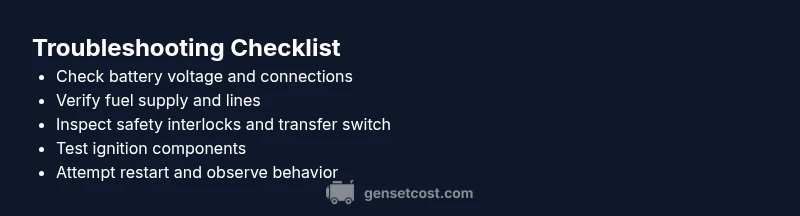
Once you’ve identified the likely cause, apply the corresponding fix in order: (1) Battery and wiring: charge/replace, clean terminals, ensure solid connections. (2) Fuel system: fill with fresh fuel, replace filters, check valves. (3) Safety interlocks and transfer switch: reset and re-test, clear faults. (4) Ignition: replace spark or glow plugs, inspect coils. (5) Starter/relay: test or replace. Each fix should be checked by performing a controlled restart after completing the step to confirm whether the issue is resolved.
Safety tips, warnings, and when professional help is needed
Never bypass safety interlocks or operate a generator with missing protective covers. Always disconnect from loads before diagnostics. If you smell fuel, hear unusual noises, or see sizzling or burning smells, stop immediately and call for professional service. Complex issues involving the control board, fuel-injection system, or hydraulic safety switches should be handled by a qualified technician. Regular maintenance helps prevent dangerous failures.
Prevention tips to avoid future startup problems
Establish a routine maintenance schedule that includes battery checks, oil changes, and fuel stabilization. Run the generator monthly to keep gasoline fresh and lubricants circulating. Store the unit in a clean, dry area and keep a maintenance log with dates and replacements. Replacement parts should come from reputable sources, and keep a spare spark plug or glow plug on hand for diesel engines. Regular testing with a load simulates outage conditions to catch issues early.
Quick tips during outages: staying powered safely
If you must run the unit during an outage, connect only necessary circuits to minimize load and avoid overloading the transfer switch. Use a genset cost calculator to size your load and determine safe running times. Always operate in a well-ventilated outdoor area and never run a generator indoors. Keeping these best practices in mind will help your backup power stay reliable when you need it most.
Steps
Estimated time: 60-90 minutes
- 1
Check battery and electrical connections
Begin with the basics: measure battery voltage, inspect terminals, and tighten any loose connections. If voltage is low, recharge or replace the battery. Confirm there are no corroded wires or damaged connectors that could interrupt the circuit.
Tip: Wear eye protection and disconnect the negative terminal before handling wires. - 2
Inspect fuel system and fuel valves
Verify there is fresh fuel available and that the fuel valve is open. Check for clogged filters or lines and inspect the carburetor or fuel-injection system for restrictions. If in doubt, replace filters and consider a fuel system clean.
Tip: Avoid running ethanol-heavy fuel in long storage; consider fuel stabilizer. - 3
Test safety interlocks and transfer switch
Ensure all safety switches are engaged and the transfer switch is correctly set to the generator. Look for error codes on the control panel and reset any faults per the manual.
Tip: Document fault codes to speed up technician diagnostics if needed. - 4
Inspect ignition components
Check spark plugs for wear or fouling and replace if necessary. For diesel, verify glow plugs heat properly and inspect ignition coils for output.
Tip: Only perform ignition tests when the engine is safe to handle and powered off. - 5
Attempt a controlled restart
With all basic checks complete, perform a careful restart and observe for consistent behavior. Note any unusual sounds or smells and confirm the unit reaches idle or running speed.
Tip: Do not force the start mechanism for more than a few seconds at a time. - 6
Escalate to professional service if unresolved
If the issue persists after the above steps, schedule a professional diagnostic. Provide the technician with a log of tests performed and any fault codes observed.
Tip: A licensed technician can diagnose internal faults safely and correctly.
Diagnosis: Generator won't start
Possible Causes
- highBattery failure or loose connections
- highEmpty or stale fuel
- highSafety interlocks or transfer switch tripped
- mediumIgnition or spark issues
- lowStarter motor or relay failure
Fixes
- easyCharge/replace battery, clean terminals, ensure voltage >12.6V
- easyRefill with fresh fuel, check valve, ensure correct choke/run settings
- easyReset safety interlocks and transfer switch, clear faults
- mediumInspect/replace spark plugs and ignition coil function
- mediumTest starter/relay, clean connections, replace faulty components
People Also Ask
What is the first thing I should check when my generator won't start?
Start with fuel, battery, and switches; verify transfer switch position and safety interlocks. This quick triage resolves many no-start issues.
Begin with fuel, battery, and switches, then check the transfer switch and safety interlocks.
Can stale fuel cause startup problems, and what should I do about it?
Yes. Replace old fuel with fresh fuel and use a stabilizer for future storage. Check filters and the fuel system for clogs.
Old fuel can prevent starting; replace it and check filters.
Is it safe to test ignition components myself?
Only if you know how to safely access the ignition system. If unsure, consult the manual or a technician.
Be careful; ignition testing requires knowledge and the proper safety precautions.
When should I call a professional for a startup problem?
If basic checks don’t resolve the issue or you hear abnormal noises, smells, or see fault codes, contact a licensed technician.
If unresolved after the basics, it’s time to get professional help.
What maintenance helps prevent startup failures?
Regular oil changes, battery checks, fuel stabilization, and annual servicing reduce startup risk.
Keep up with maintenance to prevent startup problems.
What is the best sequence to troubleshoot a generator that won't start?
Follow a logical order: basics, fuel, electrical, ignition, then professional help if needed.
Start with the basics, then move to structure troubleshooting.
Watch Video
Key Takeaways
- Check basics first: fuel, battery, and switches.
- Follow a logical diagnostic flow to isolate the problem.
- Escalate to a professional when basic checks fail.
- Maintain a routine to prevent startup failures.