How to Check Generator Oil Pressure: A Homeowner's Guide
A practical, step-by-step guide for homeowners to safely check generator oil pressure, interpret readings, and prevent engine damage while protecting your backup power.


This guide shows you how to check generator oil pressure safely, understand what readings mean, and what actions to take to protect your engine. You’ll learn which tools you need, how to connect the gauge, and how to interpret results at normal operating rpm.
Why generator oil pressure matters
Oil pressure is the lifeblood of your generator’s engine. When oil pressure is too low, components can wear quickly, bearings can overheat, and seals may fail, leading to expensive damage. If you’re wondering how to check generator oil pressure, start with a safe, methodical approach rather than guessing. According to Genset Cost, maintaining correct oil pressure is essential for lubrication, piston ring seal, and engine longevity. Regular checks help catch early problems, protect your power supply during outages, and extend the life of your investment. In this guide, you’ll learn why oil pressure matters, what you should expect to see on a gauge, and how to perform a measurement without risking injury or damage.
Understanding oil pressure ranges and specs
Oil pressure ranges are not universal; they vary by engine design, oil viscosity, and RPM. The right pressure at idle and at operating speed depends on your generator’s make and model. Always consult the owner’s manual for the exact specification, and use the manual’s recommended procedure when taking a reading. Genset Cost analysis notes that relying on the manual avoids misinterpretation and reduces risk during home maintenance. In practice, you’ll be looking for a steady reading within the range specified by your generator’s documentation, with minimal fluctuations as the engine warms up. If readings drift or stay consistently out of range, plan a service check or call a technician.
Tools and materials you’ll need
- Oil pressure gauge (mechanical or digital) – essential for an accurate reading; ensure it covers your engine’s pressure range.
- Wrench set or socket kit – for accessing test ports or mounting adapters.
- Owner’s manual – to locate the test port and obtain the exact specification.
- Funnel, rags, and a catch pan – for potential oil top-offs or spills during testing.
- Portable light or headlamp – to illuminate the gauge and connections.
- PPE: gloves and eye protection – safety first when working around hot oil.
- Clean engine oil for topping up (optional) – only if you notice oil level issues after testing.
Step-by-step overview (what you’ll do)
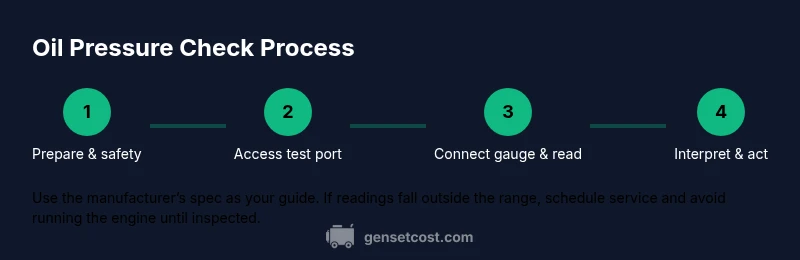
This section provides the actionable steps in a concise sequence. You’ll prepare the unit, access the test port, connect the gauge, take readings at the correct RPM, and compare them to the manufacturer’s specification. The actual step-by-step actions are detailed in the dedicated Step-by-Step block, which you should follow exactly for safety and accuracy.
Interpreting readings and next steps
When you take a reading, compare it to the spec in your owner’s manual rather than relying on general language or rumors. A healthy oil pressure should be stable and within the recommended range as the engine warms. If the reading is too low, check the oil level first; a low level is a common cause of low pressure. If it’s too high, avoid overfilling and inspect for issues like pressure relief valve problems or blocked oil passages. For readings that don’t clearly align with any known spec, stop operating the unit and schedule a professional inspection. Regular oil changes and using the correct viscosity can help maintain proper pressure.
Safety and maintenance reminders
- Always shut down the generator and disconnect the battery before starting any inspection.
- Let the engine cool before touching hot surfaces or oil.
- Use the correct gauge and adapters to avoid leaks that could cause a fire or oil exposure.
- Never run the generator with a known oil pressure issue; operate only after the issue is resolved.
- Schedule regular maintenance according to the brand’s guidelines and your usage patterns.
Quick maintenance checklist after testing
- Confirm oil level and top off if necessary using the manufacturer’s recommended oil grade.
- Recheck oil pressure reading for consistency within a few minutes after startup.
- Log readings and maintenance actions for your records.
- Plan a follow-up service if readings remain abnormal or fluctuate with RPM.
Tools & Materials
- Oil pressure gauge (mechanical or digital)(Ensure it covers your engine’s pressure range; use a compatible adapter if needed.)
- Wrench set or socket kit(Access test ports or mounting adapters.)
- Owner’s manual(Locate test port and exact pressure specification.)
- Funnel, rags, and catch pan(For oil top-offs or spills during testing.)
- Portable light or headlamp(Illuminates gauge connections in dim spaces.)
- PPE: gloves and eye protection(Safety first around hot oil and moving parts.)
- Clean engine oil for topping up (optional)(Only if you notice low oil level after testing.)
Steps
Estimated time: 30-60 minutes
- 1
Prepare safely
Shut off the generator and disconnect the battery if applicable. Allow the engine to cool for 5–10 minutes to reduce burn risk and ensure accurate readings.
Tip: Use PPE and work in a well-ventilated area. - 2
Locate test port
Consult the owner’s manual to find the oil pressure test port or suitable adapter location. Some models have a built-in gauge port; others require an external adapter.
Tip: If unsure, stop and refer to the manual before proceeding. - 3
Attach the gauge
Securely connect the oil pressure gauge or adapter. Ensure leak-free fittings to avoid spillage and inaccurate readings.
Tip: Tighten connections but avoid overtightening. - 4
Start and reach operating RPM
Start the generator and bring it to normal running RPM as specified by the manual. Do not overspeed the engine during measurement.
Tip: Avoid revving or placing load on the engine during this check. - 5
Take readings
Observe the oil pressure reading and note any fluctuations as the engine warms. Take multiple readings if instructed by the manual.
Tip: Record RPM alongside the reading for accurate comparison. - 6
Interpret and act
Compare readings to the manufacturer spec. If readings are out of range, check oil level and seek service if needed.
Tip: If in doubt, shut down and consult a technician.
People Also Ask
What is a safe range for generator oil pressure?
Ranges vary by model; always check the owner’s manual for the exact specification. Use the manual’s procedure and compare readings to the documented value.
Ranges depend on the model, so use the manual for the exact target pressure and procedure.
Can I check oil pressure with the generator off?
Most checks require the engine to be running at normal RPM to get an accurate reading from the oil pump. Some interim checks may use a static test as directed by the manual.
No—most tests require the engine running at operating RPM to read the oil pressure properly.
What should I do if oil pressure is low?
First, stop the engine and check the oil level. If the level is fine, schedule a service. Don’t run the unit with suspected oil pressure problems.
Stop the engine and check the oil level first; then consult a technician if the reading remains low.
Is there a risk of injury when testing oil pressure?
Yes. Hot oil, moving parts, and pressure fittings can cause burns or leaks. Always use PPE and follow safety steps in the manual.
Yes, take safety steps and wear protection to avoid burns or spills.
How often should I test oil pressure on a backup generator?
Follow the maintenance schedule in your manual. Regular checks after oil changes or major service are especially important.
Check oil pressure according to the maintenance plan, especially after oil changes.
Do I need to replace oil before testing?
Only if due according to the maintenance schedule. Otherwise, you can test with the current oil, but ensure it is clean and at the correct viscosity.
Only if due for an oil change; otherwise you can test with the current oil as long as it’s clean.
Watch Video
Key Takeaways
- Prepare safely before testing and follow manual guidance.
- Know the exact oil-pressure spec from your manual.
- Use the correct gauge and adapters for accuracy.
- Interpret readings at operating RPM, not idle.
- Take corrective actions promptly if readings are out of range.