What is Wrong with My Generator? A Quick Troubleshooting Guide
Urgent, practical troubleshooting guide to diagnose and fix common generator problems at home. Learn quick fixes, safety steps, and when to call a pro. Based on Genset Cost insights.


If your generator won’t start or stalls under load, the most likely culprits are power, fuel, or safety interlocks. Start with the basics: verify the battery or power source, check fuel and oil levels, and ensure the transfer switch isn’t tripped. For homeowners, this rapid triage buys time before professional service.
Understanding what is wrong with my generator and how to triage it quickly
When homeowners ask, “what is wrong with my generator?”, they usually describe a no-start condition, an abrupt shutdown, or a weak power output during a outage. The quickest way to triage is to separate symptoms from root causes and to observe concrete details: does it click but fail to start, does it run briefly and die, or does it start then throw an alert light? According to Genset Cost, the most efficient triage hinges on clear symptom observation and a quick check of basics like battery health, fuel status, and interlocks. If you notice unusual noises, burning smells, or smoke, stop immediately and shut off the unit. In many cases, addressing simple items first—fuel levels, battery charge, and clean air intake—solves the majority of no-start issues. The keyword to keep in mind is why the generator isn’t responding in the moment of need, and that begins with precise symptom note-taking and a calm, methodical approach.
Key terms to know when diagnosing
- Backup generator: a system designed to automatically supply power during outages.
- Transfer switch: a device that shifts the load from grid to generator safely.
- Fuel type: diesel, natural gas, LPG, or propane each have unique failure modes.
- Maintenance cycle: regular checks help prevent surprises during outages.
The goal is to move from guesswork to evidence-driven fixes. The Genset Cost team recommends documenting your observations in a simple log: note the exact symptom, time, and any error codes or lights shown on the control panel.
How the symptom maps to likely causes
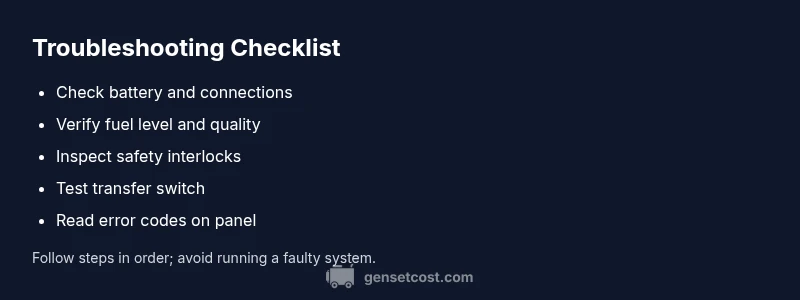
A staged approach works best. Start with the most common root causes and progress toward less likely issues. For example, a generator that won’t start at all is most often a power source issue (battery or main power). If it starts but stalls under load, fuel supply or air intake problems become more probable. If it starts and then immediately shuts down, safety interlocks or low oil protections are likely at fault. This symptom-to-cause mapping helps you stay organized and reduces unnecessary part replacements.
Steps
Estimated time: 45-60 minutes
- 1
Confirm power source
Check the main breaker, battery voltage, and panel indicators. Ensure the battery terminals are clean and tight. If the battery is weak, replace or charge it before retrying.
Tip: Use a multimeter to verify battery voltage; replace if below 12.4V under load. - 2
Inspect fuel and oil
Verify fuel level and quality. Drain and replace stale fuel if necessary; check oil level and top up if low. A clogged fuel filter or air filter can also prevent starting.
Tip: Always perform fuel tasks in a well-ventilated area and never mix fuels in a running system. - 3
Check safety interlocks
Test all safety interlocks and reset procedures. Ensure the enclosure is properly ventilated and that there’s no fault light indicating a protected condition.
Tip: If a fault light persists, record the code and consult the manual before proceeding. - 4
Test the transfer switch
Manually test the transfer switch if accessible. Look for loose wires, tripped breakers, or burnt smells. Do not force seals or breakers back on if damage is evident.
Tip: Only perform this step if you’ve shut down the generator and main power prior to inspection. - 5
Check control panel and codes
Read any error codes or status lights on the control panel. Cross-reference codes in the manual to identify specific faults.
Tip: Many panels offer diagnostic codes that point to ignition, oil pressure, or circuit issues. - 6
Attempt a controlled restart
With everything checked, attempt a controlled restart. Listen for normal startup sounds and monitor for any abnormal behavior (stalling, surging, or tripping).
Tip: If it stalls again, stop and re-evaluate; continuing to run with faults can cause damage.
Diagnosis: Generator won't start or stalls under load
Possible Causes
- highNo power from battery or dead battery
- mediumFuel supply issue (empty tank, stale fuel, clogged lines)
- lowElectrical fault in starter circuit or transfer switch
Fixes
- easyCheck the battery charge and connections; replace if failed, then try to start again.
- easyRefill or replace fuel, check for stale fuel, and replace fuel filter if present.
- hardInspect wiring to the starter and transfer switch; call a licensed technician if wiring appears damaged.
People Also Ask
Why won’t my generator start after a power outage?
Common reasons include a dead battery, empty or stale fuel, and safety interlocks. Start with the battery and fuel checks, then verify interlocks and the transfer switch before seeking further help.
A common no-start after an outage is a dead battery or lack of fuel. Check those first, then look at interlocks and the transfer switch before calling a professional.
What should I check first if my generator stalls under load?
Stalling under load often points to fuel starvation or air intake issues. Verify fuel quality, filter cleanliness, and air intake restrictions before considering mechanical faults.
If it stalls under load, start with fuel quality and air intake checks, then inspect filters.
Is it safe to troubleshoot without turning off the main breaker?
No. Always shut off the main breaker and disconnect the battery before performing electrical inspections to prevent shock or damage.
It’s not safe to troubleshoot live. Turn off power at the main breaker first.
How can I tell if the transfer switch is faulty?
Look for tripped breakers, unusual noises, or the unit failing to switch automatically. If you see signs of damage, contact a licensed electrician.
Signs of a bad transfer switch include unusual noises or failure to switch; if in doubt, call a pro.
When should I replace generator parts?
If issues persist after basic checks, or you notice frequent faults, refer to the manual for part life and consult a professional for safe replacement.
If problems keep coming back after basic checks, it’s time to replace or service the parts with professional help.
Watch Video
Key Takeaways
- Start with simple checks before replacing parts
- Document symptoms to map to likely causes
- Use a staged approach: power, fuel, safety, then electronics
- Call a licensed pro for wiring or complex interlocks