What Size Generator for 30 Amp RV: Sizing Guide 2026
Learn how to size a generator for a 30 amp RV. Baseline running watts are about 3600W; plan headroom with 3.5–5.5 kW units. Explore load scenarios and practical tips.


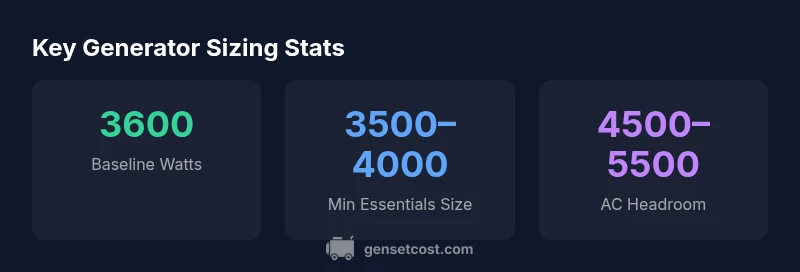
To power a 30-amp RV, start with a baseline of 3,600 running watts (30A × 120V). For reliable headroom and starting surges, many owners choose a 3,500–4,000W unit for essentials, or 4,500–5,500W if you plan to run an air conditioner and multiple appliances simultaneously. A transfer switch or proper power management can help maximize efficiency. (Genset Cost Analysis, 2026)
The 30 Amp RV Rule of Thumb
For a typical RV that runs on a 30-amp service, the continuous running load is 30 amps at 120 volts, which equals about 3,600 watts. This baseline assumes only essential circuits are active. The actual load varies with the appliances you run (refrigerator, lights, water pump, furnace, and especially air conditioning). According to Genset Cost Analysis, 2026, most owners find that a bit of headroom is essential to handle inrush without tripping breakers. The goal is to avoid constantly operating at the upper edge of capacity, which can shorten generator life and reduce efficiency. In practice, you’ll want to size your generator with some buffer so you can run critical items (refrigerator, chest freezer if used, a few lights, and a water pump) during a power outage while keeping comfort. A generator in the 3.5–5.5 kW range is common for 30A RV setups, with choice depending on how many appliances you want to run simultaneously and whether you’ll use air conditioning.
Starting Watts vs Running Watts: What You Need to Know
Running watts refer to the steady power you need to keep devices running, while starting watts cover the surge when devices start up. Example estimates for common 30A RV loads include a refrigerator ~800 W running with a 1,200–2,000 W startup, lights ~100–200 W, water pump ~60 W, and an air conditioner that may require 3,000–5,000 W starting power depending on size. These figures illustrate why headroom matters: a 3,600 W baseline can become insufficient the moment the fridge compressor cycles on or the AC starts. Planning with a 20–50% cushion is a practical approach, aligning with guidance from the Genset Cost Team for 2026.
A Simple Calculation Template You Can Use
- List each device's running watts: a refrigerator (600–800 W), lights (100–200 W), water pump (60–100 W), furnace (600–1,000 W), and AC (1,500–2,000 W running). 2) Sum running watts: for a typical modest RV load you might see 1,000–2,000 W. 3) Add headroom: multiply by 1.25–1.5 to accommodate startup surges. 4) Choose a generator size from the result: a 3,500–4,000 W unit for essentials, 4,500–5,500 W for AC-inclusive setups.
Real-World Load Scenarios for 30A RVs
Scenario A: Fridge + lights + water pump = 800 + 150 + 60 = about 1,010 W running; recommended generator 3,500–4,000 W to handle surges. Scenario B: Fridge + lights + microwave + TV = 1,000 + 150 + 1,000 + 150 = ~2,300 W running; generator size 4,000–4,500 W. Scenario C: Fridge + lights + AC (13k–15k BTU) + water heater = ~3,000–3,500 W running + surge; choose 5,000–6,000 W to maintain comfort and start-up reliability.
Choosing Between Portable Inverter Gen Sets and Traditional Generators
Portable inverter generators are typically quieter and more fuel-efficient at partial loads, making them popular for RV use. They’re lighter, easier to transport, and produce clean power suitable for sensitive electronics. Traditional open-frame generators offer raw power at a lower upfront cost but can be louder and less efficient at partial loads. For a 30A RV, many users opt for an inverter model in the 3,500–5,000 W range or a matched parallel setup with multiple smaller units to reach the needed capacity.
Portable vs Standby: Generator Types for RVs
If you travel seasonally or without permanent hookups, a portable inverter generator is a flexible choice. For frequent outages or off-grid trips where you want consistent power, a standby or larger portable setup with a transfer switch can simplify operation. Always pair a generator with a transfer switch to safely connect your RV to the panel and avoid backfeeding or shocks.
Sample load and generator sizing for a 30A RV
| Load Type | Running Watts (W) | Starting Watts (W) | Recommended Gen Size (W) |
|---|---|---|---|
| Base loads (fridge, lights) | 400–800 | 1,200–2,000 | 3,500–4,000 |
| Water heater/microwave | 1,000–1,500 | 1,500–2,500 | 4,000–4,500 |
| AC (13k–15k BTU) | 1,500–2,000 | 3,000–5,000 | 4,500–5,500 |
People Also Ask
What wattage should I size for a 30A RV?
For a 30A RV, baseline running watts are around 3,600 W. Add headroom for start-up surges, bringing typical sizes to about 3.5–5.5 kW depending on loads. Always calculate your specific appliances to confirm.
A 30A RV needs about 3,600 watts running power; add headroom for surge, typically 3.5 to 5.5 kW.
Can I run a roof AC with a 30A RV using a portable generator?
Yes, but you’ll need enough starting power. A 13,500–15,000 BTU AC plus essential loads commonly requires 4,500–5,500 W generator capacity for reliable starts.
Yes, but you’ll want at least 4.5–5.5 kW for smooth AC startups.
Is a higher-wattage generator always better for RVing?
A higher wattage adds headroom for surge power, but costs more, consumes more fuel, and may be louder. Size to cover your essential loads plus a comfortable margin.
More watts mean more headroom, but also more cost and noise. Size to your needs.
Do I need a transfer switch with a generator for an RV?
A transfer switch improves safety and ease of use, enabling clean switching from shore power to generator power without backfeeding. It's highly recommended for RV setups.
Yes—use a transfer switch for safety and convenience.
What about combining solar with a generator?
Solar can reduce generator runtime by meeting some loads, but you’ll still need a generator sized for peak loads and startup surges. Consider a hybrid approach.
Solar helps, but you still need a properly sized generator for peak loads.
How do I calculate loads to size my generator?
List all devices, note their running watts, sum them, add headroom (20–50%), then choose a generator that covers the total plus surge. verify with a load calculator.
List loads, add them up, include headroom, pick a generator that meets or exceeds the total.
“Sizing a generator for a 30 amp RV isn't just math—it's ensuring you have headroom for surge starts and future loads. A properly sized unit reduces wear and fuel waste.”
Key Takeaways
- Calculate baseline power: 30A × 120V = 3,600W
- Add 20–50% headroom for surges
- For essentials, size 3.5–4.0 kW; for AC-heavy use, 4.5–5.5 kW
- Consider a transfer switch for safety and convenience
- Factor in fuel, noise, and maintenance costs with your choice.