What Size Generator for 50 Amp RV: A Practical Sizing Guide
A data-driven guide to sizing a generator for a 50 amp RV, including base vs peak loads, portable vs standby options, and practical ranges with guidance from Genset Cost Analysis, 2026.


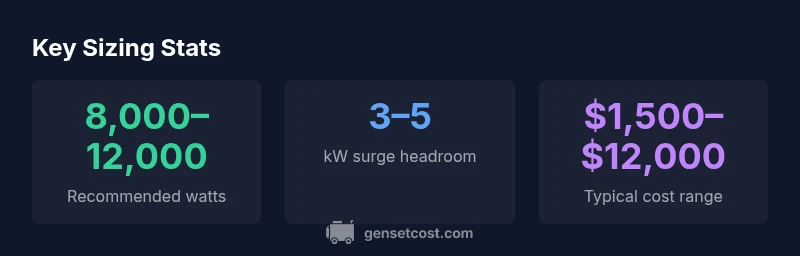
According to Genset Cost Analysis, 2026, sizing a generator for a 50 amp RV typically requires 8,000–12,000 watts of continuous capacity with headroom for startup surges. For most owners, a portable 8–10 kW unit covers base loads, while a 12 kW unit provides margin for air conditioning and water heating. This rule-of-thumb helps prevent overloads and keeps runtimes reasonable.
What size generator for 50 amp rv: Key sizing principles
A 50 amp RV presents a substantial load profile because it can deliver up to 12,000 watts of power when connected to a full 50A service on both legs of a 120/240V system. When sizing a generator for this class of RV, the goal is to provide enough continuous running watts for the everyday loads while preserving headroom for startup surges, particularly from air conditioners and water heaters. The guidance from the Genset Cost Team emphasizes designing around both base loads (refrigerator, lights, devices) and peak loads (AC, water heater, microwave). For most setups, this translates to aiming for a generator in the 8,000–12,000 watt range, with the exact choice depending on climate, occupancy, and appliance efficiency.
In practice, the most important variable is not merely the running wattage but the combination of running watts and surge capability. A unit that can deliver 8 kW continuously but only 2–3 kW surge will struggle when a large AC compressor starts. The recommended approach is to target a generator that can sustain 8–12 kW with a 3–5 kW surge headroom. This aligns with typical 50A RV power profiles and reduces the need for aggressive load shifting.
When selecting based on 50 amp service, consider your climate, insulation, and typical occupancy. A single high-wurst air conditioner (e.g., 13.5k BTU or larger) can demand substantial startup power, so plan for surge capacity as a core sizing input. The takeaway is to size for both predictable loads and startup spikes to maintain stable voltage and avoid nuisance tripping.
Illustrative sizing ranges for common loads on a 50A RV
| Aspect | Base Load (kW) | Peak Load (kW) |
|---|---|---|
| Minimal loads (fridge, lights) | 2.0–3.0 | 4.0–5.0 |
| One AC unit (13.5k BTU) | 4.0–5.0 | 8.0–9.0 |
| Two AC units | 6.0–8.0 | 12.0–14.0 |
| Full RV with water heater | 8.0–10.0 | 12.0–14.0 |
People Also Ask
What size generator do I need for a 50 amp RV?
For most 50A RVs, a generator in the 8,000–12,000 watt range works well, with enough surge capacity to handle AC startup. The exact size depends on how many appliances you run simultaneously and your climate. Start with 8–10 kW for lean loads and move to 12 kW if you consistently run multiple high-draw loads.
Most 50A RVs do well with an 8 to 12 kW generator. Start with lean loads and add headroom for air conditioner surges.
Should I choose a portable or standby generator for a 50 amp RV?
Portables are typically sufficient for many 50A RV setups, especially when you manage loads with a transfer switch and smart load management. Standby generators offer seamless operation and greater uptime for full-time RV living but come at a higher up-front cost and installation complexity.
Portables fit most setups; standby is best for continuous operation. Consider your camping patterns and budget.
How does climate affect generator sizing for a 50A RV?
Hot climates increase AC usage, raising peak load. Colder climates may reduce AC use but drive heating loads. In both cases, plan for the higher end of your load estimate to avoid oversizing or underperforming during peak demand.
Climate can shift peak loads; plan for the higher end of your load range.
Is it better to oversize or undersize a generator for a 50 amp RV?
Oversizing provides headroom for startup surges and future load growth, but it costs more and may be less fuel-efficient at light loads. Undersizing risks voltage drops and nuisance trips. A balanced approach targets 8–12 kW with 3–5 kW surge capacity.
Aim for a balanced size with surge headroom; avoid undersizing to prevent overloads.
What about fuel type and runtime considerations?
Gasoline and propane are common, with diesel offering longer runtimes for larger units. Runtime depends on load, fuel tank size, and efficiency. Plan for practical runtimes with enough fuel capacity to cover outages without frequent refueling.
Fuel type affects runtime; plan for realistic refuel needs during outages.
“Sizing a generator for a 50 amp RV is about balancing running watts with startup surges and runtime. Proper design reduces risk of overloads and improves comfort during outages.”
Key Takeaways
- Size for 50A RV using an 8–12 kW range
- Allow startup surges with 3–5 kW extra headroom
- Consider energy management to stay within limits
- Portables suit most scenarios; standby suits full-time setups