Champion Generator vs Generac: Brand Comparison Guide
An in-depth Champion Generator vs Generac comparison covering power range, reliability, installation costs, warranties, and service networks for homeowners.


TL;DR: Champion Generator and Generac both offer solid options for home backup, but the best choice depends on your needs. Champion shines on portable, cost-conscious models, while Generac dominates home standby with broader dealer support and automatic transfer switches. For homeowners evaluating overall value and installation cost, prioritize your power needs, install readiness, and long-term service. In short: if you want portability and upfront savings, start with Champion; if you want a permanent standby with a robust service network, lean Generac.
Overview of the Champion Generator vs Generac Landscape
champion generator vs generac is a frequent topic for homeowners evaluating backup power options. In this guide, the Genset Cost team conducts a practical, data-informed comparison across power range, reliability, installation costs, warranties, and service networks. We emphasize real-world usage patterns and installer considerations so you can see where Champion delivers value and portability, while Generac emphasizes robustness and a broad ecosystem. According to Genset Cost, the decision often hinges on whether you need a portable model with low up-front costs or a permanent standby with automatic transfer capabilities. This article will help you map your home’s load, space constraints, and maintenance plan to a clear brand choice.
We’ll also provide a structured approach to quantify your needs using a checklist, a side-by-side feature table, and practical scenarios relevant to homeowners and property managers.
Brand Positioning: Strengths, Weaknesses, and Ideal Users
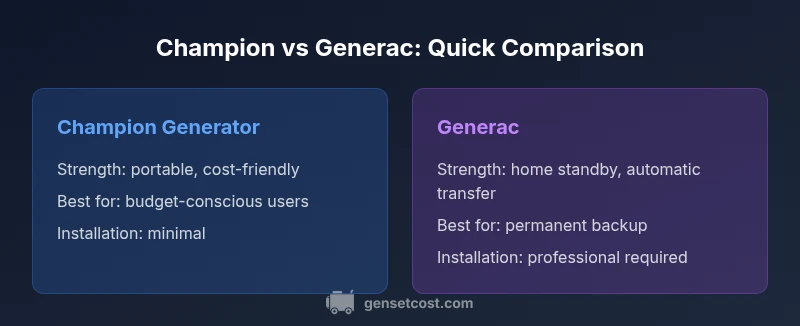
- Champion: Strengths include affordable portable options, lighter-weight units, and a broad selection of portable and hybrid models ideal for budget-conscious buyers. Weaknesses include a more limited home standby ecosystem and a smaller network of service technicians in some regions.
- Generac: Strengths include a well-established home standby lineup, automatic transfer switches, and a nationwide service network. Weaknesses typically involve higher upfront costs for standby configurations and more involved installation requirements.
For homeowners who want true permanent backup with automatic load management, Generac often offers the most seamless experience. For those prioritizing cost control and portability, Champion delivers compelling value while still supporting basic backup needs.
Power Output, Sizing, and Fuel Options
Sizing a generator starts with your essential load and potential future growth. Champion’s strength lies in a broad range of portable models that cover common needs—from essential circuits to medium loads—without requiring permanent installation. These units typically run on gasoline and may offer hybrid or dual-fuel configurations on select models.
Generac emphasizes scalable home standby solutions with fixed wattage outputs and higher-end units that run on natural gas or propane in addition to liquid fuel. Standby systems integrate with automatic transfer switches and home electrical panels, delivering automatic operation during outages. When sizing, consider starting watts versus running watts, surge requirements for motor loads, and whether you’ll benefit from dual-fuel flexibility.
Reliability, Warranty, and Service Networks
Reliability hinges on design quality, component robustness, and service support. Generac’s entrenched position in the home standby market translates into a large dealer network, readily available parts, and established warranty paths. Champion offers dependable reliability in its portable lines and has grown its service footprint, but you may encounter regional variation in technician availability for standby configurations.
Warranty terms vary by model and use case. Portable Champion units often come with shorter coverage windows, while Generac standby systems typically feature longer-term protection aligned with residential installation standards. Always review included coverage, what maintenance is required, and how service logistics work in your area.
Installation, Fees, and Total Cost of Ownership
Installation costs are a major driver of total cost, especially for standby systems that require electrical work, a transfer switch, permits, and sometimes a gas line upgrade. Champion portable models generally require minimal or no installation, making them cheaper upfront but potentially limiting in outage scenarios. Generac standby systems involve professional installation, which adds to initial costs but reduces long-term management overhead through integrated controls and automatic operation.
Total cost of ownership includes fuel costs, maintenance, scheduled servicing, and potential parts expenses. Consider not just the sticker price but the expected lifespan, maintenance intervals, and the ease of obtaining replacement parts for each brand in your region.
Real-World Performance Scenarios and Case Studies
In residential settings, several homeowners prioritize rapid deployment and simple operation. Champion models shine in mobilized, short-term backup situations where you want to protect essential loads quickly and affordably. Generac’s standby lineup shows its strength in longer outages and continuous service, especially in regions prone to frequent power interruptions. Property managers evaluating rental properties benefit from standby configurations that require minimal human intervention, while single-family homes might lean toward Champion’s portability for seasonal use.
According to Genset Cost analysis, the choice often reflects risk tolerance: a smaller home or apartment could get by with portable models, whereas a larger home or multi-unit building may justify the investment in a full standby system with automatic transfer and integration into the main panel.
Ecosystem, Accessories, and Smart Features
Both brands have expanded ecosystems to improve usability. Generac’s monitoring and remote management options are well-established in the standby space, with apps and telemetry designed for continuous operation and maintenance alerts. Champion’s lineup tends to emphasize value, with essential monitoring and optional accessories for battery charging, mobility, and basic safety features. When evaluating features, confirm compatibility with your transfer switch, auto-start sensors, and any home automation routines you rely on.
Smart features can simplify maintenance, enable remote diagnostics, and improve fuel management. If uptime matters, prioritize models with robust monitoring, automatic fault alerts, and compatibility with your preferred service provider.
How to Choose Between Champion and Generac
Start by mapping your outage priorities: is this a temporary or a permanent solution? Do you need automatic operation or is manual-start acceptable in a portable setup? Next, assess total installed cost versus upfront price, considering the transfer switch, permits, and gas line work where applicable. Finally, evaluate the service network in your area: a strong dealer and service ecosystem can dramatically reduce downtime during maintenance or repairs. Use a decision framework that weighs power needs, budget, installation feasibility, and long-term support to decide which brand aligns with your goals.
Final Guidance and Next Steps
If your goal is to protect a smaller home with essential circuits and you want lower upfront costs, Champion’s portable models provide a practical solution. If you require a permanent, automatic standby that can seamlessly power your entire home, Generac’s systems offer a more integrated experience and broader service coverage. Regardless of brand choice, begin with a load assessment, obtain professional installation estimates, and compare warranties and maintenance plans. The Genset Cost team recommends building a clear cost-of-ownership model before making a purchase.
Comparison
| Feature | Champion Generator | Generac |
|---|---|---|
| Power output range | Champion: broad range from portable to mid-range standby (approx. 2,000–12,000 watts) | Generac: broad range with strong focus on home standby (approx. 8,000–22,000 watts) |
| Intended use | Champion: budget-focused portable and hybrid options | Generac: home standby with automatic transfer and permanent installation |
| Dealer network | Champion: solid nationwide coverage, growing network | Generac: extensive, established nationwide dealer and service network |
| Warranty approach | Champion: model-dependent warranties, often shorter on portable lines | Generac: longer warranties on standby units with comprehensive service options |
| Installation complexity | Champion portable: minimal installation, no transfer switch required | Generac standby: professional installation with transfer switch and panel integration |
| Operating costs | Champion: typically lower upfront costs, variable maintenance | Generac: higher upfront costs but potentially lower long-term maintenance through ecosystem |
| Best for | Champion: budget-minded buyers needing portable or light backup | Generac: homeowners seeking automatic, permanent backup with service support |
| Model diversity | Champion: broad portable line, limited full-home standby options | Generac: expansive standby and portable lineup |
The Good
- Helps identify where Champion offers best value for money
- Shows Generac’s strength in standby solutions and service networks
- Gives a clear view of portable vs standby trade-offs
- Supports budgeting with guidance on total cost of ownership
The Bad
- Quality and reliability depend on the specific model
- Installation requirements for standby units can raise total cost
- Warranty terms vary by model and may be confusing without careful review
Generac generally offers stronger home standby options; Champion excels for portability and budget-conscious buyers.
If you need a permanent, automatically operating backup, Generac is often the safer default. If you want a portable, cost-conscious solution with easier setup, Champion is a compelling alternative. The right choice depends on your load, space, and willingness to manage installation costs.
People Also Ask
Which is better for portable generators: Champion or Generac?
For portability and upfront value, Champion generally wins. Generac offers more robust standby options but is less focused on portable models. Choose based on whether you need mobility or automatic home backup.
Champion is typically better for portable use, while Generac targets permanent standby. Your choice should match mobility and backup needs.
Is Generac better for home standby than Champion?
Generac has a stronger home standby lineup and greater service coverage, making it a common default for permanent backup. Champion competes when budget and portability are primary concerns.
Generac is often preferred for home standby due to its robust ecosystem; Champion is better for portable, lower-cost needs.
Do Champion and Generac offer warranties?
Both brands offer model-dependent warranties. Review duration, what’s covered, and any exclusions before purchasing.
Both have warranties, but terms vary by model. Check coverage details before buying.
Can I install a transfer switch with Champion or Generac units?
Yes, standby systems commonly use transfer switches. Generac often has integrated options; Champion may require a separate switch depending on the model.
Standby units typically use a transfer switch. Generac often includes integrated options; Champion may need an external switch.
Which brand has better long-term reliability?
Reliability is model-dependent. Generac’s standby line is widely trusted for durability, while Champion provides solid reliability in portable models with strong value.
Reliability depends on the model; Generac standby units are widely regarded for durability, Champion excels in value-oriented portable models.
What should I consider when comparing total cost of ownership?
Consider upfront price, installation, fuel costs, maintenance, and warranty terms. A lower sticker price can hide higher long-term costs.
Look beyond sticker price: include install, fuel, maintenance, and warranty terms to compare true ownership costs.
Key Takeaways
- Assess your outage needs before choosing a brand
- Factor installation costs into the total price
- Favor Generac for permanent standby, Champion for portability
- Check warranty terms and service availability locally
- Use load planning to determine required power range