Diesel Generator vs Gas: A Comprehensive Home Backup Comparison
A thorough comparison of diesel generators and gas generators for home backup power. Learn about cost, runtime, maintenance, emissions, and ideal use cases to choose the right fuel type.


Diesel generator vs gas: Diesel units typically deliver longer runtimes, better fuel efficiency under heavy loads, and greater durability, while gas units offer lower upfront costs, easier refueling, and quieter operation. For frequent, high-demand outages, diesel generally wins; for lighter use, gas can be a more flexible, cost-effective choice. Your decision hinges on load, fuel access, and long-term ownership costs.
Why the Diesel Generator vs Gas decision matters
Choosing between a diesel generator and a gas generator is not just about upfront price. It determines how reliably your home can power essential systems during outages, how often you’ll visit the fuel pump, and what kind of maintenance routine fits your property. When homeowner budgets and property-management considerations align, the diesel generator vs gas comparison helps you quantify trade-offs in fuel availability, refueling logistics, and long-term ownership costs. According to Genset Cost, the most cost-effective choice often depends on expected outage duration, peak load, and how you plan to store and access fuel. The diesel generator vs gas decision is rarely one-size-fits-all; it hinges on how you balance risk, convenience, and total cost of ownership.
Fuel and Runtime: How each option performs under real-world conditions
Fuel density and delivery play central roles in the diesel generator vs gas decision. Diesel fuel has a higher energy density, which translates to longer runtimes between refuels for the same tank size. Gasoline or propane, while often cheaper upfront, tends to provide shorter runtimes per refill and can require larger or more frequent storage depending on usage. In practical terms, if you expect extended outages in which you’ll run a higher percentage of your circuits—a sump pump, furnace, and well pump, for example—diesel often offers a practical advantage. If outages are shorter or irregular and your load is moderate, gas can reduce the frequency of maintenance and simplify refueling plans. The key is to model your peak load, expected outage duration, and available fuel sources before selecting between the two.
Maintenance and Longevity: Which option lasts longer with regular use
Maintenance needs and longevity split significantly between diesel and gas in the field. Diesel engines are known for robust longevity and lower wear when operated at steady, moderate-to-high loads, which is common in backup scenarios that keep essential circuits online for many hours. Regular maintenance—oil and filter changes, battery checks, and fuel system maintenance—tays similar in both, but diesel systems often benefit from longer intervals between major overhauls when run regularly at design loads. Gas engines may require more frequent tune-ups at similar duty cycles and can be more sensitive to fuel quality. Overall, durability in a diesel setup is commonly cited as a primary justification for higher upfront costs in exchange for long-term reliability.
Emissions, Noise, and Compliance: Environmental and local rules matter
Diesel generators typically emit more particulates and lower-frequency noise than gasoline or propane units, especially if not equipped with advanced mufflers and particulate filters. Gas options tend to be quieter and cleaner at the point of use, which can matter for neighborhoods with strict noise ordinances or emissions restrictions. In many jurisdictions, fuel type also correlates with permit requirements and transfer-switch configurations. When evaluating diesel generator vs gas, consider local noise ordinances, air-quality rules, and any HOA restrictions that might apply to your installation.
Initial Cost and Total Cost of Ownership: Weighing upfront vs ongoing costs
Initial costs for diesel units are usually higher due to bigger engines, heavier construction, and robust fuel systems. Gas units—especially those designed to run on natural gas or propane—often come with lower upfront prices and simpler installation if a fuel line or propane tank is readily available. However, total cost of ownership includes fuel price volatility, fuel storage needs, maintenance frequency, and potential retrofit expenses. If outages are frequent and long, the higher fuel efficiency of diesel and longer component life can offset upfront costs over time. If outages are rare or short, gas may present a lower-risk, budget-friendly option.
Sizing, Transfer Switches, and System Integration: Getting it right the first time
Sizing is critical in the diesel generator vs gas decision. A unit that’s too small will fail to support essential circuits, while one that’s oversized incurs unnecessary cost and can shorten equipment life if run under light loads. Transfer switch compatibility is another important consideration; almost all home backup systems work with either fuel type, but the wiring and panel integration may differ slightly depending on the chosen generator. Work with a qualified electrician to determine load priorities, calculate surge requirements, and select a model that aligns with your transfer-switch setup.
Reliability in Different Climates: How weather and operational conditions affect performance
Diesel engines tend to perform well in colder climates when fuel gelling is managed with additives and proper storage practices. Gas engines can be more sensitive to fuel quality, especially in long-term storage, but modern designs and stabilized fuels have mitigated many concerns. For coastal or humid environments, corrosion protection and enclosure temperature management are critical regardless of fuel type. The diesel generator vs gas decision should factor climate, ambient temperature, storage strategy, and maintenance discipline to sustain reliability.
Best Use Scenarios: When to prefer diesel vs when gas shines
If your priority is continuous, high-load operation during prolonged outages, diesel usually provides better reliability and lower operating costs over time. If your outages are infrequent, your load is modest, and you want a lower upfront investment with simpler refueling, gas can be the superior option. For property managers overseeing multiple units, consider a mixed strategy where essential systems run on gas during winter and switch to diesel for extended outages or high-demand events. The right approach balances risk, cost, and convenience.
Fuel Logistics and Storage Planning: Practical tips to avoid outages caused by fuel issues
Fuel management is a practical differentiator in the diesel generator vs gas equation. Diesel must be stored safely with proper containment and fuel stabilizers, and you should plan for tank size relative to expected outage duration. Gas options require reliable supply lines or propane tank inventories; ensure you have a plan for refueling continuity, especially in severe weather when deliveries may be delayed. Regularly inspect fuel quality, lines, and connections, and keep a maintenance log focused on the fuel system.
Environmental and Safety Considerations: Keeping your installation compliant and safe
Maintenance best practices include proper ventilation, drip containment, and regular testing of automatic transfer switches. Diesel engines produce heat, exhaust, and potential HP exhaust fumes; ensure installation in well-ventilated enclosures and consider emissions-compliant models with modern filtration. Gas units generally produce fewer particulates but require safe storage of fuel to prevent leaks and fire hazards. A thoughtful diesel generator vs gas plan emphasizes safety, ventilation, and compliance with local codes.
Practical Decision Framework: A checklist for homeowners and property managers
Use this quick framework when choosing between diesel and gas: (1) assess peak load and outage duration; (2) evaluate fuel availability, storage capacity, and refueling logistics; (3) compare total cost of ownership including maintenance and fuel volatility; (4) check local regulations and transfer-switch compatibility; (5) plan for noise, emissions, and safety considerations. This structured approach helps ensure the choice aligns with your property’s needs and your long-term maintenance plan.
Conclusion-free wrap-up: how to move forward with confidence
The diesel generator vs gas decision is nuanced and highly dependent on your specific use case. A systematic evaluation of load, fuel infrastructure, and costs—guided by professional installation advice—will yield the most reliable outcome for your home or multi-unit property.
Comparison
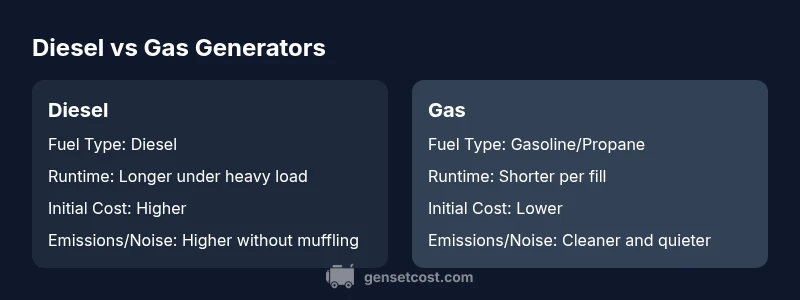
| Feature | Diesel Generator | Gas Generator |
|---|---|---|
| Fuel Type | Diesel | Gasoline/Propane |
| Typical Runtime per Tank/Bundle | Longer runtime due to energy density | Shorter runtime per fill; may require larger storage |
| Maintenance Interval | Generally longer intervals between major overhauls at steady loads | Maintenance aligns with standard gasoline engines; may require more frequent tune-ups |
| Initial Cost | Higher upfront cost for diesel units | Lower upfront cost for gas units |
| Fuel Availability & Storage | Diesel storage and handling essential; reliability in outages varies by location | Gas lines or propane tanks provide flexible refueling but depend on supply networks |
| Durability & Lifespan | Typically longer lifespan under sustained loads | Good lifespan but often not as durable under heavy continuous use |
| Emissions & Noise | Higher emissions; louder without proper muffling | Quieter and cleaner at point of use with stabilized fuels |
| Best For | High-demand, long outages, remote storage advantages for diesel | Lower upfront costs and moderate outages for gas |
The Good
- Diesel engines offer greater fuel efficiency under heavy load and longer runtimes
- Diesel fuel has high energy density and long shelf life when stabilized
- Gas options often have lower upfront costs and quieter operation
- Gas systems can be easier to refuel during outages with reliable fuel supply
The Bad
- Diesel equipment is typically heavier and more expensive to install
- Diesel fuel availability can be inconsistent during widespread outages
- Gas setups may require a constant fuel supply or regular tank management
- Diesel engines may require more frequent maintenance if used at very low load
Diesel is preferred for high-load, frequent outages; gas is preferred for lower upfront cost and lighter use
Choose diesel when you expect long outages with heavy loads. Choose gas if you want lower initial costs and easier refueling for moderate, infrequent outages.
People Also Ask
What is the main difference between diesel and gas generators in home backup scenarios?
The primary difference is performance under load: diesel generally provides longer runtimes and better fuel efficiency at higher loads, while gas units tend to be cheaper upfront and easier to refuel. Consider expected outage duration, peak load, and fuel access when weighing the diesel generator vs gas.
Diesel typically runs longer and uses fuel more efficiently under heavy use, while gas units are cheaper to buy and easier to refuel. Think about your outages and load to decide.
Which is more cost-effective over a 10-year period?
Total cost of ownership is driven by upfront cost, maintenance, and fuel price volatility. Diesel often costs more upfront but can be cheaper to operate over time with heavy usage. Gas may be cheaper initially but fuel costs and maintenance frequency can add up with frequent outages.
Diesel may pay off if you use it a lot; gas is often cheaper upfront but fuel costs can add up.
Can I install either type with a home transfer switch?
Yes, both diesel and gas generators can be integrated with standard home transfer switches. The exact wiring and panel configuration may differ slightly, so a licensed electrician should confirm compatibility and safety requirements.
Both can use a transfer switch, but have a pro verify the wiring.
Which fuel is more reliable in extreme outages?
Reliability depends on fuel supply continuity. Diesel often wins for longer outages due to energy density and storage stability, but it requires proper fuel management. Gas systems rely on continuous fuel supply lines or propane tanks, which can be vulnerable in severe weather when delivery services are disrupted.
Diesel is typically more reliable for long outages if you manage fuel storage properly.
Are diesel generators louder and how does that affect installation?
Diesel generators are commonly louder than many gas options, though sound attenuation and enclosures help. Consider setback requirements, HOA rules, and enclosure design to minimize noise during operation while meeting safety and venting needs.
Diesels can be louder, but good enclosures reduce noise and meet safety rules.
What maintenance is required for diesel vs gas, in simple terms?
Both require regular oil changes, filter replacements, and battery checks. Diesel engines may need more attention to fuel quality and gelling prevention in cold climates, while gas engines benefit from keeping fuel stabilized and preventing varnish buildup in storage.
Oil, filters, and batteries are key. Diesel needs careful fuel storage in cold, gas needs fuel stabilization.
Key Takeaways
- Assess peak load and outage duration before selecting fuel type
- Diesel offers durability and longer runtimes; gas provides cheaper upfront costs
- Plan fuel logistics: storage for diesel or supply lines for gas
- Factor local regulations, noise, and emissions into your choice
- Consult a licensed pro to validate sizing and transfer-switch compatibility