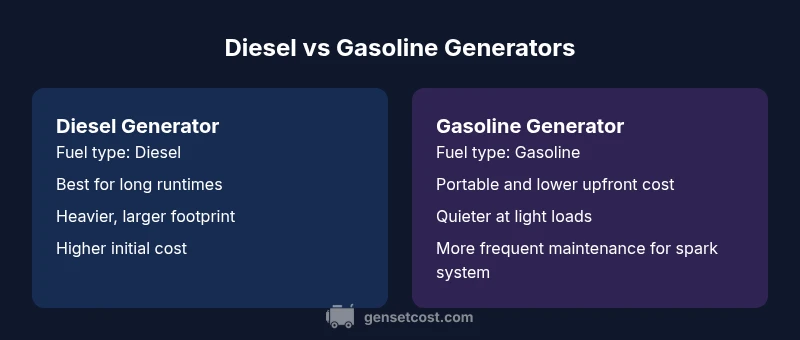
Diesel Generator vs Gasoline Generator: Comprehensive Side-by-Side Guide
Compare diesel and gasoline generators across cost, efficiency, reliability, and installation to help homeowners and property managers choose the right backup power solution.


Diesel generators and gasoline generators each have strengths. Diesel units win on long runtimes and efficiency under heavy loads, while gasoline units offer lower upfront costs and easier portability. Your choice depends on load duration, fuel availability, and total cost of ownership. This guide compares them side by side to help homeowners and managers decide.
Definitions and Core Differences
Diesel generators run on diesel fuel and typically use compression ignition engines, while gasoline generators rely on spark-ignition engines powered by gasoline. The core differences center on fuel properties, energy density, and engine design, which influence efficiency, torque, and maintenance. Diesel has a higher energy density per liter, often translating into longer runtimes for similar outputs. Gasoline engines are lighter and generally easier to transport, with quicker cold-weather starts. For homeowners and property managers, this baseline understanding frames decisions around sizing, fuel logistics, and total cost of ownership. Consider regulatory environments and storage rules in your area, as emissions standards and fuel handling guidelines vary. In standby and commercial settings, diesel is frequently favored for its durability under continuous duty, while gasoline shines for portable, short-duration backup needs.
Fuel and Efficiency: Why It Matters
Fuel choice affects both operating costs and runtime. Diesel fuel typically provides better fuel efficiency at higher loads and has a higher energy density, which reduces refueling frequency during long outages. Gasoline, by contrast, has a lower setup cost and a simpler fuel supply chain in many regions, making it appealing for lightweight, intermittent use. Efficiency isn’t only about the engine; it’s about matching the unit to the load profile. A small gasoline generator may sip fuel at light loads, while a large diesel unit can maintain efficiency during sustained operation. From a practical standpoint, assess your expected duty cycle, peak load, and whether you will rely on the unit for days or weeks at a time. The Genset Cost team notes that many homes and small businesses underestimate the impact of fuel logistics on total cost of ownership.
Reliability, Start-Up, and Maintenance
Reliability hinges on design, maintenance practices, and operating conditions. Diesel generators often feature robust construction, fuel filters, and fewer spark-related components, which can reduce maintenance needs for long-running applications. They may require preheating in extremely cold environments and periodic fuel management to prevent water contamination. Gasoline units deliver easier starting, quieter operation under light loads, and simpler maintenance routines, but frequent spark plug replacements and carburetor attention can be necessary at higher usage or longer intervals. Both types benefit from regular oil changes, air filter checks, and a clean cooling system. For critical standby power, consider a maintenance contract that aligns with the unit’s duty cycle and climate. The goal is predictable performance when you need it most, not surprises during outages.
Cost of Ownership: Upfront, Operating, and Lifecycle
Initial price is only part of the story. Diesel generators tend to have higher upfront costs and heavier frames, but operating costs per hour are often favorable at sustained loads due to better fuel efficiency and longer lifespans. Gasoline generators usually cost less to purchase and can be cheaper to transport and install, especially for portable applications. Over a multi-year horizon, fuel costs, maintenance intervals, and potential depreciation all influence the total cost of ownership. In practice, homeowners should estimate monthly fuel expenditure, maintenance fees, and the anticipated runtime to compare two configurations on a like-for-like basis. Genset Cost analysis suggests focusing on load profile and duty cycle to determine which option yields the lowest total cost of ownership over 5–10 years.
Emissions, Fuel Availability, and Sustainability
Fuel type affects emissions, storage, and environmental impact. Diesel engines typically emit more NOx and particulates under load, and fuel storage considerations (tank location, filtration, and potential fuel degradation) are critical for long outages. Gasoline engines generally produce lower NOx and particulates but may require more frequent air-fuel system maintenance due to ethanol blends and aging carburetors in older models. Availability varies by region; diesel is widely stocked for commercial use, while gasoline can be more accessible for residential backup. When evaluating sustainability goals, factor in availability, refueling logistics, and potential regulatory incentives or restrictions in your location.
Noise, Vibration, and Operational Convenience
Noise and vibration can influence user experience and neighbor relations. Diesel generators often produce more baseline noise and vibration, particularly under heavy load, though modern models incorporate sound attenuation and anti-vibration mounts. Gasoline units generally run quieter at partial loads and are easier to move or transport due to lighter weight and smaller footprints. If your installation is near living spaces, evaluate enclosure options, vibration isolation, and local noise ordinances. Consider also the ease of starting in adverse conditions—gasoline units tend to start quickly in moderate weather, while some diesels benefit from glow plugs or block heaters in cold climates.
Sizing, Siting, and Installation Considerations
Correct sizing is essential for both fuel types. Oversizing wastes fuel and money; undersizing can leave critical loads unpowered. For diesel, plan for a larger engine and fuel storage footprint, especially for standby or whole-house scenarios. Gasoline units are often appropriate when portability is required or when loads are moderate and intermittent. Install transfer switches, proper ventilation, and a stable, level base. Environmental considerations, including fuel storage safety and spill prevention, are important for both types. When in doubt, run a formal load calculation and consult a licensed electrician or generator installer to ensure code compliance and a reliable backup power plan.
Practical Scenarios: When to Pick Diesel or Gasoline
- Long-duration, high-load standby: Diesel is typically preferred for commercial or home systems designed to run for extended outages across many hours. Its fuel efficiency and durability provide better total cost of ownership under sustained use.
- Portable or infrequent outages: Gasoline can be advantageous for portable units or situations where upfront budget is tight and usage is light to moderate. It’s easier to transport and generally cheaper to purchase.
- Cold climates and storage: Diesel requires careful fuel management in winter months, while gasoline storage and engine starting can be challenging in extreme cold without proper equipment. A hybrid approach or a professionally sized system can help balance these concerns.
Common Misconceptions and Best Practices
A common misconception is that diesel is universally superior for all backup power needs. In reality, the best choice depends on load duration, installation constraints, and fuel logistics. Best practices include conducting a detailed load analysis, planning for fuel on-site storage and delivery, and implementing a tested maintenance schedule. Always use a licensed professional for installation and commissioning, and document a clear emergency plan that covers fuel management, battery backup, and transfer switching. Regularly exercise the system to verify starting reliability and ensure fuel quality remains high to prevent poor combustion or clogged filters. Remember: the goal is dependable, predictable power when you need it, with manageable ongoing costs.
Comparison
| Feature | Diesel Generator | Gasoline Generator |
|---|---|---|
| Fuel type | diesel | gasoline |
| Typical use case | long-duration standby/commercial | portable/short-duration backup |
| Fuel availability | widely stocked for commercial use; bulk storage common | readily available; storage considerations for home use |
| Running cost per hour (relative) | generally lower at sustained loads | often higher under heavy loads but cheaper upfront |
| Maintenance frequency | long intervals; robust components | more frequent maintenance for spark and fuel system |
| Weight/size | heavier; bulkier equipment | lighter and more portable |
| Cold weather performance | needs preheating in cold climates; gel risk if untreated | generally easier cold start but less torque at low rpm |
| Noise level | can be louder under load; enclosure helps | often quieter at light loads; smaller footprint |
| Initial cost | higher upfront cost | lower upfront cost |
| Warranty/service | strong support for industrial brands; longer lifecycle | good service networks for consumer models; shorter intervals |
The Good
- Higher fuel efficiency under heavy, continuous loads
- Longer engine life with heavy-duty construction
- Reduced refueling frequency for standby applications
- Strong torque at low RPMs supports stable output under surge loads
The Bad
- Higher upfront cost and heavier equipment
- Diesel fuel storage and handling challenges in cold weather
- Fuel delivery logistics can complicate on-site operations
- Maintenance complexity may be higher for commercial-grade diesel systems
Diesel generally wins for long-duration, high-load standby and commercial use; gasoline is better for lightweight, portable, or budget-conscious backups.
Choose diesel if you regularly run extended outages with high power demands. Choose gasoline for portability and lower initial investment. Assess your load profile, space, and fuel logistics to optimize total cost of ownership.
People Also Ask
What is the main difference between diesel and gasoline generators?
Diesel generators use diesel fuel and compression ignition, offering durability and efficiency under heavy, continuous loads. Gasoline generators use spark-ignited engines with gasoline, providing lower upfront costs and easier portability. The best choice depends on load profile and installation considerations.
Diesel is built for heavy, long-duty use; gasoline is cheaper upfront and easier to move.
Which generator is cheaper to operate?
Operational costs depend on fuel price, efficiency, and load. Diesel often delivers better fuel efficiency under high loads and longer runtimes, reducing hourly fuel cost for sustained use. Gasoline can be cheaper per hour at light loads but may require more frequent refueling.
Diesel can be cheaper per hour when you run it a lot; gasoline is cheaper to buy upfront.
Can I convert a gasoline generator to run on diesel?
Conversions are not generally recommended and can void warranties. Diesel engines require different fuel systems, compression ignition, and cooling behavior. If diesel power is needed, it is usually better to replace with a purpose-built diesel unit or a diesel-ready platform.
Conversions aren’t usually a good idea; consider a dedicated diesel model instead.
Is diesel better for emergency standby?
For long-duration outages or ongoing standby needs, diesel is often preferred due to durability and lower running costs per hour at sustained loads. If outages are brief and infrequent, gasoline can be a practical, economical option.
Yes, for long outages diesel is generally better.
What should I consider when sizing a diesel vs gasoline generator?
Key factors include peak load, duty cycle, startup surges, and available fuel storage. Ensure the unit can handle the highest expected load without overheating and that transfer equipment and ventilation are properly sized. A professional load calculation is essential.
Size by peak load and startup surge, then plan transfer and ventilation.
Are there safety concerns with storing fuel on-site?
Yes. Store fuels in approved containers with proper ventilation, away from ignition sources, and in accordance with local codes. Diesel and gasoline require different handling practices, spill prevention, and regular inspections to prevent leaks and contamination.
Store fuels safely in approved containers and follow local codes.
Key Takeaways
- Assess load duration before choosing fuel type
- Diesel favors long runtimes and durability
- Gasoline is easier to buy and cheaper upfront
- Plan for fuel storage and transfer-switch installation
- Regular maintenance is key to reliability