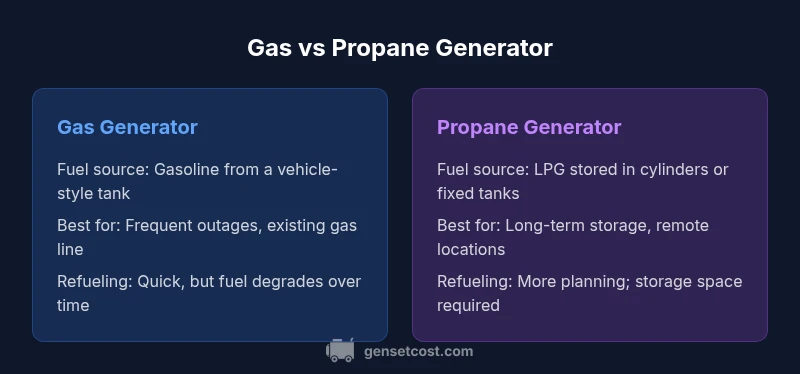
Gas Generator vs Propane Generator: A Side-by-Side Comparison
Compare gas generator versus propane generator to understand fuel availability, running costs, maintenance, and safety for home backup power planning.


Gas generator vs propane generator: which fuel type fits your home backup plan? In most cases, natural-gas engines deliver steady operation and cost efficiency when a reliable gas supply is available, while propane offers cleaner storage and less fuel-price volatility. This comparison weighs fuel availability, operating cost, maintenance, and safety to help homeowners decide.
Fuel Fundamentals: gas generator vs propane generator
When evaluating gas generator vs propane generator, the first question is how each fuel type converts chemical energy into electricity. Gasoline engines are the most common in residential portable and standby generators; propane-powered units use liquefied petroleum gas stored in cylinders or delivered via a fixed supply. The key differences stem from energy density, storage, and fuel delivery systems. Gasoline offers high energy density by volume, which means longer runtimes between refills when you have ample fuel. Propane stores as a pressurized gas and remains stable for long periods, which reduces the risk of fuel degradation or varnish buildup in the carburetor. For homeowners evaluating options, it's important to separate fuel logistics from generator efficiency: a 10 kW unit running on natural gas will draw energy from the supply line differently than the same unit fueled by propane. The energy conversion is efficient in both cases when the system is well maintained, but the cost profile and refill logistics differ significantly. The Genset Cost team notes that fuel availability varies by region, which can tip the decision toward one option over the other, depending on whether you rely on a fixed gas line or portable propane tanks. In short, the choice depends on your home's fuel infrastructure, typical outage length, and how you value ease of storage versus ongoing running costs.
Availability and Infrastructure
Gas generators connected to a home’s natural gas line enjoy a virtually limitless refuel source during outages, provided the line remains pressurized and the utility maintains service. Propane generators rely on stored LPG, typically in above-ground or underground tanks, which offers independence from the utility grid for refueling but requires regular tank management and periodic replacement of propane cylinders. For urban settings with a reliable gas network, a gas generator can minimize storage clutter and refueling stops. In rural properties or places with volatile electricity costs, a propane setup can be attractive due to its self-contained storage. The choice often hinges on your property layout, local fuel prices, and accessibility to propane suppliers or natural gas service. According to Genset Cost, the reliability of your fuel infrastructure strongly influences total cost of ownership and outage readiness. Homeowners should map out fuel delivery options, storage footprint, and the practicality of maintaining a steady supply when planning a standby system.
Cost of Running and Storage
Running costs consider fuel price per unit of energy and the efficiency of the generator at load. Gasoline-fed engines typically achieve strong heat efficiency at standard loads and may benefit from lower per-kWh costs in regions with cheap natural gas or accessible pipelines. Propane tends to have a cleaner burn with less varnish buildup, which can translate to lower maintenance expenses over time, but propane price fluctuations and the larger storage footprint can increase costs if outages are frequent. Storage convenience is also important: propane tanks can be filled on demand, but they require space and protection from the elements. Natural gas, when available, can be cheaper to operate on a per-hour basis if your home has a robust gas service. Genset Cost’s research indicates that evaluating regional fuel pricing and expected outage durations is crucial to estimating long-term costs rather than relying on upfront price alone.
Performance under Load and Sizing Considerations
Under load, both fuel types respond similarly in terms of electrical output, but fuel availability and delivery influence actual performance. Gas generators often excel for frequent outages because refueling via a fixed line minimizes downtime; propane setups, while requiring refills, can maintain consistent operation in remote locations without dependence on grid health. Sizing is essential: choose a generator that can handle starting surges for your critical loads, and ensure your fuel system can deliver the required flow at peak demand. If your load profile is highly variable, a dual-fuel or dual-tank approach might help balance reliability with cost. The Genset Cost framework emphasizes evaluating peak vs. base loads and planning for a margin of safety to avoid under-sizing.
Start-Stop Behavior and Cold Weather
Cold starts in winter can influence how quickly a generator comes online and reaches stable voltage. propane systems are less likely to gum up in cold weather due to the cleaner burn and less volatile storage behavior, while gasoline systems may experience more varnish buildup if storage times are long without fuel stabilizers. For installations near cold climates, a professionally sized standby system with proper battery and glow-plug or block heater considerations will reduce startup delays. Local climate and fuel storage strategy should guide the selection, with attention to how quickly you must restore power in freezing conditions.
Maintenance, Lifespan, and Reliability
Maintenance frequency and complexity differ between gas and propane setups. Gasoline engines require regular carburetor care, fuel stabilization if storage is extended, and periodic oil/filter changes. Propane engines tend to experience steadier combustion with less fuel degradation, resulting in lower fuel-system maintenance in many cases. However, propane storage requires robust tanks, regulators, and leak-detection practices. In both cases, following manufacturer maintenance schedules, using quality fuels, and keeping the unit protected from the elements will maximize lifespan and reliability. Genset Cost’s guidance highlights that a well-maintained unit—regardless of fuel—remains more reliable during outages.
Installation, Safety, and Codes
Fuel choice affects installation logistics and safety. Gas line connections require professional hookups and compliance with local codes, including gas-tight fittings and proper shutoffs. Propane installations demand adherence to cylinder storage rules, regulator sizing, and outdoor clearance. Both options need adequate ventilation for exhaust, proper clearance from structures, and adherence to electrical codes and transfer-switch requirements. Always engage licensed technicians for installation and system integration to ensure safe operation and to preserve warranties. Safety planning should include leak detection, secure fuel storage, and ongoing inspections.
How to Read a Model Spec Sheet
When evaluating models, compare both fuel compatibility and essential specs: rated continuous output, surge capacity, fuel consumption rate at various loads, run-time at rated loads, and fuel delivery arrangements (line-in for gas, tank/regulator for propane). Consider warranty terms, service availability, and the cost of essential accessories like transfer switches and automatic start features. For a homeowner, a side-by-side evaluation of fuel availability, long-term costs, and maintenance needs helps identify the best fit for a given outage profile. Genset Cost emphasizes aligning your technical needs with your logistical realities to avoid overbuilding or underestimating a standby system.
Decision Framework: Which Fuel Is Best for You
To decide between a gas generator and a propane generator, start with your fuel infrastructure: do you have a reliable natural gas line, or would you prefer portable propane storage? Next, evaluate expected outage duration and the frequency of use. If you want minimal refueling downtime and low storage footprint, natural gas is often preferable; if you need independence from utility service and stable long-term storage, propane is compelling. Finally, consider total cost of ownership, including fuel price volatility, maintenance, and potential conversion costs. Use a simple matrix: fuel availability, running costs, storage needs, and maintenance burden to guide your final choice. The right selection depends on your property, climate, and power needs.
Conclusion and Next Steps
This guide has outlined the core differences between gas generator vs propane generator, highlighting how fuel logistics, costs, and maintenance shape the total ownership experience. The best choice for one homeowner may differ for another, depending on fuel access, storage space, and outage expectations. Engage a qualified installer early to size the unit accurately, confirm fuel compatibility, and establish a safe, code-compliant transfer path. Planning now can save time and money when outages occur.
Comparison
| Feature | Gas Generator | Propane Generator |
|---|---|---|
| Fuel Availability | Dependent on natural gas line or utility pressure; virtually unlimited supply if service is active | Depends on propane tanks or a fixed LPG supply; needs regular refilling and storage |
| Operating Cost Profile | Typically lower per hour when natural gas is affordable and reliably supplied | Often higher per hour due to LPG price volatility and storage needs |
| Storage & Safety | No on-site fuel storage required beyond routine service; reduced space needs | Requires tanks or cylinders with outdoor protection and leak safeguards |
| Performance at Load | Excellent under continuous load with steady fuel delivery via gas line | Strong performance with proper storage; slightly more refueling planning for peak loads |
| Emissions & Environment | Similar emission profiles to gasoline engines; efficiency depends on model | Propane burns cleaner in many respects and may reduce certain emissions |
| Maintenance & Lifespan | Carburetor and fuel-system maintenance; varnish risk with old gasoline | Cleaner burn; less varnish risk; storage-related considerations dominate maintenance |
| Installation Considerations | Requires gas line integration; transfer switch compatibility essential | Requires safe propane storage and regulator sizing; separate line connections if fixed tanks |
The Good
- Lower long-term fuel costs when a reliable gas line is available
- Minimal on-site fuel storage with gas line connections
- Propane stores well for long-term outages and lacks gasoline varnish concerns
- Propane provides independence from utility service when storage is sized appropriately
The Bad
- Gasoline/NG logistics can be disrupted during outages if supply is interrupted
- Propane storage requires space, regular refilling, and handling safety measures
Gas generally wins on running costs when a stable natural gas supply exists; propane wins on independence and long-term storage
If you have a reliable gas service, choose gas for lower operating costs and minimal storage needs. If you need storage flexibility or live far from grid infrastructure, propane offers practical independence and longer storage resilience.
People Also Ask
Which fuel is cheaper to operate for a home backup generator?
Operational costs depend on local fuel prices and efficiency. Natural gas is often cheaper per hour if a stable pipeline exists, while propane can cost more per hour but offers storage independence. Regional price fluctuations and installed equipment efficiency will largely determine the total cost of ownership.
Natural gas is usually cheaper per hour if you have reliable pipeline service; propane can be more expensive per hour but gives you storage independence. Overall costs depend on your local fuel prices and how you use the generator.
Is propane safer to store than gasoline?
Propane is stored as a pressurized gas in tanks and is generally safer to store outdoors with proper shielding and ventilation. Gasoline is a liquid fuel that can degrade and gum up carburetors if stored too long without stabilizers. Both require careful handling and adherence to local codes, installation standards, and leak-detection practices.
Propane is stored as a pressurized gas and is typically safer to store outdoors with proper protection. Gasoline can degrade over time, so stabilize it and store responsibly.
Can I convert a gas generator to propane?
Some generators are designed as dual-fuel or have conversion kits available from manufacturers. Not all models support propane conversion, and kits should be installed by a licensed technician to maintain safety and warranty integrity.
Some models support propane conversions with manufacturer kits, but you’ll want a professional to install it and check warranty implications.
What about emissions and noise?
Emissions and noise depend more on engine design than fuel type. Propane often burns cleaner, potentially reducing certain emissions, while noise levels are primarily affected by engine size, muffling, and installation. Both fuels require proper exhaust routing and sound-dampening where required by code.
Emissions vary by engine design; propane can burn cleaner, but noise depends on the unit and installation.
Which fuel is better for long-term outages?
Propane stores well for extended periods, making it attractive for long outages where a supply chain might be disrupted. Natural gas depends on continued utility service, which may not be available during grid failures. Your choice should align with outage duration expectations and storage capabilities.
Propane is advantageous for long outages due to easy storage; natural gas depends on grid reliability.
How do I size for a home backup generator?
Start with a load assessment of essential circuits, account for startup surges, and aim for 1.25–1.5x surge capacity. Consider climate, fuel availability, and transfer-switch compatibility. A professional can perform a detailed calculation and propose a safe, code-compliant solution.
Assess essential loads, account for startup surges, and consult a pro to size correctly.
Key Takeaways
- Assess fuel infrastructure before selecting a generator
- Consider outage frequency and typical load to guide sizing
- Factor in storage space and safety requirements for propane
- Weigh long-term operating costs against upfront fuel-related costs
- Consult a professional to size and install correctly