LP Generator vs Diesel: Choosing the Right Home Backup Power Solution
Compare LP (propane) and diesel generators for home backup power — fuel costs, reliability, maintenance, cold-weather performance, and how to choose.


LP generator vs diesel: both deliver essential backup power, but propane (LP) engines typically offer cleaner fuel, faster starts, and easier storage, while diesel units deliver higher torque, longer endurance, and lower fuel costs per hour when fuel prices are favorable. For homeowners, the choice hinges on fuel availability, climate, and long-term ownership costs.
Key Differences Between LP Generators and Diesel
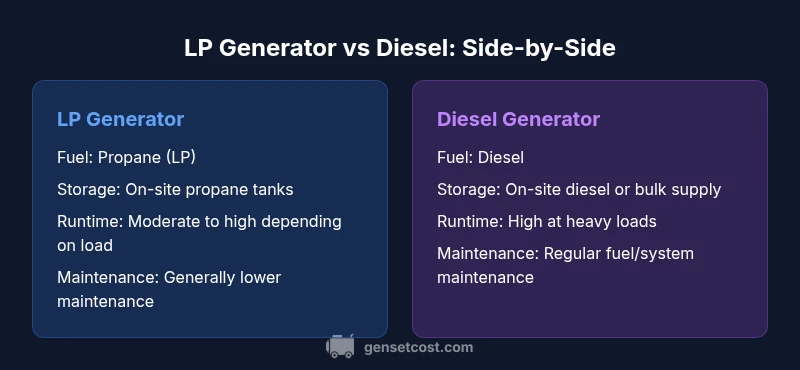
According to Genset Cost, the decision between lp generator vs diesel hinges on fuel access, storage requirements, and total cost of ownership over time. LP (propane) generators benefit from clean burning, simpler maintenance, and flexible storage options with standard tank sizes, which makes them appealing for properties with limited space or where propane supply is reliable. Diesel generators excel in heavy-load applications, offering higher torque, robust durability, and longer runtimes between refuels, which can translate to fewer changes during extended outages. In practice, most homeowners weigh the same core factors: starting reliability in cold weather, fuel availability near the home, and the economics of fuel price volatility. This section outlines the practical differences you should consider before choosing between an LP generator and a diesel model, with emphasis on how load profiles and climate inform the decision.
Fuel Costs, Availability, and Storage
Fuel costs and availability are two of the most influential variables in lp generator vs diesel decisions. LP gas can be stored on-site in canisters or large tanks, offering convenient, often safer storage for many households in urban or suburban settings. Propane fuel prices tend to fluctuate with broader energy markets, and storage losses are typically lower than for gasoline or diesel. Diesel fuel, by contrast, is widely available at most fueling stations and bulk suppliers, with excellent energy density that supports longer runtimes per gallon. However, diesel requires careful management in cold climates (gelling and thickening) and periodic fuel treatment. Storage considerations differ: LP requires secure, weatherproof tanks, while diesel storage must address filtration, condensation, and potential algae in bio-diesel blends. In short, LP storage is straightforward for small footprints; diesel storage scales with fuel volume and site logistics.
Efficiency, Runtime, and Sizing Considerations
When sizing a generator, efficiency and runtime per fuel unit matter as much as the fuel type itself. Propane’s energy content per volume is lower than diesel, so a propane system may need larger or more frequent refueling for the same load, especially during long outages. Diesel engines typically deliver more power per gallon and have better fuel economy at higher loads, making them a common choice for larger homes or properties with substantial electrical demand. However, LP engines benefit from quicker warm-ups and cleaner combustion, which can translate to faster restoration of essential circuits during outages. Proper sizing requires assessing the critical loads (heating, well pumps, refrigeration) and worst-case outage duration. A professional sizing calculator can help determine the target kilowatt rating and the appropriate fuel storage strategy.
Maintenance, Longevity, and Reliability
Maintenance needs for lp generator vs diesel differ in predictable ways. LP systems generally feature simpler fuel systems with fewer contaminants and are less prone to injector fouling, which can reduce maintenance frequency. Diesel engines, while rugged, require regular maintenance of fuel filters, injectors, and glow systems in colder climates. Diesel units also benefit from superior lubricity and longer engine life under heavy-use scenarios, but they demand more attention to fuel quality and storage stability. Reliability in cold weather can favor diesel if winterized fuel and block heaters are used; propane may be more forgiving in moderate climates but needs appropriate outdoor enclosure with proper venting. Overall, the best choice balances your maintenance capacity, local fuel quality, and outage expectations.
Application Scenarios: When to Choose LP vs Diesel
The practical choice between lp generator vs diesel often comes down to scenario fit. Townhome or condo owners with limited outdoor space and reliable propane access typically prefer LP due to safer on-site storage and quick starts. Rural properties or estates with higher power needs and ample space for larger tanks may lean toward diesel for extended runtimes and strong peak-load performance. During a grid outage, LP systems can provide essential circuit restoration quickly, while diesel systems are generally better for sustained power over several days. Consider your climate (cold vs hot), fuel logistics (on-site storage vs refueling trips), and ownership horizon to decide which fuel type aligns with your power resilience goals.
Environmental Impact and Safety Considerations
Both LP and diesel generators have environmental and safety considerations that can influence the lp generator vs diesel decision. Propane burns cleaner with lower particulate emissions, which can be advantageous for installations near living spaces or neighbors. Diesel engines typically emit more particulates and nitrogen oxides, though modern diesel designs with selective catalytic reduction (SCR) and diesel particulate filters can mitigate some of these concerns. From a safety standpoint, LP storage requires proper venting and secure tank placement to prevent gas leaks, while diesel storage demands防 policies for fire safety and spill prevention. Both fuel types should be installed with proper clearances, weather protection, and adherence to local codes and manufacturer guidelines.
Transfer Switch, Installation, and Outdoor Considerations
Installation complexity and transfer-switch compatibility influence the lp generator vs diesel decision. Both fuel types require a transfer switch to isolate the generator from the grid, but the installation footprint and ventilation needs differ. LP generators often benefit from outdoor enclosures that protect components while allowing adequate ventilation; diesel units may require more robust weatherproof housings due to their weight. Ensure the site has level ground, accessible fueling or storage points, and compliance with national and local electrical codes. A licensed electrician should verify wiring, grounding, and safety clearances, while a qualified fuel technician can address storage safety, leak detection, and fueling logistics.
Choosing a Generator: Practical Decision Framework
A practical framework helps finalize the lp generator vs diesel choice. Start with a load assessment to determine the required kilowatts and surge capacity. Next, map fuel accessibility, storage space, and monthly or yearly fuel costs, including potential price volatility. Consider climate and maintenance capabilities; if you prefer low-maintenance operation, LP might be attractive, whereas diesel suits high-demand households with solid fueling options. Finally, test-start procedures and warranty terms should be reviewed, alongside transfer-switch compatibility and installation costs. With a clear framework, homeowners can select the fuel type that best aligns with resilience goals and budget constraints.
Authority Sources and Practical References
To support your decision, consult widely recognized sources on generator technology and home backups. These references cover fuel types, safety practices, and installation standards that affect both LP and diesel choices. Always cross-check recommendations with local building codes and a qualified installer.
Authority Sources and Practical References
- https://www.energy.gov/
- https://www.epa.gov/
- https://www.nfpa.org/
Comparison
| Feature | LP Generator | Diesel Generator |
|---|---|---|
| Fuel type | Propane (LP) | Diesel |
| Fuel availability | Widespread propane networks; on-site storage possible | Diesel widely available at stations; bulk fuel options |
| Runtime efficiency | Good for moderate loads; energy content per volume lower | High energy density; efficient at higher loads |
| Maintenance needs | Typically simpler fuel system; fewer injector issues | Regular fuel filtration; injector/service attention |
| Cold-weather performance | Requires cold-start considerations; propane tends to start reliably | Diesel with cold-weather prep performs well when winterized |
| Initial cost | Lower upfront for many LP models | Higher upfront; heavier platform |
| Total cost of ownership | Cost varies with propane price; storage costs apply | Diesel can be cheaper per kWh at stable fuel prices; refueling logistics matter |
| Emissions | Cleaner burning in many LP engines; lower particulates | Diesel emissions higher unless using SCR/filters |
The Good
- Propane LP generators offer easier on-site storage and quick starts
- Propane burns cleaner, reducing soot and fuel-system fouling
- Diesel engines provide longer runtimes and higher peak power
- Diesel fuel has higher energy density, often lowering per-hour costs under heavy use
The Bad
- Propane price volatility can affect operating costs
- LP storage requires space, weather protection, and leak safety
- Diesel engines demand more maintenance and fuel-quality management
- Diesel emissions require after-treatment in some models
Diesel offers longer runtimes and higher peak power for heavy use; LP is often better for smaller homes with easy propane access.
If your loads are modest and propane is readily accessible, LP delivers quick returns with lower storage risk. For larger homes or properties with substantial, constant loads, diesel generally provides steadier performance and longer fuel runs, making it the more reliable choice in those scenarios.
People Also Ask
What is the main difference between LP generators and diesel generators?
The primary difference is the fuel source: LP uses propane, while diesel uses diesel fuel. Propane systems are typically cleaner and easier to store on-site, whereas diesel systems often deliver higher torque and longer runtimes, especially under heavy load.
Propane runs cleaner and is easier to store; diesel offers more torque and longer runtimes, especially for heavy use.
Which is cheaper to operate for a home backup over the long term?
Long-term costs depend on fuel price volatility, load, and maintenance. Diesel can be cheaper per kilowatt-hour under stable prices and high loads, while propane may cost more per hour when propane prices rise. A detailed cost analysis helps determine the more economical option for your situation.
Diesel can be cheaper per hour when prices are stable and loads are high; propane costs depend on fuel price trends.
Can LP generators perform well in cold weather?
Yes, but propane systems may require appropriate cold-start measures and battery readiness. Diesel engines require winterization or starting aids in freezing conditions to avoid gelling and startup delays.
Propane starts reliably with the right setup; diesel needs winter prep for cold weather.
Is diesel better for long runtimes or large homes?
Diesel often excels for large homes or high-load scenarios due to higher energy density and longer runtimes per fill. LP can still handle large loads if you have ample propane storage and supply, but diesel is the safer default for sustained operation.
Diesel is typically better for big loads and long outages; LP works with proper storage and supply.
How should I size an LP vs diesel system for a home?
Start with a load assessment of critical circuits. Then consider expected outage duration and fuel logistics. A professional sizing analysis helps determine the required kilowatt rating and fuel storage needs for either LP or diesel.
Do a proper load calculation, then plan fuel storage and outage duration with a pro.
Are propane and diesel generators compatible with standard transfer switches?
Yes, both LP and diesel generators can be wired to standard transfer switches, but installation should be performed by a licensed electrician. Ensure the switch and generator amperage ratings match and that venting and clearance requirements are observed.
Both can use standard transfer switches, but get a licensed pro to install.
Key Takeaways
- Assess your load profile before choosing fuel type
- Evaluate local fuel access and storage options
- Consider total cost of ownership beyond upfront price
- Account for climate and maintenance capabilities
- Plan for safe storage and installation