Diesel Generator vs Propane: A Comprehensive Comparison
Compare diesel and propane backup generators across cost, reliability, maintenance, fuel availability, and performance to help homeowners choose the right powered solution for outages.


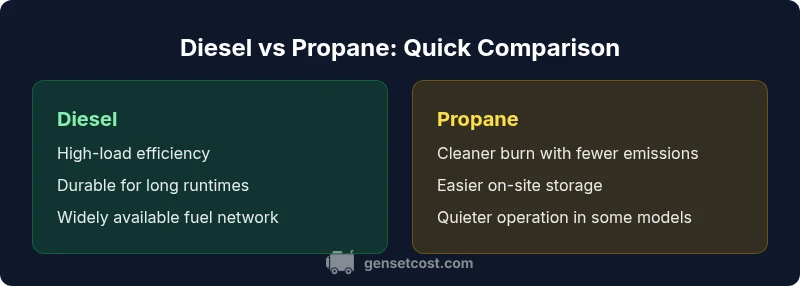
According to Genset Cost, diesel generators typically offer better long-run durability and lower fuel consumption at high loads, while propane units score for cleaner operation and easier fuel storage. For critical outages and heavy use, diesel is often favored; for moderate use and simpler fueling, propane shines. This article compares upfront costs, fuel availability, maintenance, and performance to help homeowners decide.
Diesel generator vs propane: Core differences
In the diesel generator vs propane debate, the core difference is fuel chemistry, energy density, and how those factors translate into real-world performance. Diesel engines rely on compression ignition and tend to deliver robust torque at higher loads, making them well-suited for long runtimes and heavy starting surges. Propane engines, by contrast, use spark ignition and benefit from cleaner combustion, lower odor, and easier access to fuel supply. The Genset Cost team found that most homeowners weigh reliability, fuel logistics, and total cost of ownership when choosing between these two fuel pathways. Understanding these fundamentals will help you interpret later sections that compare cost-of-ownership, maintenance intervals, and suitability for different outage profiles. In practical terms, diesel is often the choice for critical loads and remote sites, while propane serves well in smaller setups or where fuel logistics favor a cleaner fuel.
Fuel availability and handling for diesel vs propane
Fuel logistics play a pivotal role in the diesel generator vs propane decision. Diesel fuel is widely distributed and available in most regions, but it requires stable storage, fuel quality management, and periodic filtration. Propane offers easy on-site storage in tanks and can be sourced from multiple suppliers without refining, which simplifies resupply during longer outages. For homeowners, this translates into different stocking strategies: bulk diesel storage for extended outages or a smaller propane tank for periodic use. Fuel stability, refilling accessibility, and safety considerations (like proper venting for propane) should be evaluated in every sizing assessment. The bottom line is that storage habits and delivery reliability influence total ownership costs and reliability in emergencies.
Upfront cost and total cost of ownership
The diesel generator vs propane decision often hinges on total cost of ownership. Diesel units typically have a higher upfront price due to robust heavy-duty components and longer service life under demanding conditions. Propane units may come at a lower initial cost and benefit from lower fuel handling penalties in some markets. However, fuel costs over time, maintenance frequency, and the need for seasonal storage arrangements complicate the math. Genset Cost analysis shows that homeowners should model both scenarios across expected outage frequency, load demands, and local fuel pricing to gauge long-run cost implications. Remember to consider transfer switch compatibility, installation costs, and potential warranty implications when comparing total costs.
Fuel efficiency and load performance
Fuel efficiency in a diesel generator vs propane setup is highly load-dependent. Diesel engines typically deliver superior efficiency at higher loads due to energy density and combustion characteristics, translating into longer runtimes between refuels for the same power output. Propane engines may show lower efficiency at peak load but perform well for steady, moderate loads with simpler fueling logistics. When sizing, compare the expected peak and typical running loads, as this will determine which fuel path offers better miles-per-gallon (or kilowatt-hours per unit of fuel) in practical terms. For many homeowners, the diesel option wins for high-demand periods, while propane can be a viable choice for predictable, lighter workloads.
Emissions, odor, and regulatory considerations
Diesel engines tend to emit higher levels of particulates and nitrogen oxides, which can trigger regional emission controls and placement restrictions. Propane burns cleaner, producing fewer particulates and odors, which may simplify siting and indoor-use considerations in some scenarios. Regulations vary by jurisdiction, so it is essential to review local guidelines and warranty terms before choosing. In the diesel generator vs propane framework, cleaner-burning propane may reduce particulate concerns, while diesel can deliver durability at the expense of tighter emission controls. This balance matters for property managers and homeowners seeking compliance and long-term reliability.
Reliability and durability under extreme conditions
Reliability is a core criterion when evaluating diesel generator vs propane options. Diesel engines are renowned for durability under heavy-duty operation, start-up surges, and high-run-time scenarios; they often support longer duty cycles with robust components. Propane engines are frequently praised for smoother cold-start behavior and cleaner combustion, but the energy density of propane can impact endurance under heavy continuous loads unless appropriately sized. In colder climates, diesel fuel can gel if not treated, whereas propane remains vaporized under standard storage conditions with proper precautions. When planning for outages, the reliability gap tends to favor diesel for critical, continuous operation and propane for predictable, moderate use with easier refueling.
Sizing and selection framework for diesel vs propane
Sizing is the most practical step in choosing between diesel generator vs propane systems. Begin with a load assessment that lists critical circuits, essential appliances, and anticipated surges. Then, translate those loads into a required kilowatt rating, considering both starting and running watts. With a diesel setup, you’ll often see a wide range of available sizes, including heavy-duty options that excel at peak demand. Propane units come in a broad spectrum too, but you must account for storage constraints and potential efficiency variations at higher loads. Finally, factor in fuel storage, refueling accessibility, maintenance needs, and transfer switch compatibility to ensure a smooth transition from planning to installation. A clear decision framework will help you choose confidently between the diesel generator vs propane path.
Cold weather, storage, and fuel stabilization considerations
Cold weather effects differ between diesel and propane fuels. Diesel fuel can gel and wax in freezing conditions unless treated or heated, increasing the risk of startup delays in winter. Propane, stored in tanks, generally tolerates cold better but requires proper venting, leak prevention, and safe storage practices. Stabilization strategies for diesel (winterized formulations, biocides, and heaters) and propane (gas-grade storage, leak detectors, and regular inspection) can extend the usable life of fuel stocks. Homeowners should plan seasonal maintenance accordingly, ensuring that both the generator and the fuel system are prepped for temperature extremes so outages don’t coincide with winter weather.
Installation, transfer switches, and maintenance footprint
The infrastructure needs differ across the diesel generator vs propane choice. Diesel varieties often demand heavier mounting, more substantial exhaust considerations, and potentially more complex cooling systems, which can influence installation costs and space requirements. Propane systems tend to be simpler in some installations but require a fuel line and tank configuration that complies with local codes. Maintenance frequency also tends to be higher for diesel due to injector cleanliness, fuel filtration, and engine servicing. Regardless of fuel choice, ensure that a licensed professional handles electrical interconnections, transfer switch setup, and code compliance to reduce risks and optimize reliability.
Real-world use cases: homes, multi-family, small business
In real-world settings, diesel generator vs propane selections reflect actual needs. For a single-family home with a predictable outage pattern and long-duration events, a diesel unit can deliver dependable performance across a wide load range. A multi-family dwelling or small business with moderate outages and easier fuel logistics may favor propane for its simpler fuel storage and cleaner operation. Property managers should assess simultaneous load requirements like elevators, common-area HVAC, and lighting, then weigh fuel logistics, maintenance contracts, and service networks. The comparative analysis should always be anchored in the specific site, climate, energy codes, and budget constraints to avoid over- or under-sizing a generator.
Pros and cons of the diesel generator vs propane options
Before diving into a purchase, it helps to summarize general advantages and disadvantages of the two fuel paths. On balance, diesel generators excel in high-load, long-running scenarios and offer robust durability with broad service networks. Propane systems attract with cleaner emissions, easier on-site storage, and potentially simpler maintenance routines, albeit with load-dependent efficiency factors. Neither option is universally superior; the best choice hinges on your outage profile, fuel access, space, and ownership costs. The goal is a balance between reliability, safety, and total cost of ownership in your specific setting.
Decision framework: when to choose diesel vs propane
To decide between diesel generator vs propane, start with your outage profile, load requirements, and storage capabilities. If you routinely power high-demand equipment and need extended runtimes, diesel generally delivers better performance per hour and resilience. If your outages are shorter, you prioritize fuel logistics simplicity and cleaner operation, propane can be the more practical path. Always run a formal sizing exercise, consult with a licensed installer, and review warranty terms for each fuel option. The right choice aligns with your budget, climate, and safety requirements, delivering dependable backup power when it matters most.
Authority sources (further reading)
- U.S. Department of Energy (energy.gov)
- U.S. Environmental Protection Agency (epa.gov)
- National Renewable Energy Laboratory (nrel.gov)
Comparison
| Feature | Diesel | Propane |
|---|---|---|
| Fuel type | diesel | propane |
| Upfront cost | higher upfront cost | lower upfront cost |
| Fuel availability | widely available with distribution networks | requires propane storage but reliable supply |
| Fuel efficiency (high load) | excellent efficiency at high loads | good efficiency but varies with load |
| Maintenance frequency | potentially more frequent maintenance | often simpler maintenance |
| Emissions | higher particulates/nox emissions | cleaner-burning with fewer emissions |
| Cold-weather performance | gel risk in cold; winterization needed | stable performance with proper storage |
| Best for | critical, long-duration loads | moderate to light loads with easier fueling |
| Space and installation | heavier units; more complex install | lighter setups; simpler install |
| Regulatory considerations | emission controls may apply in some areas | fewer restrictions in many regions |
| Reliability under stress | proven for long duty cycles | reliable with clean-burning operation |
The Good
- Long runtimes at high loads for diesel
- Cleaner burning and easier storage with propane
- Extensive service networks for both fuels
- Flexibility in choosing equipment sizes
The Bad
- Diesel maintenance can be costlier and more frequent
- Diesel fuel quality impacts performance over time
- Propane storage requires proper tanks and venting
- Fuel costs vary by region and usage
Diesel generally wins for critical, high-demand use; propane wins for cleaner operation and easier storage in moderate-use scenarios
Choose diesel when high reliability under heavy load is paramount and long runtimes are expected. Choose propane for easier fueling logistics and cleaner emissions when usage is moderate and fuel accessibility is favorable. The best choice depends on load, climate, and maintenance commitments.
People Also Ask
What is the primary difference between diesel and propane generators?
The main difference lies in fuel type and ignition method. Diesel uses compression ignition and is generally more rugged for high loads, while propane uses spark ignition and provides cleaner combustion with simpler fuel storage. Your decision should hinge on your outage profile, available storage, and maintenance willingness.
Diesel uses compression ignition and is rugged for high loads, while propane uses spark ignition and cleaner combustion. Consider your outage profile and storage options when choosing.
Which is more cost-effective over time, diesel or propane?
Cost-effectiveness depends on usage pattern, fuel prices, and maintenance. Diesel often has higher upfront costs but may offer better fuel efficiency at high loads, while propane can be cheaper to stock and store but may incur higher fuel costs over time if used heavily.
Diesel may cost more upfront but saves on fuel at high loads; propane is cheaper to stock but can cost more over time with heavy use.
Are propane generators suitable for indoor use?
Propane produces fewer particulates and odors than diesel, which can simplify siting decisions, but indoor use generally requires strict venting, safety clearances, and code compliance. Always consult a licensed installer for proper placement and ventilation.
Propane burns cleaner, but indoor use still needs proper venting and code-compliant installation.
Can a propane generator handle long outages?
Propane can handle outages, but fuel storage capacity and transfer logistics matter. For sustained outages, diesel is often preferred due to higher energy density and longer runtimes per fuel unit, assuming maintenance and emission requirements are met.
Propane can work for outages, but diesel often lasts longer per fill for heavy use.
What maintenance does each type require?
Diesel generators generally require more frequent maintenance to manage injector cleanliness, filtration, and fuel quality. Propane systems tend to have simpler maintenance and fewer fuel-related issues, though both require routine service and adherence to manufacturer guidance.
Diesel needs more maintenance; propane is typically simpler, but both need regular service.
Key Takeaways
- Assess your load profile before choosing fuel type
- Diesel favors long outages and high-demand loads
- Propane offers cleaner operation and easier storage
- Account for fuel availability and regional regulations
- Match generator size to critical loads and budget